
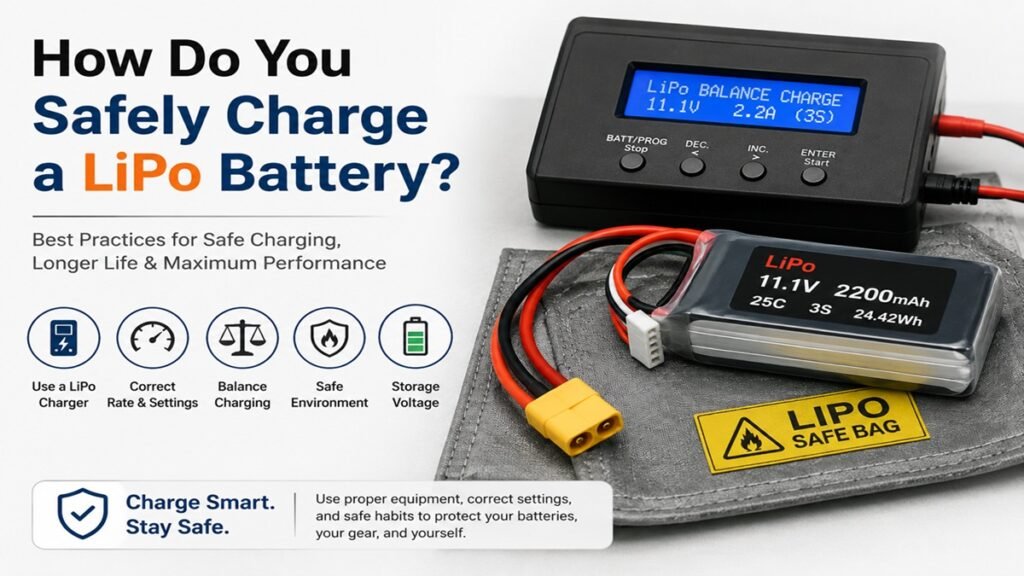
How Do You Safely Charge a LiPo Battery?
LiPo batteries have taken the place of alternative power sources in drones and other motor control systems to make these vehicles less bulky and deposit a higher energy density into the battery itself. At that, a small amount of responsibility goes hand in hand with said advantages- LiPo batteries are much less tolerant than old chemistries, like NiMH or NiCd. They can swell, vent or even fire when overcharged, punctured or not well balanced. That is why one needs to know how to charge a LiPo battery safely. You can be a hobbyist or just use LiPo packs in some device, but by employing best practices, one can increase the battery life and avoid hazardous incidents.
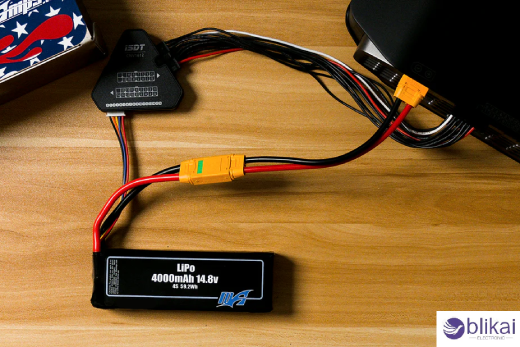
Use a Dedicated LiPo Charger
The initial and most crucial process in the safe charging of a LiPo battery is to charge it with a LiPo-designed charger. Normal chargers designed to use either NiMH or lead-acid batteries supply current in a manner that can potentially overcharge a LiPo cell. An adequate LiPo charger enables you to adjust the voltage and current, and it has balancing functions that ensure that all cells in a multi-cell pack are charged evenly. Devoid of such balancing, one of the cells might attain overvoltage ahead of the others, posing a severe fire hazard. It is not a choice, but a necessity to invest in a good LiPo-compatible charger.
Understand Charging Rates and Settings
Another important aspect, as far as LiPo safety is concerned, is charging rate. LiPo batteries are mostly rated at 1C (charge rate), meaning that they can be charged with an equal current to their capacity. An example is that a LiPo with 2200mAh should be charged with 2.2 amps. Certain current packs have higher charge rates advertised, although going above 1C on a regular basis may reduce the life of the battery, as well as raise the heat. A label on the battery always includes specifications that have to be checked. It is also important that the charger be set to the right amount of voltage per cell (3.7 V nominal, 4.2 V full charge) because a little over-voltage may kill the pack.
Balance Charging for Multi-Cell Packs
The LiPo packs installed in drones and RC cars typically have a series of more than one cell, e.g., 2S (7.4V), 3S (11.1V), etc. These packs have to be balance-charged so that all the cells get to the same voltage. An adequate balance charger is a charger that utilizes the balance connector on the battery to monitor and regulate each cell separately. In the absence of balance charging, a cell can overcharge, and the others fall behind, not only reducing the life of the pack, but also significantly increasing the chance of swelling and thermal runaway. One of the most effective safety measures that is simple to perform on a regular basis is to balance charge your pack.
Safe Charging Environment and Precautions
The charging settings and environment are significant, even with the proper charger and settings. LiPo batteries must be put and charged on a non-flammable table and not near any flammable material like paper, wood or carpets. Several hobbyists charge their LiPo batteries with fireproof LiPo charging bags or metal ammo boxes to provide an added safety measure. One should also make sure that a charging LiPo must never be left without supervision; the majority of accidents occur when the user leaves and believes that all is well. To prevent overheating, one should charge at room temperature and not expose the batteries to the sun directly. When the battery is discovered to be swollen, hot or giving off an odd odor during the charging process, then halt and dispose of the pack safely.
Storage Voltage and Long-Term Care
Safety can not be charged when the battery is full. It is equally important to store things properly. LiPo batteries are not supposed to be stored at full charge or at full discharge; they are supposed to be left at a storage voltage of approximately 3.8V per cell when they are not going to be used in the course of a few days. A large number of contemporary chargers have a storage option where the pack automatically charges to this degree. Storing at the current value of storage voltage serves to preserve the chemical stability of the pack and minimize the possibility of swelling or irreversible loss of permanent capacity. The optimal solution to increase safety and life is to combine appropriate charging with appropriate storage.
Conclusion
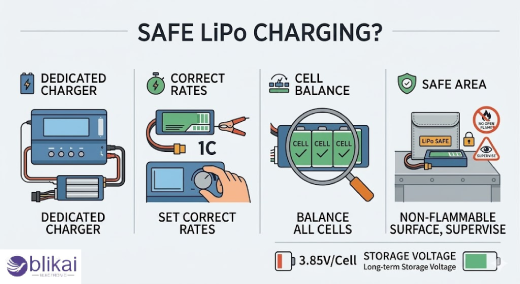
The question is, then, how can you safely charge a LiPo battery? The equation is simple, though it is non-negotiable: a special LiPo balance charger, the right voltage and charge rate, control the process in a safe area, and save your packs correctly after it. LiPo batteries may provide excellent performance and power density; however, respect and attention to detail are required. You can save your gears, your house, and you can save your money, charging your LiPo equipment every time you charge your batteries, because you are not only prolonging the life of your investment, but you are also ensuring a dependable long-term service.
