
Can Rooftop Solar Charge Your EV and Run Your Home at Night?
Rooftop solar has one awkward habit: it works hardest when many homes are quiet. The panels may be producing well at midday, but the oven, heat pump, lights, and television often matter more after sunset. Add an EV, and the timing question gets sharper.
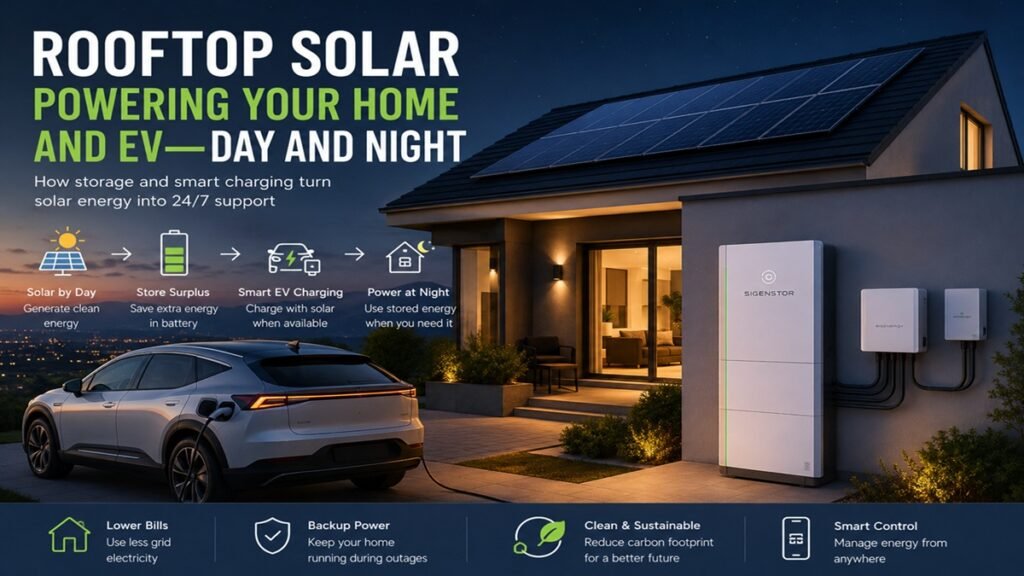
The answer is yes, rooftop solar can help charge an EV and support the home at night. But it usually takes more than panels. The home needs storage, smart charging, and a clear plan for which energy should be used first.
The midday surplus problem
Solar panels generate electricity when sunlight is available. A home uses some of that power immediately. Extra energy can be exported to the grid, stored in a home battery, or sent to an EV if the vehicle is plugged in.
That last detail matters. If the EV is parked at work all day, rooftop solar cannot charge it directly unless a stationary battery holds energy for later. If the EV is home during the day, smart charging can soak up surplus solar before it leaves the property.
The National Renewable Energy Laboratory has described solar-plus-storage as a way to shift clean energy into hours when buildings need it more. For homeowners, that means the battery is not just backup equipment. It is a timing tool.
What storage changes after sunset
Without storage, the house may export solar at noon and buy grid electricity in the evening. A battery changes that pattern by holding daytime production for later use. It can cover lighting, appliances, Wi-Fi, refrigeration, or part of an HVAC load depending on system size and household demand.
For homes planning solar, EV charging, and backup together, SigenStor home energy storage is a relevant reference point because it combines solar inverter, EV DC charging, battery components, and energy management in one system architecture.
The U.S. Energy Information Administration reports that residential electricity use varies widely by climate, home size, and installed equipment. That is why a home with a heat pump and well pump should not copy the same settings as a small mild-climate home with mostly lighting and kitchen loads.
Where bidirectional EV charging fits
Bidirectional charging lets electricity move both into and out of a compatible EV battery. Vehicle-to-home, or V2H, can allow the car to support household loads during an outage or expensive rate period. Vehicle-to-grid, or V2G, may support utility programs where local rules allow it.
For solar homes, the main value is flexibility. The EV can be a large controllable load when solar is abundant and, if compatible, a backup energy source when the home needs support. That does not mean the car should be drained casually. The system must protect driving range.
Sigenergy’sbidirectional EV DC charging page is useful for understanding this layer because its product information describes 25 kW DC charging and V2H, V2G, and V2X use cases.
A practical operating rhythm
A well-planned day might look like this: solar runs household loads in the morning, fills the stationary battery around midday, charges the EV from surplus when it is parked, and reserves stored energy for evening use. Overnight, the system may keep a backup reserve or charge from lower-cost grid power if the rate plan rewards it.
The exact rhythm depends on net metering, time-of-use rates, weather, battery size, and driving habits. A commuter who leaves before sunrise needs a different plan from someone who works from home three days a week.
The best setup is not the one that promises total independence every night. It is the one that makes solar energy easier to use when the household actually needs it. With the right storage and charging controls, rooftop solar can serve both the driveway and the living room without forcing the owner to manage every watt manually.
Explore more articles:
https://bharatarticles.com/the-rise-of-online-therapy-in-india/
https://bharatarticles.com/how-to-check-your-ip-address-and-find-your-exact-location-online-in-2026/
https://bharatarticles.com/salt-in-shampoo-potential-effects-on-hair-texture-and-moisture/
https://bharatarticles.com/how-an-indian-company-can-collect-a-debt-from-a-nepali-company/
https://bharatarticles.com/plastic-injection-molding-manufacturer-your-complete-guide-to-choosing-the-right-partner/
https://bharatarticles.com/how-to-start-a-carpet-cleaning-business/
https://bharatarticles.com/ai-in-software-development-transforming-the-future-of-coding-and-innovation/
