
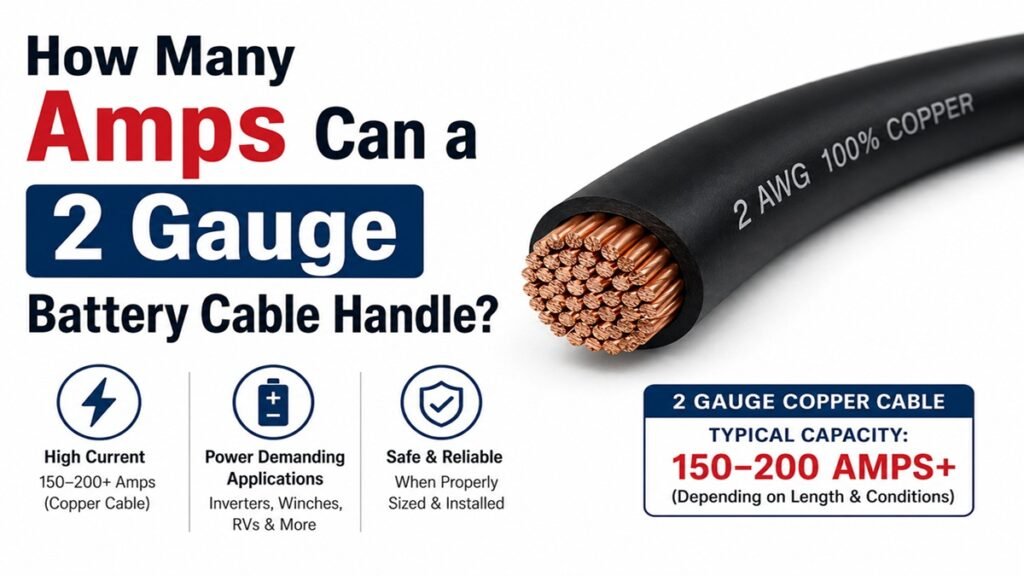
How Many Amps Can a 2 Gauge Battery Cable Handle?
A 2 gauge battery cable is in the American Wire Gauge (AWG) system that establishes the thickness and carrying capacity of electrical conductors. The fatter the wire, the less there is of it in this system. A 2 gauge cable is, by comparison, much larger than typical automotive 8 gauge or 10 gauge wiring, and is intended to carry heavy current in its typical applications. Having an approximate diameter of 0.26 inches, this size is not only low-resistance but also very durable. Its thickness causes it to be used as an option in high-performance applications where thinner cables would become hot or lead to hazardous voltage drops.
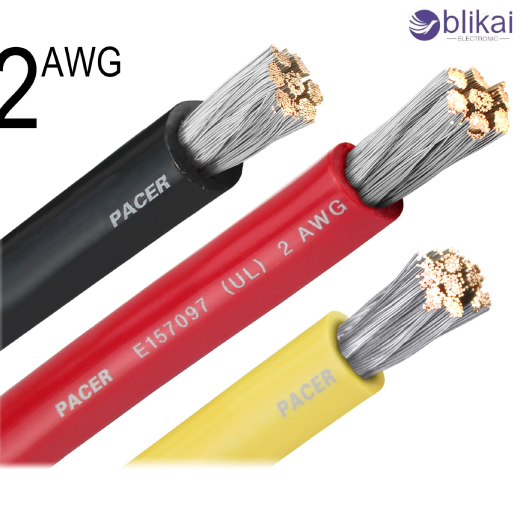
Ampacity Ratings and Current Capacity
Speaking about the amount of amps that a 2 gauge battery cable can carry, one should realize that there is no single number that can be universally applied. Ampacity is dependent on a number of variables, including length of the cable, insulation type, and whether it is pure copper or copper-clad aluminum. In general, a good quality copper 2-gauge cable can comfortably carry 150-200 amps (on a reasonable run) without compromising, and in some cases, even higher loads can be carried by shorter runs. But as you lengthen the cable, the amp rating drops as far as resistance accumulates along the line.
Real-World Applications in Vehicles and RVs
In the automotive and RV world, a 2 gauge battery cable is often used for starter cables, secondary battery banks, and mid-sized inverters. For instance, a 2 gauge cable is capable of supplying enough current for an inverter in the 1500–2000 watt range, provided that the run is kept short. In RVs, this gauge is also common for connecting house batteries to distribution panels. Aftermarket winches may be powered with 2 gauge by truck owners, and during peak loads, may draw more than 300 amps. When such an event occurs, it should be noted that there should be keen consideration of length and temperature, which will ensure that the cable does not exceed its safe working temperature.
The Importance of Cable Length and Voltage Drop
The cable length also has a very important role to play in the number of amps that a 2 gauge cable can really carry. A 3-foot cable running a car battery to a starter motor is very different from a 15-foot run in an RV electrical system. The longer the wire, the more resistance it has, and resistance produces heat and voltage drop. To suggest just one example, a 2 gauge copper cable at 10 feet could easily carry 200 amps; however, when extended to 20 feet, it may not be able to easily carry the same load without undue power loss. That is why ampacity charts have both the gauge size and length in them, because this way, the installers are able to use the correct wire to use in the installation.
Copper vs. Aluminum: Does It Matter?
The other ampacity-affecting factor is the material used in the cable itself. Industry standard is pure copper, which provides the most conductivity to its size, implying that a copper 2 gauge cable can safely handle more amps than a copper-clad aluminum (CCA) identical size. Although CCA cables are less expensive and less weighty, in most instances, they can handle not much more than 6070 percent of the current carrying capacity of pure copper. Critical applications such as winches, inverters and starter motors are always better to invest in copper despite the cost involved being higher at the initial stage. The use of inappropriate material may result in overheating, melted insulation, or even fire in the event of heavy loads.
Safety and Installation Considerations
Although a 2 gauge (or larger) battery cable can conduct up to 200 amps in most applications, good installation is no less important than wire size. All of the high-amperage cables must be fused or breaker-protected near the power source to stop electrical fires in case of a short circuit. The cable must also be laid so as not to come in contact with sharp edges, hot engine parts or abrasion points. Fully crimped and insulated lugs are essential, and a loose connection may produce heat and interfere with the whole system. Concisely, the right cable gauge is not the only puzzle piece that will decide the safety and performance of the installation in the long term.
Final Thoughts
How many amps will a 2 gauge battery cable carry? Most real-world scenarios will give you a range of between 150 and 200 amps safely with a copper 2 gauge cable with shorter lines carrying higher current. This all depends on cable length, insulation and whether it is copper or aluminum. The size is usually large enough to serve medium- and heavy-duty purposes in case you are wiring up an inverter, an RV battery bank, or a winch. You only have to remember that the right cable is half the battle, correct installation, proper connections and protective fusing will see your system not only reliable but also safe.
