
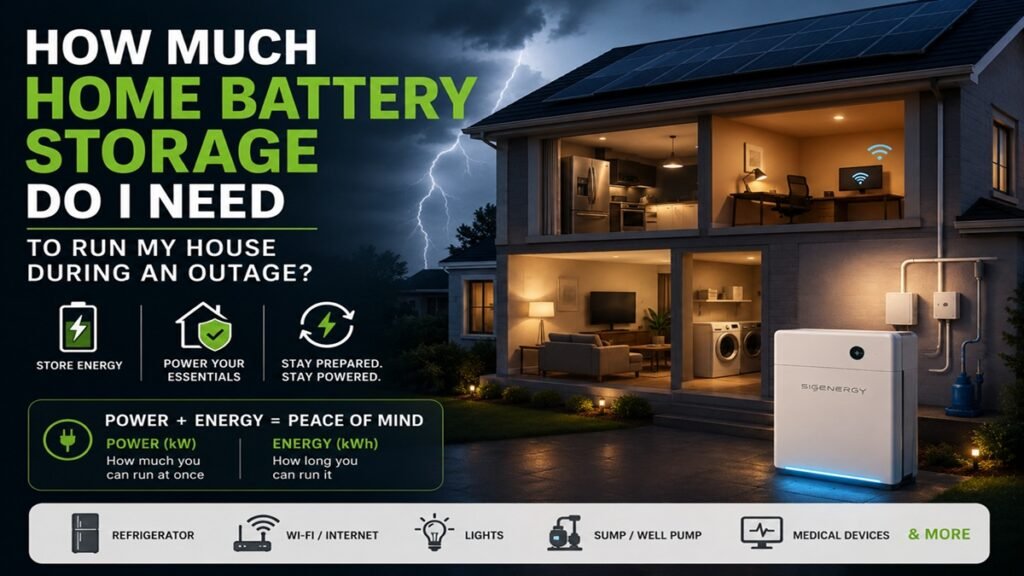
How Much Home Battery Storage Do I Need to Run My House During an Outage?
A refrigerator does not use much power every minute, but it becomes a big deal after twelve hours without electricity. Add a Wi-Fi router, a sump pump, a few lights, medical equipment, or a heat pump, and “backup power” stops being a simple yes-or-no question. The real question is how much battery capacity a home needs for the way people actually live during an outage.
Home battery storage means a stationary battery system that stores electricity from solar panels, the grid, or both, then supplies that power when the home needs it. For outage planning, the two numbers that matter most are power and energy. Power, measured in kilowatts, decides what can run at the same time. Energy, measured in kilowatt-hours, decides how long it can run.
Start with the loads that matter
Most homes do not need every appliance running during a blackout. A practical first step is to sort loads into three groups: must-run, nice-to-have, and wait-until-the-grid-returns.
Must-run loads often include refrigeration, internet, basic lighting, garage access, a well pump, sump pump, or medical devices. Nice-to-have loads might include a microwave, induction cooktop, laundry, or limited HVAC. Heavy loads such as central air, resistance heat, pool pumps, and EV charging can drain a battery quickly unless the system is designed for them.
According to the U.S. Energy Information Administration, the average U.S. household uses roughly 10,000 kWh of electricity per year, but daily usage varies widely by climate, home size, and heating fuel. That average is useful as a reference, not a sizing shortcut.
A better way to start is to look at one normal day of use, then create an outage version of that day. In an outage version, the dishwasher may wait, laundry may wait, and EV charging may pause. The refrigerator, modem, a few outlets, and basic lighting stay on. That smaller profile is often the difference between a battery that only handles a short interruption and one that keeps the home functional overnight.
Homeowners should also check whether any loads have high startup demand. A well pump or older air conditioner may need a brief surge of power when it starts, even if its running power is modest. That is why installers usually look at both continuous output and surge output before promising that a battery can support a specific appliance.
Critical-load backup vs. whole-home backup
Critical-load backup keeps selected circuits running. Whole-home backup keeps the entire electrical panel, or most of it, available. The second option feels more seamless but needs more careful load control.
A battery with 10 kWh of usable energy may cover a lean backup profile for a day in some homes. The same battery may last only a few hours if it is feeding large HVAC loads. That is why battery sizing should include both a load estimate and a conversation about comfort. Is the goal to keep food cold and phones charged, or to live almost normally through a long storm?
Systems such as home battery storage designs can help because capacity can be planned around actual backup priorities instead of a single fixed package.
There is also a comfort question hidden inside sizing. Some families are happy with a “storm mode” that keeps essential rooms usable. Others expect the kitchen, office, garage, and HVAC to behave almost normally. Neither approach is wrong, but they lead to different battery and load-management choices. Writing down that expectation before getting quotes can prevent a system from being undersized or overbuilt.
Look for smart load control
For solar homes, the next question is whether the battery can recharge while the grid is down. Some systems disconnect solar during outages unless they are designed for islanded operation. Islanding means the home temporarily operates as its own small electrical system, safely separated from the utility grid. If storm resilience is the goal, that detail deserves a direct question during the design stage.
The most useful battery plan begins with a short list of essential loads, then works outward. Homeowners comparing modern options can review SigenStor as one example of an integrated storage platform built around solar, battery, inverter, energy management, and EV charging expansion.
