
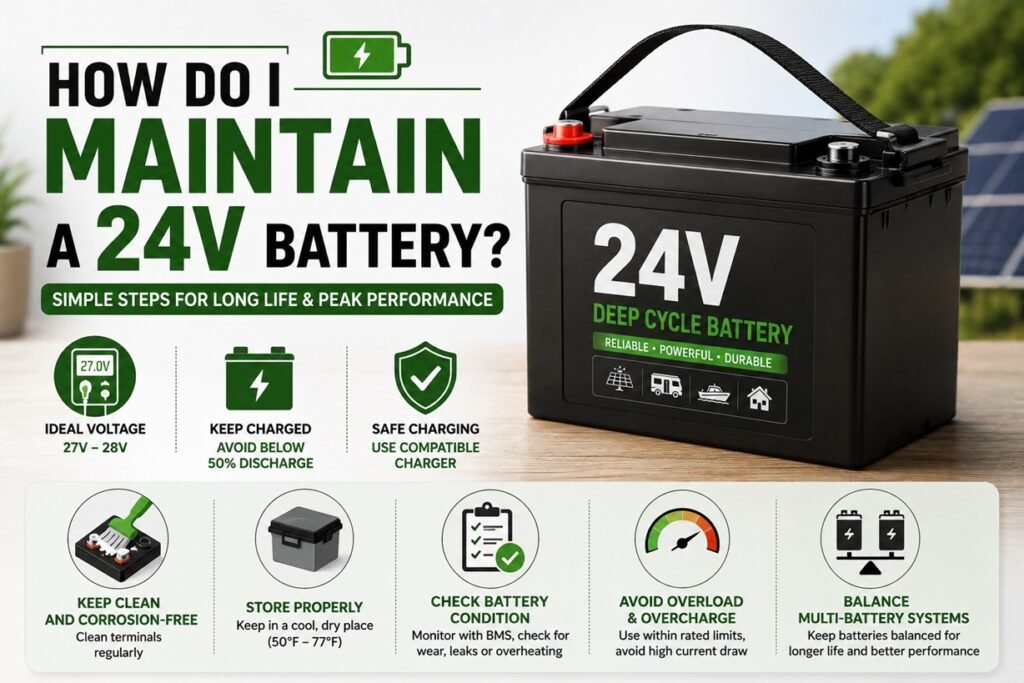
How Do I Maintain a 24V Battery?
Consistently Monitor Battery Voltage and Charge Levels
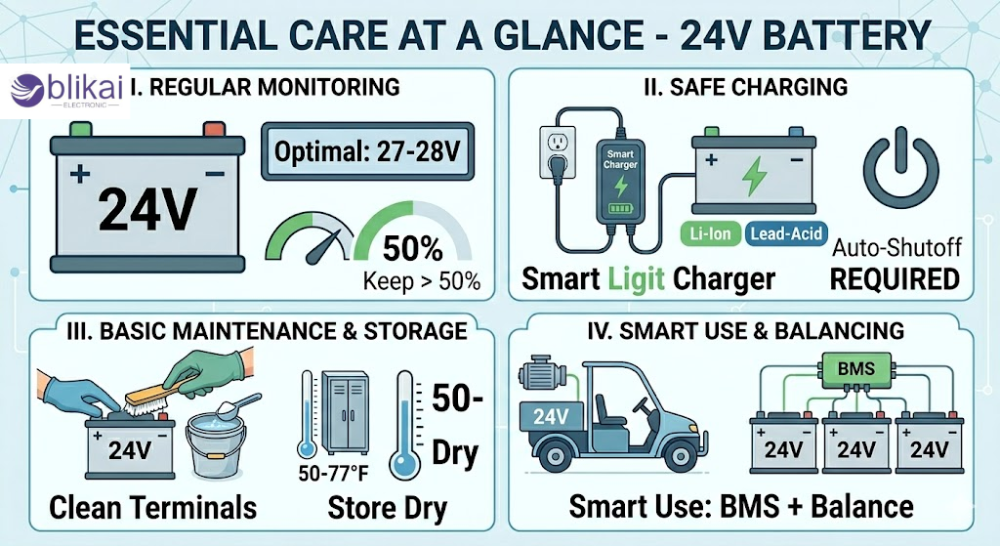
They should never be overcharged or undercharged; their optimal range should remain between 27 and 28 volts fully charged. A voltmeter or battery monitor can be helpful in understanding whether a battery is being charged properly; using either method could reveal whether its charge level has reached 27-28V fully charged state. Discharging batteries below 50% capacity might result in faster wear-and-tear and may result in decreased capacity or shorter life than anticipated, potentially leading to permanent damage to its cells. To properly discharge, avoid deep discharge rates below 50 percent capacity – deep discharges may speed wear-and-tear quicker.
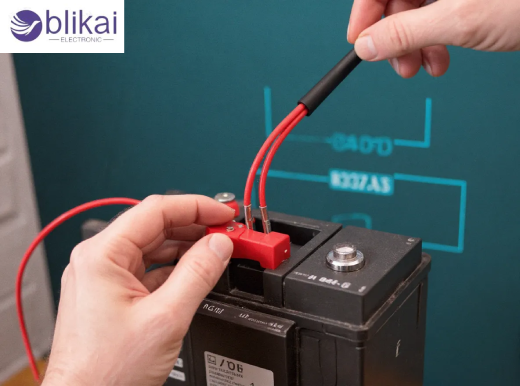
Maintain Proper Charging Procedures in Place
Always ensure you use a charger suitable for the type and voltage of battery you own – such as lithium or lead acid. The wrong charger may harm you or lead to a negative performance. Current chargers often have safety functions such as automatic shutoff to prevent overcharging; also, ensure that it can work with the chemistry of your battery, because operating different types of charging algorithms, charging not in a full batch, but in parts, can help extend life by ensuring its energy content does not vary over time.
Keep the Battery Clean and without corrosion
A 24V battery may be affected by dirt, dust, and corrosion, which are detrimental to the work of the battery. As time goes on, the battery terminals may be corroded due to exposure to moisture or acid leakage. This corrosion may disrupt the contact of the battery and the electrical parts which results in a drop in voltage and less efficiency of the battery. The terminal should be cleaned on a regular basis with a solution of baking soda and water to eliminate the acid deposit. Before reconnection, pour all the residues onto a towel and make sure that the terminals are dry. Also, clean and dry the battery compartment to ensure no debris is formed, which also causes overheating.
Properly Keep the Battery When Not in Use
In case you do not use your 24V battery longer, it is necessary to take good care of it by keeping it in a good place. Of special consideration is the storage temperature, which causes degradation or irreparable damage at extreme temperatures. Preferably, keep the battery in a cool, dry place whose temperature is between 50°F and 77°F. Both hot and cold may cause increased wear of the battery. With the lead-acid batteries, ensure they are charged, and with the lithium batteries, try to keep them at approximately 50 percent charge in order to keep them healthy.
Keep an Eye on the Battery State
The second crucial aspect of having a 24V battery is to ensure that its general condition is checked. The majority of the 24V battery systems now have built-in battery management systems (BMS) that monitor key parameters such as charge cycles, voltage, and temperature. Some systems will enable you to track these metrics through an application or display. You also need to test the battery periodically, say after every few hours, to determine whether there is any sign of wear on the battery, e.g., is it bulging, leaking or overheating. Problems can be identified early, which means that they can be prevented at a cost of costly repairs or substitution. In addition, the electrolyte must be periodically checked in flooded lead-acid batteries and distilled water refilled when required.
Do Not Overload or Overcharge the Battery
Batteries have a discharge rate, and exceeding the discharge rate that the battery can offer may result in overheating or rapid degradation. When the battery is utilized with an electric vehicle, power tools or any other high-demand application, ensure the battery is rated for the necessary load. Continuous use of a battery where the current being drawn exceeds its rated capacity may also reduce the life of its life and lead to a premature failure.
Battery Multi-Battery Systems: Think about Battery Balancing
Where batteries form part of a multi-battery system – for instance, in solar energy or large electric vehicle applications – it is desirable to balance their charges to ensure their health. Battery balancing involves making all batteries charged or discharged equally so no individual battery ends up overcharged or heavily discharged and becomes defective. The batteries of such systems need to be periodically equalized, and in case you see that one of the batteries is not performing very well compared to others, then you can replace it. Multi-battery Battery management systems (BMS) are frequently provided with a built-in balancing feature that can be used to assure even power distribution.
Conclusion
A 24V battery is able to last a long time, perform optimally and avoid unforeseen breakdowns in case it is properly maintained. It is always important to check the voltage regularly, use proper charging habits, keep the area clean and keep the battery within the required storage, as well as making sure that the battery is in the right place.
