
Gold vs Silver Investment Analysis (1976–2026): Returns, Trends, Volatility & Future Outlook
Investing in precious metals like Gold and Silver has long been a strategy for wealth preservation, diversification, and protection against inflation. But when we analyze the past 50 years, a clear question arises:
Which metal has truly delivered better returns—gold or silver?
This article presents a deep analysis of performance, volatility, economic roles, and investment strategy based on long-term historical data.
Long-Term Performance (1976–2026)
Over the past five decades, both metals have seen massive price appreciation—but the scale of growth differs significantly.
Key Data Insights
- Gold rose from $132.45 (1976) to about $5,019 (2026)
- Silver increased from $4.19 to around $84.33 in the same period
Investment Growth Comparison
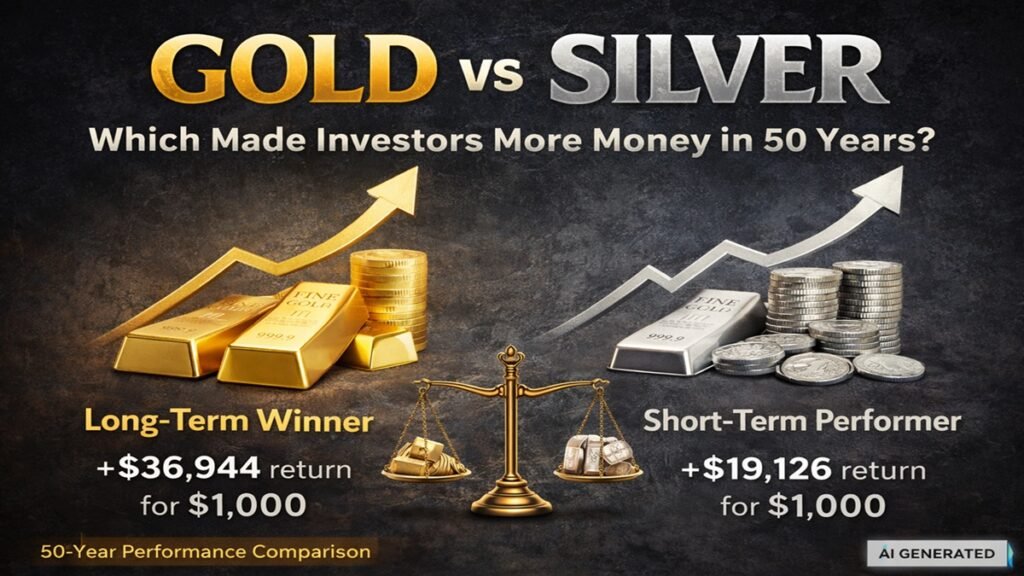
- $1,000 in gold → $37,944 (2026)
- $1,000 in silver → $20,126 (2026)
👉 Conclusion:
Gold clearly outperformed silver in long-term wealth creation, nearly doubling silver’s returns.
Why Gold Outperformed Silver
1. Store of Value Advantage
Gold has historically been considered a safe-haven asset. Central banks across the world hold gold reserves to stabilize economies during:
- Inflation
- Currency devaluation
- Geopolitical crises
This consistent demand creates price stability and long-term upward momentum.
2. Scarcity and Supply Factor
- Total mined gold: ~219,000 tonnes
- Total mined silver: ~1.7 million tonnes
Gold’s relative scarcity makes it more valuable and resilient over time.
3. Lower Volatility
Gold prices tend to rise steadily, while silver experiences sharp fluctuations due to speculative trading and industrial dependence.
Silver’s Strength: High Growth but High Risk
Despite underperforming in the long run, silver has unique advantages.
1. Industrial Demand Boost
Silver is heavily used in:
- Solar panels
- Electronics
- Medical equipment
This makes its price sensitive to economic cycles and industrial growth.
2. Higher Volatility = Higher Opportunity
Silver often delivers short-term explosive gains, making it attractive for traders.
Example:
- In 1980, silver surged dramatically compared to gold
- In recent years, silver has shown sharp upward spikes
10-Year Performance: Silver Takes the Lead
Interestingly, the last decade tells a different story.
- $1,000 in gold (2016) → ~$4,065
- $1,000 in silver (2016) → ~$5,613
👉 Insight:
Silver has outperformed gold in the short term, driven by industrial demand and market cycles.
Volatility Comparison
| Factor | Gold | Silver |
|---|---|---|
| Stability | High | Low |
| Volatility | Low | High |
| Risk Level | Moderate | High |
| Growth Pattern | Steady | Fluctuating |
👉 Silver’s price swings can be both an opportunity and a risk.
Economic Role Differences
Gold
- Wealth preservation
- Inflation hedge
- Central bank reserve asset
Silver
- Industrial metal
- Economic growth indicator
- Speculative investment asset
👉 This fundamental difference explains why gold is stable, while silver is reactive.
The Gold-Silver Ratio Strategy (80/50 Rule)
The gold-to-silver ratio helps investors decide which metal is undervalued.
How it Works:
- Ratio > 80 → Gold expensive → Buy silver
- Ratio < 50 → Gold cheap → Buy gold
Example:
- Gold: $5,000
- Silver: $75
- Ratio = ~66 → Neutral zone
👉 This strategy is widely used for timing market shifts.
Which Metal Should You Choose?
Choose Gold If:
- You want long-term wealth preservation
- You prefer low risk and stability
- You want protection against inflation
Choose Silver If:
- You are comfortable with volatility
- You want short-term gains
- You are entering with a small budget
Portfolio Strategy: Best Approach
Experts generally recommend:
- Use gold for stability
- Use silver for growth potential
- Maintain diversification
👉 Precious metals should be part of a broader investment portfolio, not the only asset.
Future Outlook (2026 and Beyond)
Gold Outlook
- Likely to remain strong due to:
- Central bank demand
- Global uncertainty
- Inflation hedging
Silver Outlook
- Growth driven by:
- Renewable energy (solar)
- Technology expansion
- Industrial demand
👉 Silver may outperform in bull markets, while gold dominates in crisis periods.
Final Verdict
- Gold = Long-term winner (stability + higher cumulative returns)
- Silver = Short-term performer (volatility + rapid gains)
👉 The smarter strategy isn’t choosing one—it’s balancing both.
Conclusion
The 50-year comparison clearly shows that while silver can deliver impressive short-term returns, gold remains the ultimate wealth preserver and long-term performer.
However, modern investment strategy favors combining both metals to balance risk and reward.
Disclaimer 2: Data Accuracy & Market Fluctuation Disclaimer
All data, figures, and historical performance mentioned in this article are based on available sources and past trends. Market conditions, prices, and returns can change rapidly due to economic, geopolitical, or industry-specific factors. The author does not guarantee the accuracy or future reliability of the information provided.
