
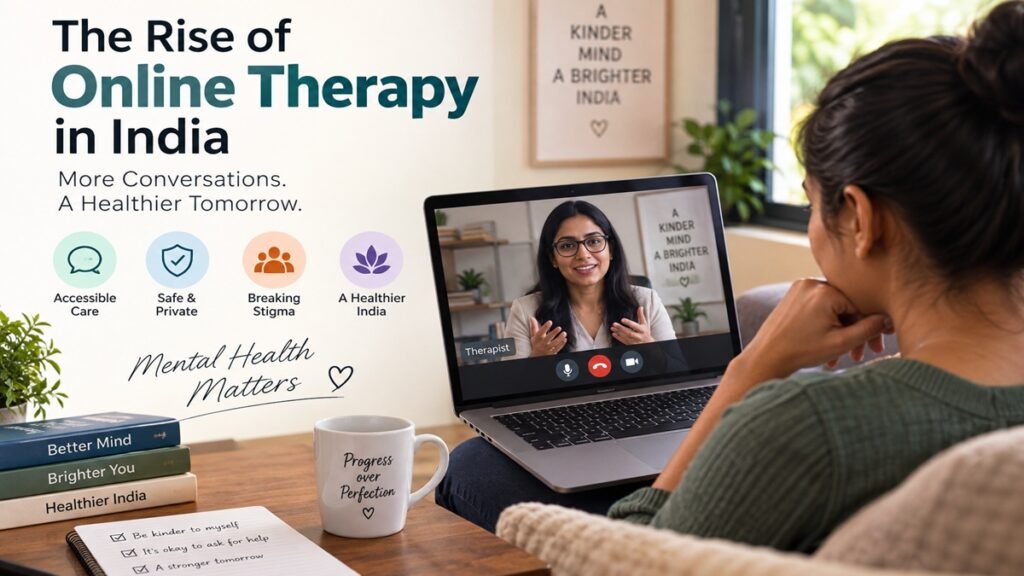
Online Therapy in India: Benefits, Challenges, Cost and How It Works
Mental health care in India is increasingly moving beyond traditional clinic-based appointments. Alongside growing awareness of mental well-being, digital healthcare has created new ways for people to connect with counsellors, psychologists, and other mental health professionals.
Online therapy in India allows people to access mental health support through video calls, phone consultations, and other digital communication methods. For people who live far from specialist services, have demanding schedules, or prefer the privacy of speaking from home, online sessions can provide a practical way to begin seeking professional support.
The growth of digital mental health services is also relevant to India’s wider healthcare challenge. The World Health Organization’s profile on mental health in India highlights significant treatment gaps across different mental health conditions, showing the continuing need to expand access to appropriate care.
At the same time, online therapy is not a replacement for every form of mental healthcare. The suitability of online treatment depends on a person’s needs, the type and severity of the problem, the therapist’s assessment, and whether additional in-person or emergency care is required.
What Is Online Therapy?
Online therapy, also called teletherapy or online counselling, refers to mental health services delivered through digital communication technologies.
Depending on the provider, a session may take place through:
- Video consultations
- Telephone conversations
- Secure messaging or text-based communication
- Online counselling platforms
- Follow-up sessions through digital applications
The therapeutic approach itself does not necessarily change simply because the session happens online. A qualified professional may use approaches such as Cognitive Behavioural Therapy (CBT), supportive counselling, behavioural techniques, or other evidence-based methods depending on the person’s situation.
Online therapy should therefore be understood primarily as a different method of delivering professional mental health care, rather than as a completely different form of therapy.
Why Is Online Therapy Growing in India?
India has a large and geographically diverse population, and access to mental health professionals is not evenly distributed. The Government of India’s National Mental Health Programme identifies the need to improve the availability and accessibility of mental healthcare across the country.
Digital services can help address part of this access problem.
A person living in a smaller city may be able to consult a professional based elsewhere without travelling several hours. Similarly, students, working professionals, caregivers, and people with mobility limitations may find it easier to schedule a remote session.
The COVID-19 pandemic also accelerated the adoption of telehealth services. However, the continued use of digital mental health services is now broader than the pandemic response alone.
India has also developed a public tele-mental-health infrastructure through the Tele-MANAS programme. According to the Directorate General of Health Services, Tele-MANAS aims to provide accessible and affordable tele-mental-health services across India through a 24×7 system.
The public can access the Tele-MANAS helpline by calling 14416 or 1800-89-14416.
How Does Online Therapy Work?
The process varies between providers, but a typical online therapy journey may look like this:
1. Finding a Suitable Professional
The user chooses a therapist or mental health professional based on factors such as qualifications, experience, specialization, language, availability, and the type of support required.
2. Initial Assessment
The first session generally involves discussing the person’s concerns, background, goals, and expectations. The professional may also determine whether online therapy is appropriate.
3. Regular Sessions
Depending on the treatment plan, sessions may take place weekly, fortnightly, or according to another schedule agreed between the client and professional.
4. Progress and Follow-Up
The therapist may review progress, modify the approach, recommend exercises between sessions, or suggest additional professional or medical support when necessary.
The exact process depends on the therapist and the individual’s circumstances.
What Does Research From India Say About Online Therapy?
Research involving Indian participants has started to examine how internet-based psychological interventions can be used in the country’s healthcare and educational settings.
For example, a randomized controlled feasibility trial involving 222 university students across four Indian campuses evaluated guided internet-delivered self-help based on Cognitive Behavioural Therapy for symptoms of generalized anxiety disorder. Participants receiving the guided intervention experienced greater reductions in anxiety symptoms, worry, and depressive symptoms than the waitlist group. The researchers described the approach as a feasible intervention for university students in India.
Read the full Indian university student study on internet-delivered guided self-help.
Another Indian study from researchers at NIMHANS, Bengaluru, examined a blended intervention combining guided internet-based self-help with four to six face-to-face sessions for people with mild to moderate depression. The pilot study included 60 participants, with 40 completing the intervention and follow-up assessments. The researchers reported improvements in depression, functioning, self-esteem, and psychological recovery among participants.
Read the NIMHANS study on blended internet-based self-help and face-to-face intervention.
Research from the Indian Institute of Technology Kanpur has also examined computerized CBT delivered remotely. A randomized controlled trial involving 598 participants in India evaluated an unguided computerized CBT intervention known as TreadWill. The study reported reductions in depression- and anxiety-related symptoms among participants who completed at least half of the intervention modules compared with the waitlist control group.
Read the Indian randomized controlled trial of TreadWill.
These studies provide evidence that digital psychological interventions can be investigated and delivered in Indian populations. However, individual results can vary, and online interventions are not automatically appropriate for every person or every mental health condition.
Is Online Therapy Effective?
Research from India and other countries has examined internet-based psychological interventions, particularly Cognitive Behavioural Therapy.
In addition to Indian research, international systematic reviews have examined internet-based CBT across different mental health conditions. A systematic review of internet-based CBT found evidence supporting its use across several clinical conditions, including depression and anxiety-related disorders.
An updated systematic review and meta-analysis comparing therapist-supported internet-based CBT with face-to-face CBT also examined the effectiveness of the two approaches across the studies included.
More recent research has investigated longer-term outcomes. A 2024 meta-analysis of internet-delivered CBT examined long-term outcomes across randomized controlled trials.
These findings provide useful evidence about digital psychological interventions, but they should not be interpreted as meaning that online therapy is automatically suitable for everyone. The appropriate treatment format depends on the individual’s circumstances, symptoms, treatment needs, and professional assessment.
Benefits of Online Therapy in India
Accessibility
Online therapy can make professional support available to people who may otherwise have difficulty reaching a mental health professional.
This can be particularly relevant for people living in areas where specialist services are limited or where travelling to a major city is difficult.
Convenience
Remote sessions remove the need to travel to a clinic for every appointment.
A person can potentially attend a session from home, provided they have a suitable private environment and a reliable internet or telephone connection.
Greater Choice
Online services can expand the geographical pool from which someone can select a professional.
Users may be able to consider therapists based on:
- Specialization
- Language
- Experience
- Therapy approach
- Availability
Privacy
For some people, attending a clinic can feel uncomfortable because of concerns about being seen by acquaintances or having to explain why they are visiting a mental health professional.
Online sessions can provide an alternative, although privacy ultimately depends on the environment in which the session takes place and the security practices of the service provider.
Flexible Scheduling
Digital sessions can sometimes make it easier to fit appointments around work, education, caregiving, or other responsibilities.
This can be particularly useful for people who have difficulty travelling during conventional appointment hours.
Online Therapy vs In-Person Therapy
Neither format is universally appropriate for every person. The choice depends on individual circumstances and professional assessment.
| Factor | Online Therapy | In-Person Therapy |
|---|---|---|
| Location | Can be accessed remotely | Requires visiting a clinic or facility |
| Travel | Usually no travel required | Travel is normally required |
| Scheduling | Can offer greater flexibility | Depends on clinic availability |
| Internet/device | Required for digital sessions | Usually not required |
| Privacy | Requires a private location | Depends on the clinic setting |
| Specialist access | Can expand geographical choice | Usually limited by location |
| Emergency situations | May require referral to local services | Can provide direct physical access to a facility |
How Much Does Online Therapy Cost in India?
The cost of online therapy varies considerably between professionals and platforms.
Factors that can affect pricing include:
- Professional qualifications
- Experience
- Specialization
- Session duration
- Type of therapy
- Individual or couples counselling
- Platform or service provider
- Whether sessions are purchased individually or as part of a package
Because prices change between professionals and platforms, users should check the current fee before booking rather than relying on a general online estimate.
Some public mental health services may also provide free or subsidized support. The Government of India’s Tele-MANAS programme provides a national tele-mental-health service through its helpline.
How to Choose an Online Therapist in India
Choosing a therapist should involve more than simply selecting the cheapest or fastest available appointment.
Check Professional Credentials
Look at the professional’s qualifications and relevant professional experience. Where applicable, verify registration or licensing information through the relevant professional or institutional source.
Consider Specialization
Different professionals may work with different concerns, such as:
- Anxiety
- Depression
- Relationship difficulties
- Stress
- Grief
- Family concerns
- Behavioural problems
- Workplace stress
Choose someone whose experience matches the type of support you are seeking.
Check Language
Communication is an important part of therapy. If you are more comfortable speaking Hindi, English, or another Indian language, check whether the professional can communicate effectively in that language.
Understand Privacy Policies
Before sharing sensitive information online, understand how the platform handles personal information, session records, communications, and account data.
Ask About Emergency Procedures
A reputable service should make clear what happens if a client needs urgent or emergency support beyond what online sessions can provide.
Privacy and Confidentiality in Online Therapy
Privacy is one of the major considerations when receiving mental health support online.
Users should consider both sides of privacy.
Platform privacy: Understand how the service handles personal information and communications.
Personal environment: Make sure the location from which you attend a session is sufficiently private.
Using a personal device, secure internet connection, headphones, and a private room can help reduce accidental disclosure of sensitive conversations.
Users should also avoid assuming that every online mental health service offers the same level of privacy or professional oversight. Checking the provider’s privacy information before beginning treatment is worthwhile.
Popular Online Therapy Approaches
A variety of psychological interventions can be adapted for digital delivery.
Cognitive Behavioural Therapy
CBT is particularly well suited to structured digital formats. Indian research involving university students has examined guided internet-delivered CBT-based self-help for generalized anxiety symptoms, while other Indian research has investigated computerized CBT interventions delivered remotely.
Stress Management
Professionals may use online sessions to help clients understand stressors and develop healthier coping strategies.
Relationship Counselling
Some providers offer online relationship or couples counselling, although suitability depends on the circumstances of the individuals involved.
Supportive Counselling
Online sessions may also provide a structured environment in which people can discuss emotional difficulties and work toward practical coping strategies.
For people specifically looking for professional support through a digital platform, online therapy in India is one option for exploring online counselling services.
Limitations of Online Therapy
Online therapy has important limitations that should not be overlooked.
Technology Problems
Poor internet connectivity, device problems, audio issues, or interruptions can affect a session.
Lack of Physical Presence
Remote sessions do not provide the same physical environment as an in-person clinical setting. This can matter in situations where direct observation or immediate physical intervention is required.
Privacy at Home
A person may not have access to a quiet or private room. Family members, roommates, children, or other people may unintentionally interrupt a session.
Not Suitable for Every Situation
Some mental health situations require more intensive assessment, immediate intervention, medical care, or in-person services.
For this reason, online therapy should not be treated as a universal replacement for conventional mental healthcare.
Online Therapy and India’s Tele-Mental Health Infrastructure
India’s digital mental health ecosystem now includes both private online therapy services and government-supported programmes.
The Government of India’s Tele-MANAS programme aims to provide universal access to equitable, accessible, affordable, and quality mental health care through 24×7 tele-mental-health services across Indian states and union territories.
The programme can also provide counselling, video consultations with mental health specialists, e-prescriptions, follow-up services, and links to in-person services when required.
The public can access Tele-MANAS by calling 14416 or 1800-89-14416.
This is important because digital mental health care is not limited to commercial therapy platforms. Public tele-mental-health infrastructure is also becoming part of India’s broader healthcare system.
When Should You Consider In-Person Care?
Online therapy may not be the appropriate first or only option in every situation.
Consider seeking direct medical or mental health assessment when:
- Symptoms are severe or rapidly worsening
- A professional recommends an in-person assessment
- There is an immediate safety concern
- Medication assessment or management is required
- The person needs a level of care that cannot be delivered remotely
- A crisis requires immediate local intervention
If someone is in immediate danger or there is an urgent risk of self-harm or harm to another person, seek emergency assistance or go to the nearest appropriate emergency medical facility rather than relying solely on a routine online therapy appointment.
For non-emergency mental health support in India, the Government’s Tele-MANAS service can be reached at 14416 or 1800-89-14416.
Getting Started With Online Therapy
If you are considering online therapy for the first time, a simple approach is:
- Identify the type of support you are looking for.
- Research qualified professionals or established platforms.
- Check qualifications, experience, specialization, and language.
- Review privacy and confidentiality information.
- Confirm the session format and cost.
- Make sure you have a private place for the session.
- Ask what happens if you need additional or emergency care.
- After an initial session, assess whether the therapist and approach are appropriate for your needs.
It is also reasonable to change therapists if the professional relationship or therapeutic approach does not feel suitable.
Frequently Asked Questions
Is online therapy available in India?
Yes. Online mental health services are available through private providers as well as government-supported tele-mental-health programmes such as Tele-MANAS. The Government of India’s service is available through 14416 and 1800-89-14416. More information is available through the official National Mental Health Programme information.
Is online therapy effective?
Research involving Indian populations has examined internet-delivered CBT and other digital psychological interventions. For example, an Indian university student trial found greater reductions in anxiety symptoms, worry, and depressive symptoms among participants receiving guided internet-delivered self-help compared with a waitlist control. However, outcomes vary according to the intervention, condition, level of professional support, and individual circumstances.
Can I have therapy in Hindi?
Many online services and individual professionals offer sessions in Indian languages. Availability depends on the therapist or platform, so users should confirm the language before booking.
Is online therapy private?
Online therapy can be conducted privately, but privacy depends on both the platform’s data practices and the environment from which the client attends the session. Users should review the provider’s privacy information and choose a private setting.
Is online therapy suitable for everyone?
No. Some situations require in-person assessment, emergency intervention, or more intensive care. A qualified professional can help determine the most appropriate form of support.
Can I switch therapists?
In many private therapy services, clients can request a different therapist if the initial professional is not a suitable match. Policies vary by platform.
The Future of Online Therapy in India
The expansion of digital healthcare is becoming an important part of India’s mental health infrastructure.
Government programmes such as Tele-MANAS demonstrate that tele-mental-health services can be incorporated into the wider public healthcare system.
At the same time, Indian research institutions and universities continue to study internet-based psychological interventions. Studies involving Indian university students, NIMHANS, and IIT Kanpur have all contributed evidence to the growing body of research on digital mental health interventions in the Indian context.
Future developments may include better digital assessment tools, multilingual services, improved remote-care platforms, and stronger integration between online and in-person healthcare.
Technology should support professional mental healthcare rather than replace professional judgment. Quality, privacy, appropriate referral, and patient safety will remain important as digital mental health services expand.
Conclusion
The rise of online therapy in India reflects a broader change in how people access healthcare. Digital sessions can reduce travel barriers, expand access to professionals, and provide greater flexibility for people who may find traditional appointments difficult to attend.
Importantly, research conducted with Indian participants has begun to provide evidence about how internet-based psychological interventions can work in the country’s own social and healthcare context. Studies involving university students, NIMHANS, and IIT Kanpur have examined different forms of digital CBT and online mental health interventions.
India’s Tele-MANAS programme further demonstrates the growing role of digital mental health services, providing a government-supported route to tele-mental-health assistance through 14416 and 1800-89-14416.
For anyone considering online therapy, the most important steps are to choose an appropriately qualified professional, understand the service’s privacy practices, and recognize when additional or in-person care may be necessary.
Online therapy can be an important part of modern mental healthcare, but its value ultimately depends on combining technology with qualified professionals, appropriate treatment, privacy, and patient safety.
Sources and Further Reading
-
Government of India – National Mental Health Programme and Tele-MANAS
-
World Health Organization – Mental Health in India
-
Internet-Delivered Guided Self-Help for Generalized Anxiety Disorder Among University Students in India
-
NIMHANS – Blended Internet-Based Self-Help and Face-to-Face Intervention for Depression
-
IIT Kanpur – Randomized Controlled Trial of Computerized CBT in India
-
PubMed – Systematic Review of Internet-Based CBT
-
PubMed – Internet-Based CBT Compared With Face-to-Face CBT
-
PubMed – Long-Term Outcomes of Internet-Delivered CBT
Editorial Note: This article provides general information about online mental health services and is not a substitute for diagnosis, treatment, or emergency medical care from a qualified professional.
