
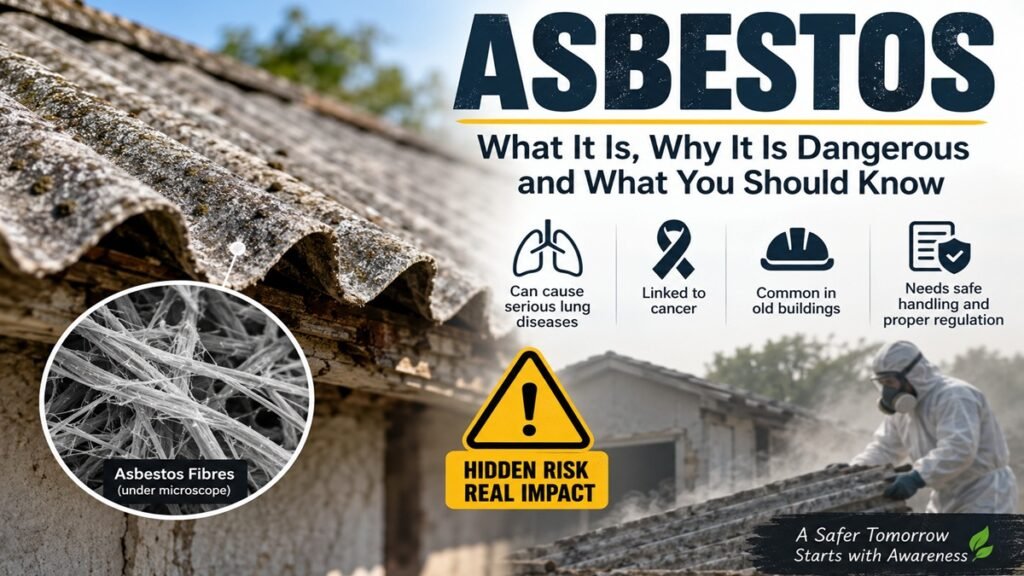
Asbestos: What It Is, Why It Is Dangerous, Health Risks, Uses, Exposure and Why It Is Still Used
Asbestos is one of those materials that looks ordinary but has a remarkably complicated history. For decades, it was widely used in construction, manufacturing, insulation, roofing, pipes, automotive components, and many other products because it is strong, heat-resistant, chemically resistant, and a poor conductor of electricity.
The same properties that made asbestos commercially useful, however, also contributed to its widespread use before its health risks were fully understood.
Today, the scientific evidence is clear: all forms of asbestos are carcinogenic to humans. The World Health Organization (WHO) states that all forms of asbestos, including chrysotile or “white asbestos,” can cause cancer and serious respiratory disease. The International Agency for Research on Cancer (IARC) also classifies all forms of asbestos as carcinogenic to humans.
This creates an important question:
If asbestos is known to cause cancer, why does it still exist in old buildings and why are asbestos-containing products still regulated in some countries rather than universally removed immediately?
The answer requires understanding both the science of asbestos exposure and the difference between existing asbestos-containing materials and new exposure to airborne asbestos fibres.
What Is Asbestos?
Asbestos is not a single chemical or a single mineral. It is a general name for a group of naturally occurring mineral fibres.
These minerals can be separated into extremely thin, durable fibres. Their physical characteristics made them valuable for industrial applications.
According to the U.S. National Cancer Institute (NCI), asbestos refers to six naturally occurring minerals that form bundles of fibres. They are broadly divided into two groups:
- Serpentine asbestos
- Amphibole asbestos
Chrysotile is the best-known serpentine asbestos and has historically been the most widely used commercial form.
The amphibole group includes:
- Crocidolite
- Amosite
- Tremolite
- Actinolite
- Anthophyllite
The scientific evidence summarized by WHO and IARC concludes that all forms of asbestos are carcinogenic to humans.
Why Was Asbestos Used So Much?
To understand why asbestos became so widespread, it is important to understand its physical properties.
Asbestos fibres have several characteristics that were extremely attractive to manufacturers.
1. High Heat Resistance
Asbestos can tolerate high temperatures and has historically been used in applications where heat resistance was important.
This made it useful in insulation, fire-resistant materials, industrial equipment, and some automotive components.
2. Fire Resistance
Asbestos does not burn in the same way as ordinary organic materials.
Because of this, asbestos-containing materials were historically promoted for fire protection and insulation.
3. Mechanical Strength
Despite being composed of extremely thin fibres, asbestos can provide considerable strength when incorporated into materials.
This was particularly useful when asbestos fibres were mixed with cement.
4. Chemical Resistance
Asbestos has useful resistance to many chemical environments.
This contributed to its use in industrial products and construction materials.
5. Electrical Insulation
Asbestos does not conduct electricity well.
Historically, this made it useful in some electrical and industrial applications.
6. Low Cost and Availability
Asbestos was naturally occurring and could be mined and processed on a large industrial scale.
The combination of performance and cost made it attractive to manufacturers.
The National Cancer Institute describes asbestos as useful because its fibres are resistant to heat, fire and chemicals and do not conduct electricity.
Where Was Asbestos Used?
Historically, asbestos was used in a surprisingly large number of products.
Common applications included:
- Roofing sheets
- Cement boards
- Building insulation
- Pipes
- Fire-resistant materials
- Industrial insulation
- Brake and clutch components
- Gaskets
- Textiles
- Fire blankets
- Some electrical products
- Construction materials
The World Health Organization has documented historical and current commercial uses including roofing products, water supply lines, fire blankets, automobile clutch and brake components, gaskets, and pads.
This widespread historical use is one reason asbestos exposure remains a public-health concern even decades after some countries restricted its use.
A building does not have to be new to create an asbestos exposure issue.
An old building undergoing renovation or demolition can potentially release asbestos fibres if asbestos-containing materials are disturbed.
Why Is Asbestos Dangerous?
The central problem with asbestos is not simply that the material exists.
The major health concern is inhalation of asbestos fibres.
When asbestos-containing materials are damaged, cut, drilled, sanded, broken, scraped, or otherwise disturbed, microscopic fibres can become airborne.
A person nearby may then breathe those fibres.
Once inhaled, some fibres can become trapped in the respiratory system.
The NCI explains that asbestos fibres can become trapped in the lungs and remain there for long periods. Over time, they can contribute to inflammation and scarring and can lead to serious diseases.
Why Are Asbestos Fibres So Difficult for the Body to Deal With?
The physical structure of asbestos fibres is important.
They are extremely thin and durable.
Unlike many ordinary particles that the body can remove relatively easily, asbestos fibres can persist in tissues.
The body’s immune system can attempt to respond to fibres that become lodged in the lungs, but persistent fibres can contribute to chronic inflammation and tissue damage.
Research summarized by IARC describes mechanisms through which asbestos fibres can contribute to carcinogenesis, including generation of reactive oxygen species, DNA damage, and interference with cellular processes.
This helps explain why asbestos-related diseases can develop many years after exposure.
Is All Asbestos Dangerous?
Yes.
This is an important point because there has historically been debate around different types of asbestos.
Some discussions distinguish between chrysotile and amphibole asbestos.
However, the current scientific position of WHO and IARC is clear:
All forms of asbestos are carcinogenic to humans.
This includes chrysotile, which is commonly called white asbestos.
WHO specifically includes chrysotile among the asbestos forms that are carcinogenic.
IARC similarly concludes that all forms of asbestos cause cancer in humans.
Therefore:
Less hazardous than another form does not mean harmless.
What Diseases Can Asbestos Cause?
Asbestos exposure is associated with several serious diseases.
1. Mesothelioma
Mesothelioma is a relatively rare but aggressive cancer involving thin membranes around organs.
The most common form is pleural mesothelioma, affecting the lining around the lungs.
Asbestos exposure is a major cause of mesothelioma.
IARC reports sufficient evidence that asbestos causes mesothelioma.
2. Lung Cancer
Asbestos exposure can cause lung cancer.
The risk becomes particularly concerning when asbestos exposure is combined with smoking.
The NCI reports that people exposed to both asbestos and tobacco smoke have a substantially increased risk of lung cancer compared with exposure to either risk factor alone.
This is one reason smoking cessation is particularly important for anyone with occupational or historical asbestos exposure.
3. Asbestosis
Asbestosis is a chronic lung disease caused by asbestos exposure.
It involves scarring and fibrosis of lung tissue.
As the lungs become scarred, breathing can become increasingly difficult.
The disease can develop after prolonged exposure and may take many years to become clinically apparent.
The NCI describes asbestosis as an inflammatory condition that can cause shortness of breath, coughing, and permanent lung damage.
4. Cancer of the Larynx
IARC and WHO identify asbestos as a cause of laryngeal cancer.
5. Ovarian Cancer
Asbestos exposure is also associated with ovarian cancer.
This is one reason it is incorrect to think of asbestos as a substance that affects only the lungs.
WHO identifies cancer of the ovary among the cancers caused by asbestos exposure.
Can Asbestos Cause Cancer After a Long Delay?
Yes.
One of the most concerning characteristics of asbestos-related disease is the long latency period.
A person may be exposed to asbestos and experience no obvious symptoms for many years.
The NCI notes that asbestos-related diseases can take 10 to 40 years or more to develop after exposure.
This creates an unusual public-health problem.
A person who worked around asbestos decades ago may still develop an asbestos-related disease today.
This is also why asbestos exposure cannot be evaluated only by looking at today’s workplace conditions.
Historical exposure matters.
Is There a Safe Level of Asbestos Exposure?
This question is more complicated than simply saying that one specific amount is always safe or unsafe.
Health risk generally depends on factors such as:
- Amount of exposure
- Duration of exposure
- Frequency of exposure
- Type of asbestos fibre
- How the material was disturbed
- Individual factors
- Smoking history
The NCI identifies dose, duration, fibre characteristics, source of exposure, smoking and other individual factors among the considerations affecting asbestos-related disease risk.
However, the public-health approach is not to encourage people to find a “safe amount” of asbestos.
WHO’s stated approach is to prevent exposure and ultimately eliminate asbestos-related disease by stopping the use of asbestos and replacing it with safer alternatives.
Does Simply Having Asbestos in a Building Make the Building Dangerous?
Not necessarily.
This is one of the most important distinctions to understand.
An asbestos-containing material can be relatively stable when it is intact and undisturbed.
The risk can increase significantly when the material becomes damaged or is subjected to work that releases fibres.
Examples include:
- Drilling
- Cutting
- Grinding
- Sanding
- Breaking
- Scraping
- Demolition
- Improper removal
The NCI explains that when asbestos-containing products are disturbed, tiny fibres can be released into the air and subsequently inhaled.
Therefore:
Asbestos-containing material should not be disturbed unnecessarily.
Why Are Old Asbestos Roof Sheets a Concern?
Asbestos-cement roofing sheets were historically popular because asbestos fibres could reinforce cement while providing durability and weather resistance.
However, old roofing sheets can become damaged through:
- Age
- Weathering
- Impact
- Improper repairs
- Drilling
- Cutting
- Replacement work
- Demolition
The danger becomes particularly relevant when fibres become airborne.
This is why workers repairing, replacing, demolishing, or otherwise disturbing old asbestos-containing roofing materials require appropriate controls.
Should You Drill an Old Asbestos Sheet?
No.
If a sheet is suspected to contain asbestos, drilling, cutting, grinding, sanding, or breaking it without appropriate controls can release fibres.
The safest general approach is:
Do not disturb suspected asbestos-containing material unnecessarily.
If work is necessary, the material should be assessed and handled using appropriate asbestos-control procedures by trained professionals.
What Happens During Asbestos Removal?
Asbestos removal is not simply a matter of taking a sheet down and throwing it away.
The goal is to prevent fibres from becoming airborne and exposing workers or nearby people.
Depending on the material and situation, professional asbestos-control procedures can involve:
- Assessment of the material
- Controlled work areas
- Appropriate respiratory protection
- Protective clothing
- Dust suppression
- Careful removal
- Controlled packaging
- Proper transport
- Decontamination
- Cleaning and inspection
The Central Pollution Control Board has documented Indian standards and practices relating to asbestos, including recommendations for worker safety, handling, storage, transportation, warning signs, and preventing airborne fibre release.
How Can Asbestos Exposure Happen at Work?
Historically, some of the highest-risk occupations included:
- Asbestos mining
- Asbestos manufacturing
- Construction
- Insulation work
- Shipbuilding
- Demolition
- Roofing
- Industrial maintenance
- Some automotive work
Today, exposure can still occur during renovation, maintenance, demolition, repair, or removal of older asbestos-containing materials.
Can Family Members of Workers Be Exposed?
Potentially, yes.
Historically, workers heavily exposed to asbestos could carry fibres home on contaminated clothing, footwear, skin, or hair.
This is known as secondary or take-home exposure.
The NCI notes evidence that family members of heavily exposed workers may face increased risk, potentially because fibres can be carried into the home on clothing and other items.
This is one reason occupational asbestos-control programmes can include procedures for changing clothes, showering, and preventing contaminated work clothing from entering the home environment.
What About Smoking and Asbestos?
Smoking and asbestos exposure together are particularly concerning for lung cancer.
The NCI reports that smokers exposed to asbestos have a lung-cancer risk greater than the individual risks associated with asbestos and smoking considered separately.
Therefore, someone with a history of occupational asbestos exposure should take smoking cessation particularly seriously.
How Many People Are Affected by Asbestos?
The global impact is substantial.
The WHO estimates that occupational exposure to asbestos causes more than 200,000 deaths worldwide each year, based on WHO/ILO estimates, and accounts for a substantial proportion of deaths from work-related cancers.
WHO also estimates a substantial burden of disability associated with asbestos exposure.
These figures demonstrate why asbestos is not simply an old construction-material issue.
It remains a global occupational and public-health problem.
If Asbestos Is So Dangerous, Why Was It Used for So Long?
This is an important historical question.
Asbestos has an unusual combination of desirable industrial properties:
- Strength
- Heat resistance
- Fire resistance
- Chemical resistance
- Electrical insulation
- Durability
- Low cost
These properties made asbestos extremely useful.
At the same time, the diseases caused by asbestos exposure often develop only after a long latency period.
That means the health consequences of exposure may not become obvious until decades later.
This long delay made the relationship between exposure and disease more difficult to recognize historically.
As scientific evidence accumulated, governments and health organizations increasingly introduced restrictions, workplace controls, and bans.
Is Asbestos Completely Banned Worldwide?
No.
This is another important misconception.
Asbestos has been prohibited in more than 50 WHO Member States, according to WHO.
However, asbestos has not been universally banned worldwide.
Some countries continue to have regulated asbestos use, particularly chrysotile.
WHO’s public-health position is that stopping the use of all forms of asbestos is the most efficient way to eliminate asbestos-related disease.
What Is the Situation in India?
India requires particular attention because asbestos-containing products have historically been used in construction and industrial applications.
It would be inaccurate to simply say:
“Asbestos is completely banned in India.”
The current Indian regulatory framework is more complicated.
The Bureau of Indian Standards (BIS) currently lists standards covering asbestos or fibre-cement based products, including:
- Corrugated and semi-corrugated asbestos-cement sheets
- Asbestos-cement pressure pipes
- Asbestos-cement flat sheets
- Asbestos-cement building boards
- Asbestos-cement pipes and fittings
- Asbestos-cement cable conduits
- Fibre-cement products
BIS lists these products under its certification framework.
India’s Asbestos and Fibre-Cement Quality Control Order
The Indian regulatory situation becomes particularly interesting with the Asbestos or Fibre Cement Based Products (Quality Control) Order, 2024.
The official government notification states that the Bureau of Indian Standards is the certification and enforcement authority for the specified goods and articles covered by the order.
The order identifies multiple asbestos and fibre-cement products against applicable Indian Standards.
Read the official Asbestos or Fibre Cement Based Products (Quality Control) Order, 2024.
This means that saying simply:
“India has banned asbestos”
would be an oversimplification.
A more accurate statement is:
India regulates specified asbestos and fibre-cement products through standards and quality-control requirements, while asbestos exposure remains a recognized occupational and public-health hazard.
Why Doesn’t India Simply Ban All Asbestos?
There are several factors behind the complexity of asbestos regulation.
First, large quantities of asbestos-containing materials already exist in buildings, factories, homes, pipes, roofs, and infrastructure.
Second, immediately removing every existing asbestos-containing product could itself create exposure if demolition and disposal are poorly managed.
Third, industries and workers may have historically depended on asbestos-containing products.
Fourth, replacement materials and transition policies need to be economically and technically practical.
The public-health argument for eliminating asbestos is nevertheless strong.
Does “Chrysotile Is Safer” Mean It Is Safe?
No.
This distinction is extremely important.
Chrysotile has sometimes been described as less persistent in the lungs than certain amphibole fibres.
However, “less hazardous than another asbestos fibre” does not mean “safe.”
WHO explicitly includes chrysotile among the asbestos forms that are carcinogenic to humans.
IARC also classifies all forms of asbestos as carcinogenic.
Therefore:
Less hazardous than another form does not mean harmless.
What Are Safer Alternatives to Asbestos?
The appropriate substitute depends on the application.
Modern construction can use a variety of materials such as:
- Non-asbestos fibre cement
- Metal roofing
- Concrete products
- Gypsum-based boards
- Mineral-based insulation
- Modern polymer materials
- Other engineered construction materials
However, “replacement” should not mean simply switching to another material without evaluating its own health and environmental characteristics.
Is Asbestos Dangerous If It Is Wet?
Moisture can reduce the tendency of some dust to become airborne during controlled work, but this does not make asbestos safe.
A person should not assume that simply wetting an asbestos sheet makes cutting or breaking it harmless.
Proper asbestos-control procedures involve more than water.
They can include controlled work methods, protective equipment, containment, specialized cleaning, packaging, and regulated disposal.
Can You Identify Asbestos Just by Looking at It?
Usually, you should not rely on appearance alone.
Many asbestos-containing materials look similar to non-asbestos materials.
An old cement sheet, board, insulation product, or other material may not reveal its composition simply by visual inspection.
If determining whether a material contains asbestos is important, professional assessment and, where appropriate, laboratory analysis may be necessary.
Most importantly, do not cut or break a suspicious material simply to inspect it.
What Should You Do If You Find Suspected Asbestos?
The safest general approach is:
1. Do Not Disturb It
Avoid drilling, cutting, breaking, sanding, or scraping the material.
2. Keep People Away From Damaged Material
If the material is damaged or deteriorating, prevent unnecessary access until it can be assessed.
3. Do Not Sweep Asbestos Dust
Dry sweeping can potentially redistribute contaminated dust.
4. Do Not Use Ordinary DIY Methods
Vacuuming with ordinary household equipment or performing uncontrolled demolition is not an appropriate substitute for asbestos-control procedures.
5. Contact Appropriate Professionals
For significant renovation, demolition, or removal work involving suspected asbestos, use professionals familiar with asbestos safety and applicable local requirements.
What If an Old Asbestos Sheet Is Already Installed?
Do not automatically assume that it must immediately be removed.
The appropriate decision depends on factors such as:
- Condition of the material
- Location
- Likelihood of disturbance
- Whether renovation is planned
- Potential exposure to occupants
- Applicable local regulations
- Availability of safe removal services
In some circumstances, leaving an intact material undisturbed may create less immediate exposure risk than improperly removing it.
This is why asbestos management is not simply:
“Find asbestos → break it → throw it away.”
The removal process itself can create airborne fibres if performed incorrectly.
Asbestos and Demolition
Demolition is one of the situations in which asbestos exposure can become particularly important.
When an old building is demolished, asbestos-containing materials can be:
- Broken
- Crushed
- Cut
- Fragmented
- Released as dust
Without proper controls, workers and nearby people can potentially inhale airborne fibres.
Why Are Asbestos Diseases Still Appearing Today?
Because asbestos has been used for many decades.
The long latency period means that exposure from the past can produce disease much later.
Additionally, asbestos-containing materials remain in many older buildings and infrastructure systems.
Therefore, even if new asbestos use decreases, health consequences can continue for decades.
This is one reason asbestos is often described as a legacy occupational and environmental health problem.
The Difference Between Asbestos Exposure and Asbestos Disease
Another important point is that:
Exposure does not automatically mean disease.
The NCI explains that although asbestos exposure is widespread at low levels, most people do not develop asbestos-related illness. Higher and repeated occupational exposure has historically been associated with greater risk.
However, because serious diseases can result and because asbestos is carcinogenic, exposure should be prevented wherever reasonably possible.
If someone has a significant occupational exposure history, discussing it with a qualified healthcare professional can be appropriate.
What Are the Symptoms of Asbestos-Related Disease?
Symptoms vary depending on the disease.
Possible symptoms can include:
- Persistent cough
- Shortness of breath
- Chest discomfort
- Reduced exercise tolerance
- Unexplained respiratory symptoms
However, symptoms are not specific to asbestos exposure.
Many other medical conditions can cause similar symptoms.
Asbestos-related disease may also remain silent for many years.
Therefore, a person should not attempt to diagnose an asbestos-related disease based solely on symptoms.
Can Asbestos Exposure Be Prevented?
Yes.
This is one of the most important conclusions from decades of asbestos research.
Prevention can involve:
- Avoiding unnecessary asbestos use
- Replacing asbestos with safer alternatives
- Identifying asbestos-containing materials
- Preventing unnecessary disturbance
- Training workers
- Using appropriate protective equipment
- Controlling dust
- Proper removal procedures
- Appropriate waste management
- Medical surveillance of appropriately exposed workers
WHO states that asbestos-related diseases are preventable and identifies stopping asbestos use and preventing exposure during handling and removal as key public-health actions.
Why Asbestos Is a Public-Health Issue, Not Just a Construction Issue
It is easy to think of asbestos as something that only concerns factory workers or construction workers.
That is too narrow.
Asbestos can become a public-health issue because asbestos-containing materials may exist in:
- Residential buildings
- Schools
- Factories
- Hospitals
- Warehouses
- Industrial plants
- Public infrastructure
- Old water systems
- Commercial buildings
People may encounter these materials during:
- Renovation
- Plumbing work
- Electrical work
- Roofing repairs
- Demolition
- Maintenance
- Waste handling
This makes awareness particularly important.
Does Asbestos Cause Immediate Poisoning?
Generally, asbestos is not like a conventional poison that produces immediate symptoms after a small exposure.
Its major danger is associated with long-term health consequences following inhalation of fibres.
A person can therefore be exposed without immediately feeling sick.
This is one reason asbestos is particularly deceptive.
Someone may disturb an asbestos-containing material, feel completely normal afterward, and still have had an exposure that should be taken seriously.
The diseases associated with asbestos commonly have long latency periods.
Is One-Time Exposure Dangerous?
A single exposure does not mean that a person will definitely develop cancer.
Risk depends on exposure characteristics, including dose and duration.
However, it is also inappropriate to conclude that every brief exposure is completely harmless.
The NCI notes that asbestos-related diseases have been observed after relatively brief exposures, although people who develop disease are often those with occupational or substantial environmental exposure.
The practical lesson is simple:
Do not intentionally expose yourself to asbestos just because the exposure is expected to be brief.
Why Does WHO Recommend Eliminating Asbestos?
WHO’s reasoning is based on prevention.
If asbestos exposure causes preventable cancer and respiratory disease, eliminating the source of exposure can prevent future disease.
More than 50 WHO Member States have already prohibited asbestos use through legal measures.
So, Should Asbestos Be Banned?
From a public-health perspective, the scientific case for preventing asbestos exposure and moving away from asbestos use is strong.
WHO explicitly supports stopping the use of all forms of asbestos as the most efficient way to eliminate asbestos-related diseases.
However, the legal question is different in each country.
A complete policy cannot simply focus on banning new production while ignoring millions of existing asbestos-containing materials.
A comprehensive approach needs to address:
- New asbestos use
- Existing asbestos-containing buildings
- Worker protection
- Renovation and demolition
- Waste disposal
- Exposure monitoring
- Medical surveillance
- Safer substitutes
- Public awareness
This is particularly important in countries where asbestos-containing products remain part of the existing built environment.
India’s Current Position: Ban or Regulation?
The answer is more nuanced than a simple yes or no.
India currently has standards and regulatory requirements covering specified asbestos and fibre-cement products.
The Bureau of Indian Standards lists asbestos and fibre-cement products under its certification framework, including asbestos-cement sheets, pipes, boards, and other products.
The Asbestos or Fibre Cement Based Products (Quality Control) Order, 2024 also specifies covered products and identifies BIS as the certification and enforcement authority.
Read the official Asbestos or Fibre Cement Based Products (Quality Control) Order, 2024.
Therefore, it is not accurate to write:
“All asbestos is completely banned in India.”
A more accurate description is:
India regulates specified asbestos and fibre-cement products, while asbestos exposure is recognized internationally as a serious carcinogenic and occupational-health hazard.
This distinction is especially important when discussing asbestos roofing sheets or asbestos-cement products in India.
The Real Problem With Asbestos
The biggest problem is not that asbestos is strong.
Its strength, heat resistance, and durability are exactly why it became popular.
The problem is that the same material can release microscopic fibres that, when inhaled, can remain in the body and contribute to serious disease years or decades later.
The scientific evidence is now extensive.
WHO states that all forms of asbestos are carcinogenic. IARC classifies asbestos as carcinogenic to humans. The NCI documents its association with mesothelioma, lung cancer, asbestosis, and other diseases.
Final Verdict: What Should Ordinary People Remember?
If you remember only a few things about asbestos, remember these:
- Asbestos is a group of naturally occurring mineral fibres.
- It was widely used because it is strong, heat-resistant, fire-resistant, chemically resistant, and electrically insulating.
- All forms of asbestos are considered carcinogenic to humans.
- The major exposure route of concern is inhalation of airborne fibres.
- Asbestos-related diseases can take decades to appear.
- Asbestos can cause mesothelioma, lung cancer, asbestosis, and other cancers and respiratory diseases.
- Smoking combined with asbestos exposure substantially increases lung-cancer risk.
- Intact asbestos-containing material is not the same situation as actively cutting, drilling, sanding, or demolishing it.
- Suspected asbestos should not be disturbed unnecessarily.
- Professional assessment and controlled removal are safer than DIY demolition.
- WHO recommends eliminating the use of all forms of asbestos and replacing them with safer alternatives.
- India should not simply be described as having a total asbestos ban; specified asbestos and fibre-cement products remain covered by Indian standards and quality-control requirements.
Conclusion
Asbestos is a striking example of how a material can be technologically useful while simultaneously creating a serious long-term health problem.
Its physical properties made it valuable for construction, insulation, fire resistance, industrial equipment, roofing, pipes, and many other applications. But the microscopic fibres that made asbestos durable can become a serious health hazard when they become airborne and are inhaled.
The scientific evidence is now clear that all forms of asbestos, including chrysotile, are carcinogenic to humans. WHO identifies asbestos as a cause of mesothelioma, lung cancer, laryngeal cancer, ovarian cancer, and asbestosis, while IARC classifies all forms of asbestos as carcinogenic.
The problem is particularly complicated because asbestos-related diseases can take decades to develop. A material installed many years ago can therefore remain relevant to today’s occupational and public-health decisions.
This does not mean that every old asbestos-containing building must immediately be demolished. In fact, uncontrolled removal can itself create exposure by releasing fibres into the air. The correct approach depends on the condition of the material, the likelihood of disturbance, the planned work, and applicable safety requirements.
India’s situation also needs to be understood accurately. The country has standards and quality-control requirements covering specified asbestos and fibre-cement products, rather than a simple blanket prohibition covering every existing asbestos-containing material.
From a public-health perspective, however, the direction recommended by WHO is clear: prevent asbestos exposure, replace asbestos with safer alternatives wherever possible, and protect workers and the public from asbestos fibres during maintenance, renovation, demolition, and removal.
Asbestos is therefore not simply an “old building material.” It is a long-term occupational and environmental health issue whose consequences can continue long after the material was originally installed.
Sources and Further Reading
-
World Health Organization – Asbestos
-
WHO – Chemical Safety and Health: Asbestos
-
IARC – About Asbestos
-
National Cancer Institute – Asbestos Exposure and Cancer Risk
-
Bureau of Indian Standards – Asbestos or Fibre Cement Based Products
-
Government of India – Asbestos or Fibre Cement Based Products (Quality Control) Order, 2024
-
Central Pollution Control Board – Asbestos Safety and Related Indian Standards
-
IARC – Mechanisms and Carcinogenic Effects of Asbestos
Disclaimer: This article is for general educational and informational purposes only. It does not constitute medical, occupational-safety, environmental, legal, or regulatory advice. If you suspect that a building material contains asbestos, avoid disturbing it and consult an appropriately qualified professional before renovation, repair, demolition, or removal.
