
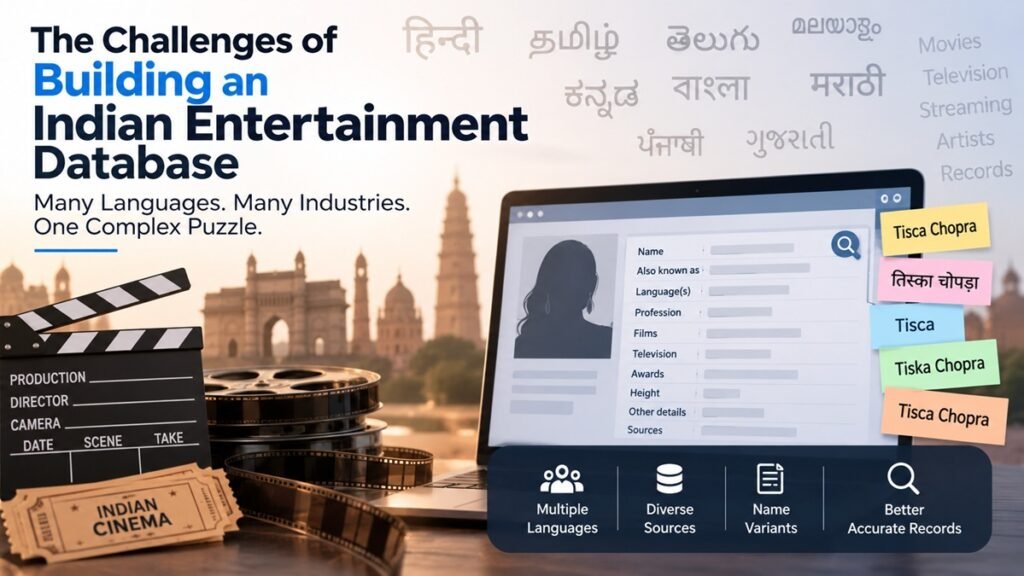
How Indian Film and Television Personalities Are Catalogued Online
Indian entertainment is not one industry. It is a dozen film industries in as many languages, plus national and regional television, plus a streaming sector that crosses all of them. Anyone building a reference database discovers quickly that the assumptions borrowed from cataloguing Hollywood do not survive contact with it.
The scale problem
India produces more feature films annually than any other country, across Hindi, Tamil, Telugu, Malayalam, Kannada, Bengali, Marathi, Punjabi, Gujarati and more. A performer may work across several, with a career that is well documented in one language’s press and nearly invisible in another’s.
The consequence for a database is uneven coverage that does not correlate with actual prominence. Someone with twenty credits in Malayalam cinema can have a thinner online record than someone with three Hindi releases, purely because of which press is indexed in English.
Names across scripts
The single hardest technical problem. A name written in Devanagari, Tamil or Bengali script has no single correct Latin transliteration, and multiple spellings circulate simultaneously — frequently including variants the person uses themselves in different contexts.
| Issue | Effect on a database |
|---|---|
| Multiple romanisations | The same person appears as several entries |
| Regional spelling conventions | Search fails unless variants are aliased |
| Initials in South Indian naming | Sorting conventions differ from surname-based systems |
| Screen names versus legal names | Two records with no obvious link |
| Post-marriage name changes | Career split across two entries |
The fix is aliasing: one canonical page and redirects from every variant. Sites that skip this end up with duplicate entries that diverge, and neither is complete.
Where reliable data actually comes from
For Indian entertainment, some of the more dependable sources include film certification records, industry association listings, award records, and streaming platform credits. Publicity biographies, on the other hand, are often copied from one another and may not always provide enough evidence for individual claims.
Physical attributes such as height and measurements are another example of information that can be difficult to verify. These details may originate from an early magazine profile and then appear repeatedly across websites without an easily traceable source. An entry for an established performer such as Tisca Chopra Feet illustrates how specialised databases can document specific details while leaving unsupported fields blank. In a reference database, leaving an unverified field empty is often more useful than filling it with an assumption.
Television is worse documented than film
Daily serials employ enormous numbers of performers across hundreds of episodes, and the credits are rarely captured anywhere systematic. A television actor with a decade of continuous work can have a smaller online footprint than a film newcomer with one release, which says nothing about either career.
What good coverage looks like
- Language and industry are recorded as fields, not inferred from the name.
- Every romanisation variant redirects to one canonical entry.
- Regional credits count equally with Hindi ones.
- Unknown fields stay blank rather than being filled with a guess.
- Sources are traceable to something other than another database.
Why it matters beyond trivia
These records are the input to search results, voice assistants and AI answers, and errors propagate into all three. A wrong birth year or a duplicated entry does not stay on the site it originated on — it becomes the answer a hundred million people are given.
For an industry this large and this poorly served by English-language indexing, the volunteer and specialist databases are frequently the only places where regional careers are recorded at all. That makes their conventions — particularly on transliteration and aliasing — worth more scrutiny than they usually get.
