
Real Plants That Naturally Glow In The Dark
Introduction
The idea of plants glowing softly in the night has charmed human imagination for centuries. While we often see artificial LED-lit planters or genetically engineered glowing trees in laboratories, the natural world also holds remarkable examples of organisms that emit light. These are known as bioluminescent organisms—living beings that produce light through biochemical reactions.
But do real plants glow in the dark naturally?
The answer is: indirectly, yes, though not all “glowing plants” are plants in the traditional sense. Many of the naturally glowing life-forms associated with forests and soil are actually fungi, which are biologically different from plants but historically grouped with them due to their appearance and environment.
This article explores real glowing organisms found in nature, why and how they glow, and whether you can grow them at home.
What Is Bioluminescence?
Bioluminescence is the production of light by a living organism through a chemical reaction. Typically, this involves:
- Luciferin (a light-producing compound)
- Luciferase (an enzyme that triggers the reaction)
- Oxygen
When these elements interact, they release energy in the form of visible light. The glow is often blue, green, or yellow, depending on the species.
Why Do Some Organisms Glow?
There are several ecological purposes for glowing in nature:
| Purpose | Description |
|---|---|
| Attracting Insects | Helps spores spread (fungi). |
| Defense Mechanism | Confuses or deters predators. |
| Communication | Used in signaling and mating (common in fireflies). |
| Decoy Strategy | Lures prey toward light in darkness. |
In glowing fungi, the glow may help insects detect and spread spores, helping reproduction.
Real Organisms That Glow in Forests (Often Mistaken as Plants)
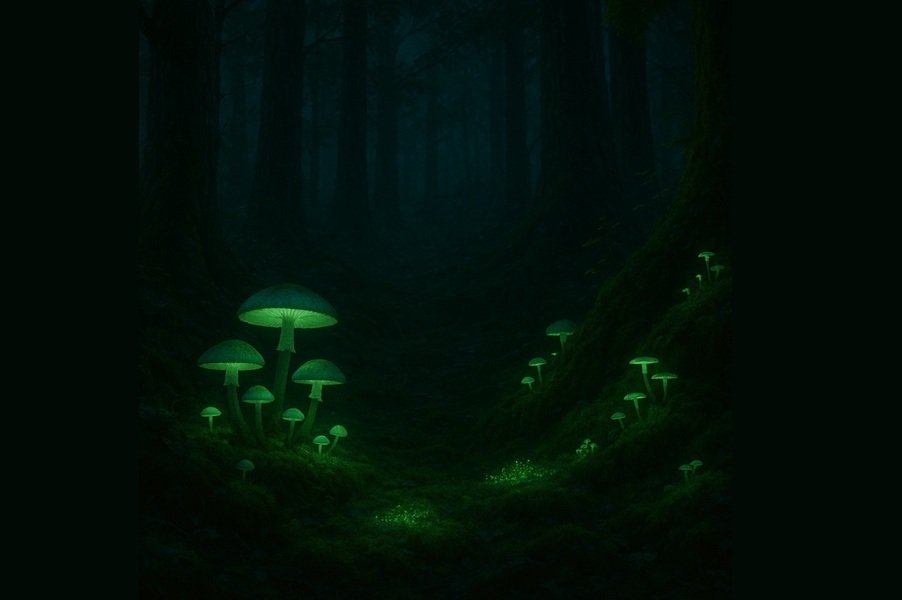
These are popularly called “Ghost Mushrooms” or “Fairy Fire Mushrooms.” They are real, naturally glowing life-forms seen in forests around the world.
1. Mycena Chlorophos
- Found in Japan, Taiwan, Brazil.
- Emits a soft green glow at night.
- Grows on decaying wood in humid forests.
- The glow is visible for several hours after dark.
2. Panellus Stipticus (The “Bitter Oyster Mushroom”)
- Found in North America, Europe, Asia.
- Emits a dim greenish light, seen best in complete darkness.
- Can be cultivated on hardwood logs or sawdust substrates.
3. Armillaria Mellea (Honey Fungus)
- Its mycelium (root-like structure) glows, not the mushroom cap.
- Creates glowing wood known as “Foxfire”.
- Observed in dense forests and moist logs.
4. Omphalotus Olearius (Jack-o’-Lantern Mushroom)
- Found in Europe, India, and North America.
- Bright orange mushroom, but its gills glow faintly green in darkness.
- Important note: This mushroom is poisonous and should not be consumed.
Plants That Glow — But With Help
Although most true plants do not naturally produce light, some exhibit glow due to the presence of symbiotic organisms like algae or fungi.
5. Glowing Phytoplankton on Shore Plants
- Coastal plants and sand dunes sometimes glow at night due to bioluminescent algae washed ashore.
- These glowing waters are seen famously in:
- Maldives
- Lakshadweep
- Vietnam
- California
6. Glowing Moss (Schistostega Pennata)
- Also known as Goblin Gold.
- Grows in caves and shaded damp environments.
- Does not produce light, but reflects any available light, appearing to glow neon green.
Can Scientists Create Real Glowing Plants?
Yes. Genetic engineering has made it possible to insert bioluminescent genes from fungi, algae, or bacteria into plant DNA.
Recent Scientific Developments:
| Year | Breakthrough | Details |
|---|---|---|
| 2010 | Glow-in-the-dark tobacco plants | Used luciferase gene from fireflies. |
| 2020 | Self-sustaining glowing houseplants | Researchers used genes from bioluminescent mushrooms. |
| 2024 | Commercial glowing plants becoming available | Small ornamental glowing plants may soon be sold worldwide. |
However, most glowing plants are still experimental and regulated.
Can You Grow Glow-in-the-Dark Organisms at Home?
Yes — if you choose glowing fungi, which are easier to cultivate than genetically modified plants.
Safe Options to Grow:
- Panellus stipticus grow kits (easily available online).
- Mycena species cultures sold by speciality mushroom suppliers.
Requirements:
- Moist, humid environment
- Decaying wood substrate
- Low-temperature and low-light area
Important:
Some glowing mushrooms are toxic. They are for display only, not consumption.
Cultural and Mythological Significance
| Culture/Region | Belief |
|---|---|
| Indian Forest Folklore | Glowing wood was believed to be forest spirits’ guiding light. |
| European Legends | Deep forests glowing at night were linked to fairies and forest guardians. |
| Japanese Mythology | Glowing mushrooms featured in ghost tales and yokai stories. |
The natural glow has influenced poetry, folk art, and storytelling for centuries.
Conclusion
The natural world is full of enchantment, and glowing organisms are some of its most magical residents. While true plants rarely glow by themselves, many fungi and bioluminescent organisms create radiant beauty in forests, caves, and shorelines.
With ongoing scientific research, we may soon see everyday ornamental houseplants glowing softly in the dark, combining nature and technology in a new form of sustainable illumination.
