
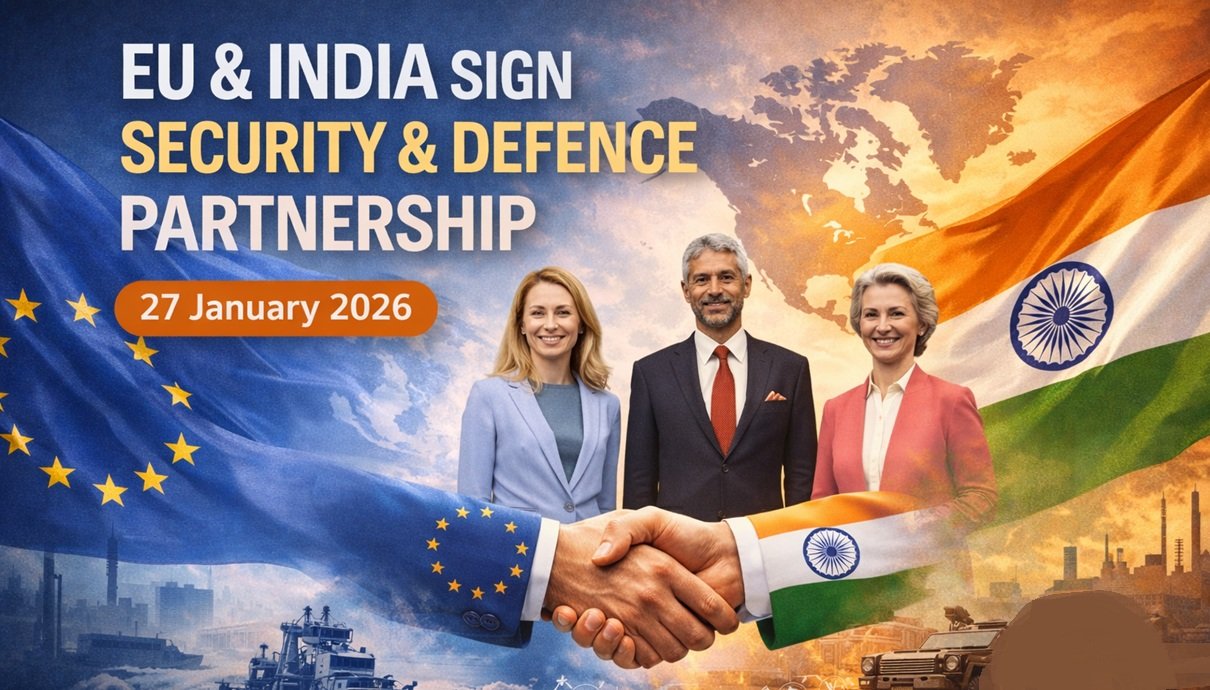
Security and Defence: EU and India Sign Landmark Security & Defence Partnership
The European Union and India have taken a decisive step forward in their strategic relationship by signing a Security and Defence Partnership on 27 January 2026, on the margins of the EU–India Summit in New Delhi.
The agreement was formally signed by Kaja Kallas, High Representative of the EU for Foreign Affairs and Security Policy / Vice-President of the European Commission, and S. Jaishankar, India’s External Affairs Minister.
This partnership marks a new chapter in EU–India relations, elevating security and defence cooperation to a structured, long-term, and action-oriented framework.
A Strategic Response to a Changing Global Environment
The EU–India Security and Defence Partnership emerges at a time of heightened geopolitical instability, evolving security threats, and rapid technological transformation. From maritime insecurity and cyber threats to terrorism and hybrid warfare, both sides face challenges that cannot be effectively addressed in isolation.
The partnership reflects:
- A shared assessment of global and regional security risks
- A commitment to deeper strategic coordination
- A recognition that security is now a core pillar of EU–India relations
It builds on decades of engagement while setting a clearer direction for future cooperation on peace, security, and defence.
Political Significance of the Agreement
Speaking at the signing ceremony, HR/VP Kaja Kallas highlighted the strategic importance of the agreement:
“The EU and India maintain a long-standing strategic partnership. With today’s signing of a new Security and Defence Partnership, we are entering a new phase of EU–India relations. Security is now a core part of our relationship.”
This statement underlines a shift from issue-based cooperation to a comprehensive strategic alignment, placing security and defence at the centre of bilateral engagement.
A Dynamic and Forward-Looking Framework
The Security and Defence Partnership establishes a comprehensive framework that defines the level of strategic ambition between the EU and India. Rather than a symbolic declaration, it is designed to deliver concrete results through regular dialogue, operational cooperation, and coordinated policy action.
The framework is:
- Forward-looking, addressing emerging and disruptive technologies
- Flexible, allowing adaptation to evolving threats
- Inclusive, covering traditional and non-traditional security domains
Importantly, it reaffirms both sides’ commitment to a rules-based international order, with the United Nations at its core.
Key Areas of Cooperation Under the Partnership
The agreement expands EU–India cooperation across a wide spectrum of security and defence domains:
Maritime Security
- Joint efforts to enhance safety and stability in the Indo-Pacific
- Counter-piracy operations and freedom of navigation
Cyber and Digital Security
- Cyber defence cooperation
- Addressing cybercrime and malicious cyber activities
Artificial Intelligence and Emerging Technologies
- Responsible use of AI in defence
- Cooperation on emerging and disruptive technologies
Hybrid Threats and Resilience
- Countering hybrid warfare tactics
- Protection of critical infrastructure
Counterterrorism
- Preventing violent extremism
- Intelligence sharing and best practices
Organised Crime
- Addressing transnational organised crime
- External dimensions of law enforcement cooperation
Space Security and Defence
- Secure and sustainable use of outer space
- Protection of space-based assets
Defence Industry and Capacity Building
- Defence initiatives, including industry-related cooperation
- Capacity building for partner countries
Peace, Training, and Human Security
- International peace and security missions
- Training, education, and consular cooperation
- Women, peace, and security initiatives
Building on Established EU–India Cooperation
The partnership does not start from scratch. It builds on existing and expanding cooperation, including:
- Joint maritime activities with EU Naval Forces (EUNAVFOR), particularly in counter-piracy operations (June 2025)
- India’s engagement with the EU’s ESIWA+ project (Enhancing Security Cooperation in and with Asia and the Indo-Pacific)
- Annual EU–India Security and Defence Consultations
- Launch of a Strategic Dialogue on Foreign and Security Policy in June 2025
- Sectoral dialogues on maritime security, cyber security, counterterrorism, and non-proliferation
The new partnership provides a single structured umbrella to coordinate and deepen these efforts.
Implementation and the Way Forward
The Security and Defence Partnership will be implemented through:
- A dedicated annual EU–India Security and Defence Dialogue
- Thematic exchanges and expert-level consultations
- Periodic reviews to assess progress and recalibrate priorities
This ensures the partnership remains results-driven, responsive to global challenges, and aligned with evolving strategic realities.
The agreement will also form an integral part of the strengthened Joint EU–India Comprehensive Strategic Agenda, reinforcing cooperation beyond defence into diplomacy, trade, technology, and global governance.
Strategic Implications
This partnership signals:
- The EU’s deeper engagement in the Indo-Pacific
- India’s growing role as a global security partner
- Greater convergence between European and Indian strategic outlooks
- A move toward multipolar security cooperation
By institutionalising defence and security cooperation, the EU and India position themselves as like-minded partners shaping regional and global stability.
Conclusion
The signing of the EU–India Security and Defence Partnership on 27 January 2026 represents a historic upgrade in bilateral relations. It transforms long-standing cooperation into a structured strategic framework capable of addressing both present and future security challenges.
As global security dynamics continue to evolve, this partnership lays the foundation for deeper trust, operational cooperation, and strategic alignment between Europe and India—making security not just a shared concern, but a shared responsibility.
