
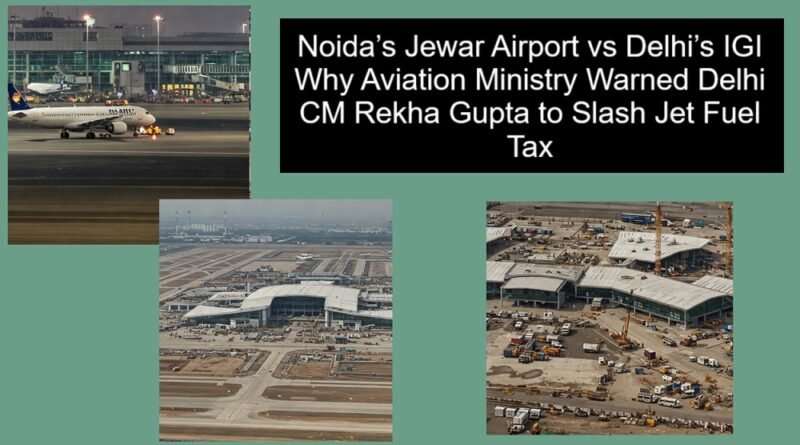
Noida’s Jewar Airport vs Delhi’s IGI: Why Aviation Ministry Warned Delhi CM Rekha Gupta to Slash Jet Fuel Tax
Introduction
The aviation landscape in the National Capital Region (NCR) is on the verge of a major transformation. With Noida International Airport at Jewar nearing its launch, a strategic pricing move by the Uttar Pradesh government has raised eyebrows—and alarm bells—in Delhi. The Union Ministry of Civil Aviation has formally urged Delhi Chief Minister Rekha Gupta to cut the Value Added Tax (VAT) on Aviation Turbine Fuel (ATF), or risk losing flights to the soon-to-be-operational Jewar airport.
The Tax Tug of War: Jewar’s Advantage
One of the biggest operational costs for airlines is jet fuel, accounting for nearly 40% of total airline expenses. In a calculated move to attract airlines, the Uttar Pradesh government slashed VAT on ATF to just 1% for Noida International Airport. In stark contrast, Delhi continues to levy a steep 25% VAT on aviation fuel.
This tax difference makes Jewar significantly more attractive for airlines, as reduced fuel costs could lead to cheaper ticket prices—up to ₹1,000–₹1,500 less per passenger. For low-cost carriers and long-haul airlines alike, the economics are clear.
Aviation Ministry’s Urgent Appeal
On March 19, 2025, Union Civil Aviation Minister Ram Mohan Naidu sent an official letter to Delhi CM Rekha Gupta, asking her to bring down Delhi’s ATF VAT from 25% to 4%.
“The higher tax rate on ATF in Delhi could shift air traffic to Noida, affecting Delhi airport’s revenues and competitiveness,” the minister stated in his letter.
The ministry’s concern stems from the fear that Indira Gandhi International (IGI) Airport could lose its status as the dominant air hub in North India if it cannot match the cost-effectiveness of Noida’s new entrant.
Industry Warnings: The Pressure is Mounting
This concern isn’t limited to the central government. Key stakeholders in the aviation ecosystem, including Delhi International Airport Limited (DIAL) and the PHD Chamber of Commerce and Industry, have also raised red flags.
They warn that unless Delhi acts soon to reduce the VAT on ATF:
- Airlines may shift operations to Noida.
- Delhi may witness reduced air traffic.
- The revenue loss for the Delhi government could be significant.
With major airlines like IndiGo, Akasa Air, Lufthansa, Swiss Air, and Singapore Airlines expressing interest in operating from Jewar, the shift is not just a possibility—it’s imminent.
Noida International Airport: Ready for Takeoff
Scheduled to open by April 2025, Noida International Airport is designed to handle 12 million passengers annually in Phase 1, with future expansion already in the pipeline. The facility promises:
- Lower operating costs for airlines
- State-of-the-art infrastructure
- Seamless connectivity to Delhi-NCR via expressways and metro
The 1% ATF VAT incentive is the cherry on top, making it one of the most cost-efficient hubs for airlines to operate in India.
The Bigger Picture: A Competitive NCR Airspace
This developing story is more than a local tax issue—it’s about the future of air travel in the Delhi-NCR region. If Delhi fails to respond competitively:
- IGI Airport’s hub status may decline.
- Passengers may prefer flying from Noida due to cheaper tickets.
- Airlines may restructure routes to reduce operational costs.
For a city that has long been the heartbeat of Indian aviation, this is a critical turning point.
Conclusion
With the clock ticking toward the launch of Noida International Airport, the pressure is mounting on the Delhi government to act. The Aviation Ministry’s warning is clear: Adapt or lose out.
Whether Delhi chooses to reduce the VAT on aviation fuel will determine not just the fate of IGI Airport, but also how the aviation balance of power shifts in Northern India.
