
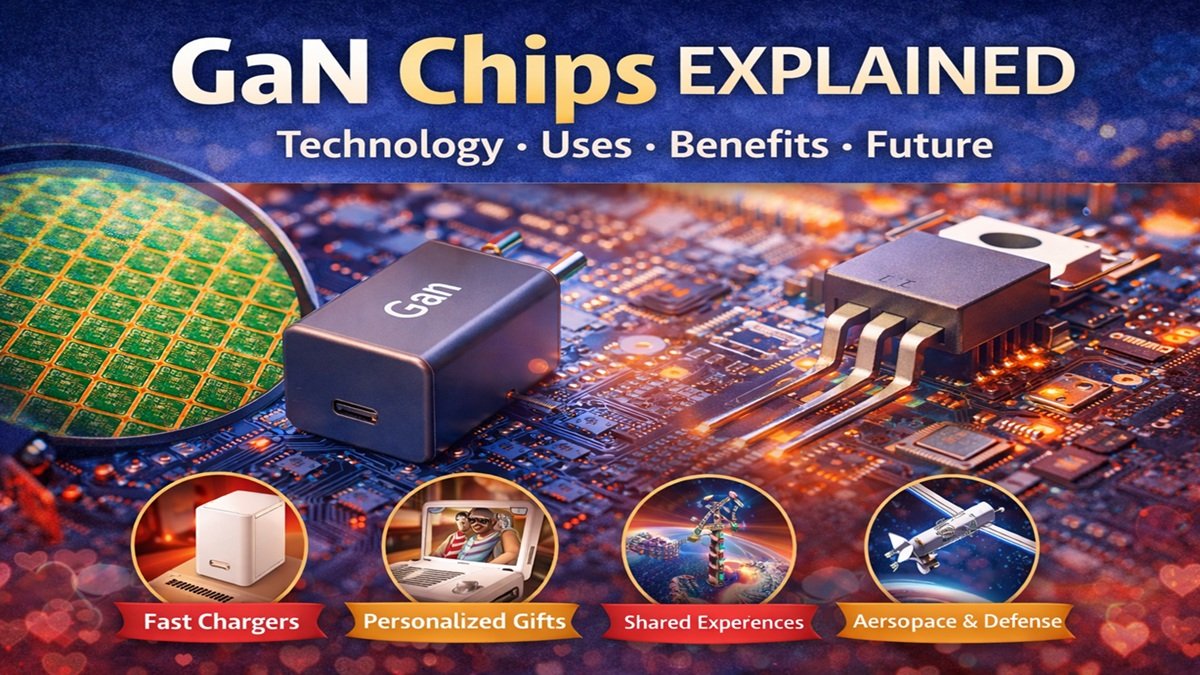
GaN Chips: A Complete Guide to Gallium Nitride Technology, Uses, Benefits, and the Future
Gallium Nitride, commonly known as GaN, is one of the most important breakthroughs in modern semiconductor technology. From ultra-fast smartphone chargers to electric vehicles, data centers, 5G networks, and space applications, GaN chips are reshaping the future of electronics.
This long-form guide explains what GaN chips are, how they work, why they are superior to silicon, where they are used, their advantages and limitations, and what the future holds for this revolutionary technology.
What Are GaN Chips?
GaN chips are semiconductor devices made using Gallium Nitride (GaN), a wide-bandgap material composed of gallium and nitrogen. Unlike traditional silicon-based chips, GaN devices can operate at:
- Higher voltages
- Higher temperatures
- Much higher switching frequencies
This makes GaN ideal for power electronics, where efficiency, size reduction, and heat management are critical.
GaN chips are most commonly used in:
- Power transistors
- Power ICs
- RF (radio frequency) devices
Why Gallium Nitride Is Different from Silicon
For decades, silicon dominated the semiconductor industry. However, silicon has physical limits. GaN overcomes many of these limitations due to its wide bandgap properties.
Key Material Differences
| Property | Silicon (Si) | Gallium Nitride (GaN) |
|---|---|---|
| Bandgap | ~1.1 eV | ~3.4 eV |
| Breakdown Voltage | Lower | Much higher |
| Switching Speed | Moderate | Extremely fast |
| Heat Resistance | Limited | Excellent |
| Power Density | Lower | Very high |
Because of these properties, GaN chips can handle more power in a smaller space, with far less energy loss.
How GaN Chips Work
GaN chips are commonly built as GaN transistors, especially High Electron Mobility Transistors (HEMTs).
Basic Working Principle
- GaN forms a special structure that allows electrons to move extremely fast
- This creates a two-dimensional electron gas (2DEG) with very low resistance
- Low resistance means:
- Less heat generation
- Higher efficiency
- Faster switching
Unlike silicon MOSFETs, GaN transistors do not need thick insulating layers, enabling ultra-compact designs.
Major Types of GaN Devices
1. GaN Power Transistors
Used in chargers, power supplies, EV inverters, and industrial power systems.
2. GaN RF Devices
Used in:
- 5G base stations
- Radar systems
- Satellite communication
- Defense electronics
3. GaN Power ICs
Integrate multiple power components on a single chip, reducing size and complexity.
Applications of GaN Chips
1. Fast Chargers & Consumer Electronics
GaN chargers are:
- Smaller
- Lighter
- More efficient
A GaN charger can deliver higher power output (65W, 100W, or more) in a compact size compared to silicon chargers.
Common products:
- Smartphone chargers
- Laptop adapters
- Power banks
2. Electric Vehicles (EVs)
GaN chips play a critical role in:
- On-board chargers
- DC-DC converters
- Inverters
Benefits for EVs:
- Faster charging
- Longer driving range
- Reduced system weight
- Improved energy efficiency
3. Data Centers & Cloud Infrastructure
Data centers demand:
- High efficiency
- Minimal power loss
- Lower cooling costs
GaN power supplies reduce:
- Electricity consumption
- Heat generation
- Physical footprint of power units
This leads to massive energy savings at scale.
4. 5G & Telecommunications
GaN RF devices are ideal for:
- High-frequency operation
- High-power amplification
They are widely used in:
- 5G base stations
- Microwave transmitters
- Wireless backhaul systems
5. Aerospace & Defense
GaN chips operate reliably in:
- Extreme temperatures
- High radiation environments
Applications include:
- Radar systems
- Satellite communication
- Electronic warfare equipment
Advantages of GaN Chips
1. Higher Efficiency
Less energy is wasted as heat, improving overall system performance.
2. Smaller Size
High power density allows designers to reduce component size drastically.
3. Faster Switching Speed
Enables high-frequency operation, improving power conversion efficiency.
4. Better Thermal Performance
GaN can tolerate higher temperatures without degradation.
5. Lower System Cost (Long Term)
Although GaN chips are expensive individually, they reduce:
- Cooling systems
- Passive components
- Overall system complexity
Limitations and Challenges of GaN Technology
Despite its advantages, GaN still faces some challenges:
1. Higher Initial Cost
GaN wafers and manufacturing processes are more expensive than silicon.
2. Manufacturing Complexity
GaN is often grown on:
- Silicon substrates
- Silicon carbide (SiC)
This increases fabrication difficulty.
3. Design Learning Curve
Engineers must redesign circuits to fully exploit GaN’s fast switching.
4. Reliability Perception
Although reliability has improved significantly, conservative industries still require long-term validation.
GaN vs SiC (Silicon Carbide)
Both GaN and SiC are wide-bandgap semiconductors, but they serve different roles.
| Feature | GaN | SiC |
|---|---|---|
| Best for | High-frequency, low-to-medium voltage | High-voltage, high-power |
| Voltage Range | Up to ~650V | 1200V+ |
| Switching Speed | Extremely fast | Fast |
| Typical Use | Chargers, RF, telecom | EV traction, power grids |
In many systems, GaN and SiC complement each other rather than compete.
GaN Chips in India and Global Market
Globally, GaN adoption is accelerating due to:
- EV expansion
- Renewable energy growth
- 5G deployment
- Compact consumer electronics
In India, GaN technology is gaining traction in:
- Power adapters
- Defense electronics
- Research institutions
- EV infrastructure
With government focus on semiconductor self-reliance, GaN is expected to play a major role.
Future of GaN Chips
The future of GaN technology looks extremely promising:
- Wider adoption in consumer electronics
- Cost reduction due to mass production
- Integration into AI and edge computing hardware
- Expansion into renewable energy systems
- Increased use in space and defense missions
As silicon approaches its physical limits, GaN represents the next major leap in semiconductor evolution.
Conclusion
GaN chips are not just an upgrade—they are a paradigm shift in electronics. By delivering higher efficiency, faster switching, compact size, and superior thermal performance, Gallium Nitride is redefining how power and high-frequency systems are designed.
From your smartphone charger to electric vehicles and satellite systems, GaN is quietly powering the future.
As manufacturing scales and costs fall, GaN chips are expected to become as common—and as essential—as silicon is today.
