
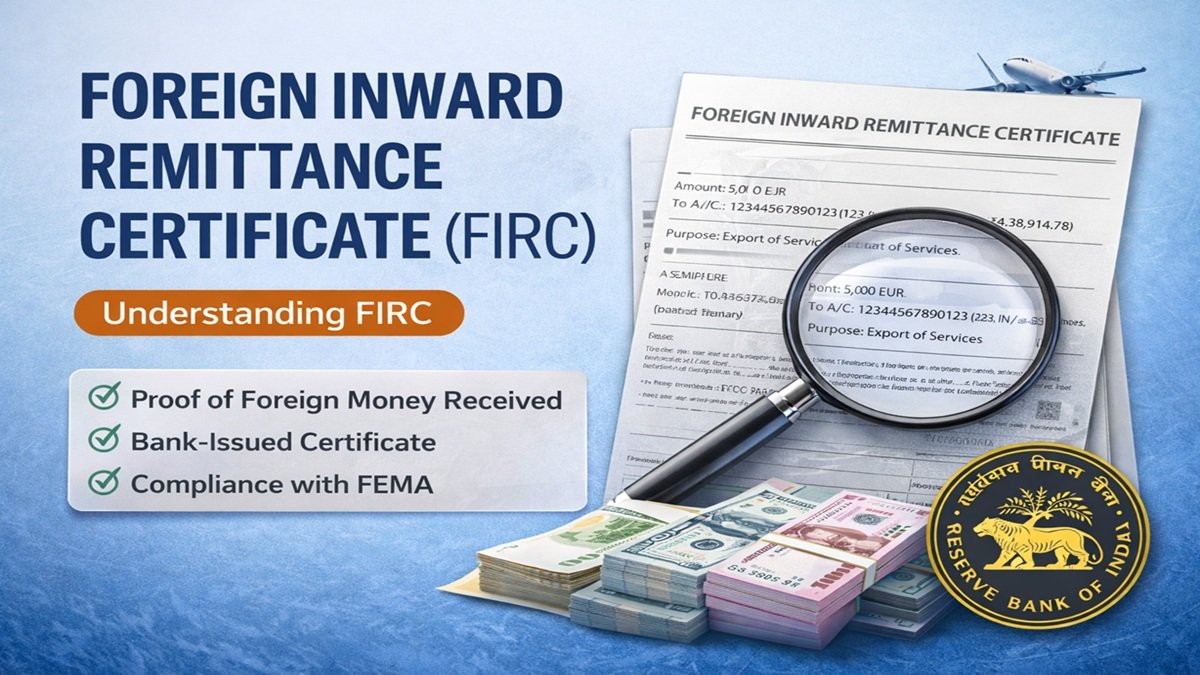
What Is a Foreign Inward Remittance Certificate (FIRC)? A Complete, Practical Guide
Meta description: A Foreign Inward Remittance Certificate (FIRC) is an official document issued by Indian banks as proof of foreign money received from abroad. This detailed guide explains meaning, purpose, eligibility, online FIRC, RBI rules, GST, exports, freelancers, startups, and common mistakes.
Introduction
Whenever money comes into India from a foreign country—whether for exports, freelancing, investments, loans, or services—the government needs a verifiable record of that inflow. This is where the Foreign Inward Remittance Certificate (FIRC) becomes crucial.
An FIRC is not just a banking formality; it is a legal and regulatory proof that foreign exchange has entered India through authorised banking channels in compliance with Indian foreign exchange laws.
For exporters, freelancers, startups, and companies receiving overseas payments, FIRC is often mandatory for taxation, GST compliance, FEMA reporting, and incentives.
What Is a Foreign Inward Remittance Certificate (FIRC)?
A Foreign Inward Remittance Certificate (FIRC) is an official certificate issued by an Authorised Dealer (AD) bank in India confirming that a specified amount of foreign currency has been received from outside India and credited to an Indian bank account.
It acts as documentary evidence that:
- The funds originated outside India
- The remittance complied with foreign exchange regulations
- The purpose of remittance is declared and recorded
FIRC is issued under the regulatory framework of Reserve Bank of India and governed by FEMA provisions.
Legal Framework Governing FIRC in India
FIRC operates under the following laws and regulations:
1. FEMA, 1999
The Foreign Exchange Management Act (FEMA) regulates all cross-border foreign exchange transactions in India. FIRC serves as proof of FEMA-compliant inflow.
2. RBI Master Directions
The Reserve Bank of India issues master directions to Authorised Dealer banks specifying:
- Reporting requirements
- Purpose codes
- Documentation norms
3. GST & Income Tax Laws
FIRC is often required to:
- Claim GST export benefits
- Justify foreign income during income tax assessments
Who Issues an FIRC?
An FIRC is issued by:
- Authorised Dealer Category–I Banks
- Indian banks receiving the foreign remittance
- Banks where the recipient maintains the account
Only RBI-authorised banks can issue valid FIRCs.
Who Needs an FIRC?
You may need an FIRC if you are:
Exporters
- Goods exporters
- Service exporters
- Software & IT service companies
Freelancers & Consultants
- Receiving payments from foreign clients
- Claiming GST export exemption
Startups & Companies
- Receiving foreign investment
- Getting overseas service income
- Raising funds from abroad
Individuals
- Receiving foreign gifts or inheritances
- Foreign pensions or salaries
Why Is FIRC Important?
1. Proof of Foreign Income
FIRC confirms that income was earned in foreign currency and repatriated legally.
2. GST Compliance
For export of services, FIRC is essential to:
- Prove receipt in convertible foreign exchange
- Claim zero-rated GST supply
3. FEMA Compliance
It protects recipients from penalties under FEMA for unreported inflows.
4. Tax Assessments
Income Tax authorities may ask for FIRC to:
- Verify foreign earnings
- Validate exemptions or deductions
5. Government Incentives
FIRC is required to claim:
- Export incentives
- Duty drawback
- Remission schemes
Information Contained in an FIRC
A standard FIRC includes:
- Name and address of beneficiary
- Bank reference number
- Amount received (foreign currency + INR equivalent)
- Date of receipt
- Remitting country
- Purpose code
- Mode of remittance
- Sender details
Purpose Codes in FIRC (Very Important)
Each FIRC carries a purpose code, which defines the nature of remittance.
Common examples:
- P0101 – Export of goods
- P0802 – Software services
- P0806 – Business consultancy
- P1301 – Equity investment
- P1401 – Loan receipt
Incorrect purpose codes can cause:
- GST rejection
- FEMA scrutiny
- Compliance issues
Types of FIRC
1. Physical FIRC
- Issued on bank letterhead
- Signed and stamped
- Traditionally used earlier
2. e-FIRC (Electronic FIRC)
- Digitally generated
- Issued via bank portal or email
- Now widely accepted
Most banks have shifted to e-FIRC after RBI’s digital reporting push.
How to Apply for an FIRC (Step-by-Step)
Step 1: Receive Foreign Remittance
Funds must come through:
- SWIFT transfer
- International wire
- Approved payment gateways
Step 2: Check Bank Credit Advice
Verify foreign currency details and purpose code.
Step 3: Apply to Your Bank
- Online banking portal
- Branch request
- Email request (bank-specific format)
Step 4: Pay Applicable Charges
Banks may charge:
- ₹500 – ₹2,000 per FIRC (varies by bank)
Step 5: Receive FIRC
- PDF (e-FIRC)
- Physical copy (on request)
FIRC vs Bank Realisation Certificate (BRC)
| Aspect | FIRC | BRC |
|---|---|---|
| Issued by | Bank | Bank |
| Purpose | Proof of foreign remittance | Proof of export realisation |
| Used for | FEMA, GST, tax | DGFT, export incentives |
| Mandatory | Often yes | Export-specific |
For exporters, both may be required.
FIRC for Freelancers & Service Exporters
Freelancers exporting services must meet these GST conditions:
- Supplier in India
- Recipient outside India
- Payment in convertible foreign exchange
- Place of supply outside India
FIRC is proof of condition #3.
Without FIRC:
- GST exemption may be denied
- 18% GST liability may arise
Common Mistakes to Avoid
- Not requesting FIRC immediately
- Wrong purpose code selection
- Assuming bank statement is enough
- Ignoring e-FIRC availability
- Losing old FIRCs (keep backups)
Is FIRC Mandatory in All Cases?
Legally, RBI does not mandate FIRC for every inflow, but:
- GST law
- Export regulations
- Tax authorities
often require it in practice.
So, operationally, FIRC is treated as essential.
How Long Does It Take to Get an FIRC?
- Online banks: 1–3 working days
- PSU banks: 3–7 working days
- Manual cases: up to 10 days
Validity of FIRC
- No formal expiry
- Must match transaction date
- Should be preserved for 8 years (tax record best practice)
Conclusion
The Foreign Inward Remittance Certificate (FIRC) is a cornerstone document in India’s foreign exchange compliance system. Whether you are a freelancer earning from abroad, a startup raising foreign funds, or an exporter claiming benefits, FIRC acts as legal proof, tax shield, and regulatory safeguard.
In an era of increasing scrutiny under FEMA, GST, and income tax laws, treating FIRC as an optional document can lead to serious compliance risks. Obtaining it on time, with correct purpose codes, is not just good practice—it is essential financial hygiene.
