

What is a Basis Point (BPS)?
A Basis Point (BPS) is a unit of measurement used in finance to express changes in interest rates, bond yields, and other percentages. One basis point is equal to one-hundredth of a percentage point or 0.01%. This small unit of measure is widely used in financial markets to describe small variations in rates and yields with precision.
Key Definition
1 Basis Point = 0.01%
100 Basis Points = 1%
For example:
- A change from 2.00% to 2.25% is an increase of 25 basis points.
- A decrease from 3.50% to 3.25% is a reduction of 25 basis points.
Why Use Basis Points?
In financial markets, even small changes in rates or yields can have significant implications, particularly when dealing with large sums of money. Basis points provide a clear and standardized way to discuss these small changes, avoiding confusion.
For instance:
- Instead of saying, “The interest rate increased by 0.10 percentage points,” it’s more precise to say, “The interest rate increased by 10 basis points.”
- In bond markets, where yield changes are often minute, basis points offer greater clarity than percentages.
Applications of Basis Points
- Interest Rates:
Central banks often use basis points to communicate changes in benchmark interest rates. For example, if the Reserve Bank of India (RBI) raises the repo rate by 50 basis points, it means the rate increased by 0.50%. - Bond Yields:
Basis points are crucial in bond markets, where yield changes are expressed in BPS. For instance, if a bond’s yield increases from 2.75% to 3.00%, this is described as a 25 basis point rise. - Loan and Mortgage Rates:
Banks often adjust lending and mortgage rates in increments of basis points. For instance, a 10 BPS increase in a mortgage rate corresponds to a 0.10% rise in interest. - Financial Spreads:
Basis points are used to describe the difference (spread) between two rates. For example, if a corporate bond yields 4.50% and a government bond yields 4.00%, the spread is 50 basis points.
How to Convert Basis Points to Percentages
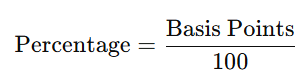
To convert basis points to percentages, divide the number of basis points by 100.
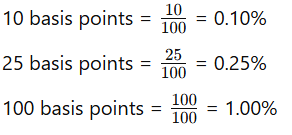
Examples:
To convert percentages to basis points, multiply the percentage by 100.

Examples:
- 0.05% = 0.05×1000.05 \times 100 = 5 basis points
- 1.25% = 1.25×1001.25 \times 100 = 125 basis points
Advantages of Using Basis Points
- Precision: Basis points provide a precise way to express small changes in rates and yields, especially in markets where even minor shifts matter.
- Standardization: The use of basis points eliminates ambiguity when discussing changes in percentages.
- Universality: Basis points are widely understood and accepted across financial industries, from banking to fixed-income markets.
Practical Examples
- Central Bank Policy:
If a central bank cuts its key interest rate from 6.00% to 5.75%, this is referred to as a 25 basis point reduction. - Bond Yields:
A corporate bond’s yield moves from 4.10% to 4.50%. The increase is 4.50%−4.10%=0.40%4.50\% – 4.10\% = 0.40\%, or 40 basis points. - Loan Rates:
A bank increases its home loan rate from 8.25% to 8.35%. The change is 8.35%−8.25%=0.10%8.35\% – 8.25\% = 0.10\%, or 10 basis points.
Common Uses in Financial Discussions
- Spreads: Investors may compare the yield spread between government bonds and corporate bonds using basis points. For example, a spread of 150 basis points means a corporate bond offers a 1.50% higher yield than a government bond.
- Fees and Commissions: Financial institutions often express fees or expense ratios in basis points. For instance, a mutual fund may have an expense ratio of 50 basis points (0.50%).
Limitations of Basis Points
- Complexity for Beginners: The concept of basis points can initially confuse those unfamiliar with financial terminology.
- Relatively Small Measure: Basis points are most useful for small changes; larger movements in percentages may not require such granularity.
Conclusion
Basis points (BPS) are an indispensable tool in the world of finance, providing precision and clarity when discussing small percentage changes in interest rates, bond yields, and financial spreads. They are especially critical in fixed-income markets, central bank policy announcements, and discussions of financial fees. Understanding basis points is essential for anyone involved in investing, banking, or financial analysis.
