
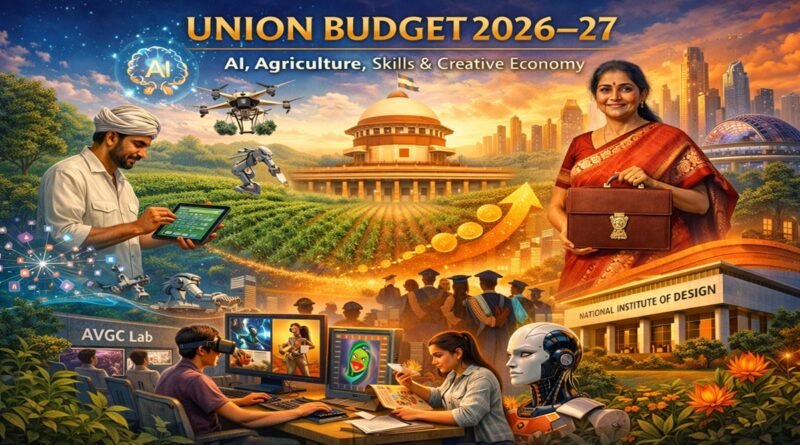
Union Budget 2026–27: AI, Agriculture, Skills and the Orange Economy as Pillars of India’s Next Growth Phase
Posted On: 01 FEB 2026, 12:59 PM
Source: PIB
The Union Budget 2026–27, presented in Parliament by Nirmala Sitharaman, marks a decisive shift in India’s development narrative—placing emerging technologies, artificial intelligence (AI), and human capital at the core of inclusive and sustainable growth. Anchored in the vision of kartavya (duty), the Budget underlines the government’s resolve to fulfil the aspirations of common citizens while strengthening their capacity to become equal partners in India’s journey towards prosperity.
At the heart of this approach lies a clear acknowledgement: technology adoption must benefit everyone—farmers seeking productivity and risk reduction, women in STEM, youth aspiring to upskill for future jobs, and Divyangjan accessing new economic opportunities. Against this backdrop, the Budget outlines a series of interconnected initiatives spanning agriculture, education, employment, design, and the fast-expanding Orange Economy.
Emerging Technologies as Instruments of Inclusive Growth
The Budget identifies AI and frontier technologies as catalytic enablers of India’s second kartavya: building capabilities that empower citizens rather than displace them. This intent is reflected in sustained support to national missions and funding mechanisms, including:
- The AI Mission, aimed at scaling responsible and indigenous AI solutions
- The National Quantum Mission, positioning India in next-generation computing and communications
- The Anusandhan National Research Fund, to deepen research excellence
- The Research, Development and Innovation (RDI) Fund, supporting translational and industry-linked innovation
Together, these initiatives signal a long-term strategy: India is not merely consuming advanced technologies but actively shaping, governing, and deploying them for social and economic transformation.
Bharat-VISTAAR: AI-Led Transformation of Indian Agriculture
A Multilingual Digital Backbone for Farmers
One of the most transformative announcements in the Union Budget 2026–27 is Bharat-VISTAAR (Virtually Integrated System to Access Agricultural Resources)—a multilingual AI-powered platform designed to modernize Indian agriculture at scale.
Bharat-VISTAAR proposes to integrate:
- AgriStack portals, which house digitized farmer and land data
- Agricultural practice packages of the Indian Council of Agricultural Research (ICAR)
- Advanced AI systems capable of contextual analysis and personalized advisories
Enhancing Productivity, Decisions, and Risk Management
The core objective of Bharat-VISTAAR is threefold:
- Enhancing farm productivity
By combining localized agronomic data with AI-driven insights, farmers can receive precise recommendations on crop selection, sowing cycles, irrigation schedules, and input optimization. - Improving farmer decision-making
Multilingual, customized advisories ensure that even small and marginal farmers—often excluded from digital tools due to language or complexity—can make informed, data-backed choices. - Reducing agricultural risk
Through predictive analytics, weather intelligence, pest and disease alerts, and market-linked advisories, Bharat-VISTAAR aims to reduce income volatility and climate-related shocks.
In essence, the platform envisions AI not as a distant, abstract technology but as a trusted digital companion for farmers—bridging knowledge gaps and democratizing access to scientific expertise.
AVGC Content Creator Labs: Fueling India’s Orange Economy
A Sector Poised for Explosive Growth
Recognizing the strategic importance of creative industries, the Budget places strong emphasis on India’s Animation, Visual Effects, Gaming and Comics (AVGC) sector—an integral component of the Orange Economy.
The AVGC industry is projected to require nearly 2 million professionals by 2030, driven by global demand for digital content, immersive entertainment, gaming, virtual production, and metaverse applications.
Nationwide Creative Infrastructure in Schools and Colleges
To build a future-ready talent pipeline, the Union Budget proposes:
- AVGC Content Creator Labs in 15,000 secondary schools
- AVGC Content Creator Labs in 500 colleges
These labs will be set up with the support of the Indian Institute of Creative Technologies, Mumbai, ensuring industry-aligned training and exposure.
Long-Term Impact
This initiative goes beyond job creation:
- It integrates creativity with technology at the school level
- Encourages early experimentation with animation, gaming, and digital storytelling
- Positions India as a global content creation hub, not merely an outsourcing destination
By embedding AVGC education into mainstream learning, the Budget strengthens India’s cultural soft power while unlocking new economic value.
Education to Employment and Enterprise: Preparing for an AI-Driven Job Market
Anticipating Disruption, Designing Solutions
The Budget candidly acknowledges that AI and emerging technologies will reshape job roles, skill requirements, and career pathways. Rather than reacting late, it proposes a proactive institutional mechanism—a High-Powered ‘Education to Employment and Enterprise’ Standing Committee.
Mandate of the Standing Committee
The Committee will:
- Assess the impact of AI and emerging technologies on employment
- Identify evolving skill requirements across sectors
- Recommend policy, curriculum, and training reforms
- Bridge gaps between education systems, industry needs, and entrepreneurial opportunities
This approach reflects a strategic shift from static education models to dynamic, future-facing skill ecosystems, ensuring that India’s demographic dividend remains an asset in the AI era.
New National Institute of Design: Strengthening Eastern India’s Creative Capacity
Design as an Economic Multiplier
Design today sits at the intersection of manufacturing, services, digital products, sustainability, and user experience. Acknowledging the rapid expansion of India’s design industry, the Budget proposes the establishment of a new National Institute of Design (NID) in Eastern India.
Regional Balance and Innovation
The new institute will:
- Boost access to high-quality design education in the eastern region
- Support regional industries, crafts, and MSMEs with design-led innovation
- Strengthen India’s global competitiveness in product and service design
This move aligns with the broader objective of balanced regional development, ensuring that creative and knowledge institutions are not geographically concentrated.
A Coherent Vision: Technology with Purpose
What distinguishes the Union Budget 2026–27 is not just the scale of announcements but their interconnected logic:
- AI in agriculture (Bharat-VISTAAR) strengthens rural incomes
- AVGC labs and design institutes expand creative and digital livelihoods
- The Education-to-Employment Committee ensures workforce readiness
- National missions and research funds provide long-term technological depth
Together, these initiatives reflect a vision where technology is inclusive, human-centric, and development-oriented—serving farmers, creators, students, researchers, and entrepreneurs alike.
Conclusion
The Union Budget 2026–27 positions India at a critical inflection point—where artificial intelligence, creativity, and human capital converge to shape the next phase of national growth. From AI-powered farms to AVGC-enabled classrooms, and from design institutions to forward-looking employment frameworks, the Budget lays down a roadmap for a resilient, skilled, and aspirational India.
By aligning innovation with inclusivity, and technology with purpose, the Budget reinforces the idea that India’s path to prosperity will be built not just on algorithms and infrastructure, but on empowered citizens equipped for the future.
