
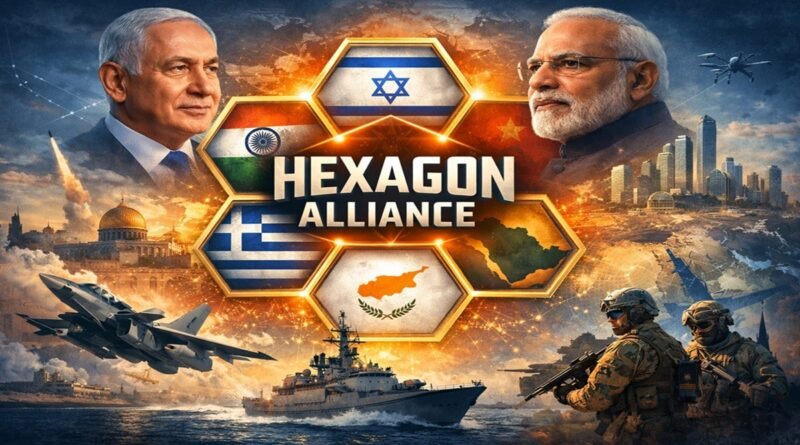
The Hexagon Alliance: Israel’s Strategic Gamble and India’s Calculated Entry into a New Geopolitical Order
Introduction: A New Axis in a Fractured World
In a world already divided by competing power blocs, war zones, economic corridors, and technological rivalries, Israeli Prime Minister Benjamin Netanyahu’s proposal of a “Hexagon Alliance” has sparked intense debate. Is this the birth of a new regional security architecture? Or is it a diplomatic branding exercise designed to reposition Israel after months of geopolitical turbulence?
The proposed framework — reportedly involving Israel, India, Greece, Cyprus, and potentially other Arab, African, and Asian states — signals something larger than a simple partnership. It reflects an emerging realignment in West Asia, the Mediterranean, and parts of the Indo-Pacific.
At its core, the Hexagon Alliance appears to be Israel’s attempt to construct a structured network of like-minded states capable of countering regional threats, reshaping trade routes, and redefining security cooperation beyond traditional Western-led systems.
But alliances are rarely just about defense. They are about power projection, economic leverage, and shaping narratives. And in this proposed hexagon, each country has its own calculations.
Background: Why Now?
The announcement of the Hexagon Alliance does not come in isolation. It emerges from a dramatically altered geopolitical landscape:
- The Gaza conflict reshaped Israel’s regional standing.
- Iran and its proxy networks remain deeply entrenched across Lebanon, Syria, Iraq, and Yemen.
- Red Sea shipping routes have faced disruption.
- Saudi Arabia and Egypt are exploring alternative land-bridge trade routes.
- India is strengthening its West Asia engagement.
- China and the United States are competing for strategic influence in global corridors.
Israel, facing both military and diplomatic pressure, appears to be transitioning from reactive security posture to proactive alliance-building.
Rather than relying solely on traditional Western backing, Israel seems to be building a diversified security and economic ecosystem — one that connects the Mediterranean to South Asia.
The Hexagon concept reflects that ambition.
Country-Wise Roles: Who Gains What?
Israel: Architect of Strategic Containment
For Israel, the Hexagon Alliance serves multiple strategic purposes.
1. Countering Iran’s Network
Israel’s foremost concern remains Iran and its allied armed groups — Hezbollah in Lebanon, Hamas in Gaza, and the Houthis in Yemen. By forming a multi-country security framework, Israel seeks:
- Intelligence sharing
- Coordinated maritime monitoring
- Strategic depth beyond its borders
- Diplomatic insulation from isolation
Instead of confronting adversaries alone, Israel aims to embed itself in a web of cooperative security relationships.
2. Breaking Diplomatic Isolation
The Gaza war intensified criticism of Israel in parts of the Global South. Building an alliance with India, Greece, and other states helps counter narratives of isolation.
It projects strength — not vulnerability.
3. Securing Economic Corridors
Israel’s strategic geography makes it a potential gateway between Asia and Europe. However, alternative trade routes (especially Saudi-Egyptian projects) could bypass Israeli territory.
An alliance with India strengthens Israel’s relevance in future connectivity corridors.
India: Strategic Autonomy Meets Selective Alignment
India’s participation is perhaps the most significant and most complex element of the Hexagon concept.
India is not a country that joins military blocs lightly. Its foreign policy has historically prioritized strategic autonomy — balancing relationships with:
- The United States
- Russia
- Iran
- Gulf nations
- Israel
Why India Is Interested
- Defense Cooperation
Israel is one of India’s largest defense technology suppliers — including drones, missile systems, and surveillance equipment. - Technology & Innovation
Cooperation in AI, cybersecurity, water management, agriculture, and quantum computing strengthens India’s modernization agenda. - Energy Security
Stability in West Asia directly impacts India’s oil supply and diaspora interests. - Connectivity Projects
Initiatives like the India–Middle East–Europe corridor depend on secure regional partnerships.
Why India Will Move Carefully
India also maintains ties with Iran and Arab nations. It cannot afford to be seen as part of an explicitly anti-Iran or anti-Muslim bloc.
Thus, India’s likely approach:
- Support economic and technological cooperation
- Engage in intelligence and defense dialogues
- Avoid formal military commitments
India’s participation may be pragmatic rather than ideological.
Greece and Cyprus: Mediterranean Strategic Anchors
At first glance, Greece and Cyprus might seem like peripheral players. In reality, they are critical nodes in the Eastern Mediterranean.
Greece
- NATO member
- Strong naval capabilities
- Ongoing tensions with Turkey
- Energy exploration interests in the Mediterranean
Alignment with Israel strengthens Greece’s regional positioning.
Cyprus
- Key island geography
- Port and maritime access advantages
- Growing cooperation with Israel in energy projects
Together, Greece and Cyprus provide Israel with:
- European connectivity
- Maritime strategic depth
- Energy corridor options
They anchor the western flank of the Hexagon.
Arab, African, and Asian States: The Uncertain Ring
The broader composition of the Hexagon remains fluid.
Potential involvement from Gulf nations, African states like Ethiopia, and possibly Asian partners reflects Israel’s desire to expand outward.
However, participation will depend on:
- Domestic political sensitivities
- Public opinion on Israel
- Relations with Iran
- Economic calculations
Some countries may engage quietly without public endorsement.
Geopolitical Implications: A New Bloc or a Branding Strategy?
The big question remains:
Is the Hexagon Alliance a new NATO-style security bloc?
Or is it a flexible diplomatic umbrella?
Scenario 1: Formalized Security Bloc
If institutionalized, the alliance could include:
- Joint military exercises
- Coordinated missile defense systems
- Maritime patrol frameworks
- Intelligence fusion centers
This would significantly alter regional power balances.
Scenario 2: Strategic Networking Platform
More likely, at least in the near term, is a looser model:
- Technology partnerships
- Defense procurement networks
- Infrastructure coordination
- Political alignment in global forums
This model would avoid triggering overt regional backlash.
Reactions from Rival States
The proposal has not gone unnoticed.
- Pakistan has expressed concerns about anti-Muslim bloc formation.
- Iran would interpret such an alliance as containment.
- Turkey may see Greece–Israel alignment as strategic encirclement.
- China may view expanded India–Israel cooperation through a competitive lens.
The alliance could therefore deepen polarization in an already tense environment.
Post-Gaza War Realignment
The Gaza conflict accelerated geopolitical repositioning.
Countries are recalibrating:
- Saudi Arabia balancing normalization talks
- Egypt reinforcing strategic corridors
- India expanding West Asia engagement
- US reinforcing deterrence presence
The Hexagon fits into this larger reshuffling.
It is less about immediate war coordination and more about long-term structural positioning.
Economic Dimensions: Trade Routes and Strategic Geography
Control over trade routes has always defined power.
With Red Sea instability and alternative land-bridge projects under discussion, Israel seeks to ensure it remains indispensable in Asia–Europe connectivity.
India’s participation increases the weight of such corridors.
This transforms the alliance from purely security-focused to geo-economic.
Is the Hexagon Sustainable?
The strength of alliances depends on:
- Shared threat perception
- Institutional commitment
- Economic interdependence
- Political stability
The Hexagon currently rests heavily on shared strategic concern about Iran and regional instability.
But without formal treaties, it remains vulnerable to political change.
India’s cautious diplomacy, Arab sensitivities, and European balancing will shape its trajectory.
Conclusion: A Strategic Experiment in a Multipolar Age
The Hexagon Alliance represents more than a diplomatic headline. It reflects a broader truth about our era:
Power is increasingly networked, not centralized.
Israel is attempting to build a security and economic network that extends beyond its immediate borders. India is exploring how far it can engage without compromising its autonomy. Greece and Cyprus see opportunity in alignment. Other states are watching carefully.
Whether the Hexagon becomes a structured alliance or remains a symbolic framework depends on events yet to unfold — Iran’s actions, Gulf politics, India’s calculus, and global power rivalries.
For now, it is best understood as a strategic experiment — an attempt to redraw regional alignments in a rapidly shifting world.
In geopolitics, new shapes often emerge before they solidify.
The Hexagon may be one such shape — still forming, still uncertain, but undeniably significant.
