
Indian Local New Year vs Happy New Year 2026: Traditions, Meanings, and Cultural Differences Explained
As the calendar turns from December 31 to January 1, the world celebrates Happy New Year 2026 with fireworks, parties, and countdowns. In India too, January 1 is widely observed as the start of a new year in urban life, offices, schools, and global interactions.
However, India is a land of multiple New Years. Long before the Gregorian calendar became common, different regions of India marked the beginning of the year based on local calendars, seasons, agriculture, and astronomy. These traditional celebrations are known as Indian local or regional New Years.
This article takes a deep, comparative look at Indian Local New Years vs Happy New Year 2026, exploring how they differ in origin, meaning, rituals, and cultural significance — and why both continue to coexist in modern India.
What Is “Happy New Year 2026”?
Happy New Year 2026 refers to the beginning of the year according to the Gregorian calendar, which is used internationally for civil, official, and global purposes.
Key Features of January 1 New Year
- Follows the Gregorian calendar
- Celebrated worldwide at midnight on January 1
- Associated with:
- Countdown celebrations
- Fireworks and parties
- Resolutions and goal-setting
- Widely observed in:
- Offices and institutions
- Schools and colleges
- Media, tourism, and global communication
In India, January 1 is a social and global celebration, especially in cities, workplaces, and among the younger generation.
What Is Indian Local or Regional New Year?
Indian local New Years are based on traditional calendars, such as:
- Hindu lunisolar calendars
- Solar calendars
- Regional almanacs (Panchang)
These New Years usually mark:
- Seasonal transitions
- Agricultural cycles
- Astrological events, especially the Sun’s movement
Each region celebrates its New Year at a different time, often with deep religious and cultural rituals.
Major Indian Local New Years Across Regions
India does not have a single traditional New Year. Instead, different regions celebrate their own.
Examples of Indian Local New Years
- Ugadi – Andhra Pradesh, Telangana, Karnataka
- Gudi Padwa – Maharashtra, Goa
- Vishu – Kerala
- Puthandu – Tamil Nadu
- Poila Boishakh – West Bengal
- Baisakhi – Punjab
- Bohag Bihu – Assam
- Navreh – Kashmir
- Losar – Ladakh and Himalayan regions
Most of these fall between March and April, though some occur in other months.
Calendar Difference: Why the Dates Are Not the Same
The biggest difference lies in the calendar system.
Happy New Year (January 1)
- Fixed date
- Based on Earth’s revolution around the Sun
- Uniform across the world
Indian Local New Years
- Based on:
- Solar movement (Sun entering a zodiac sign)
- Lunar phases
- Agricultural timing
- Dates change every year according to the Panchang
This is why Indian New Years do not fall on January 1 and vary regionally.
Difference in Purpose and Meaning
Meaning of Happy New Year 2026
- Symbolises a global reset
- Focuses on:
- Personal goals
- Career plans
- Lifestyle changes
- More social and celebratory in nature
Meaning of Indian Local New Year
- Rooted in:
- Spiritual renewal
- Gratitude to nature
- Seasonal balance
- Closely linked with:
- Farming cycles
- Community rituals
- Religious observances
Indian local New Years are less about parties and more about harmony, discipline, and blessings.
Celebration Style: Modern vs Traditional
How Happy New Year 2026 Is Celebrated
- Midnight countdowns
- Fireworks and concerts
- Parties, travel, social media wishes
- Focus on fun and entertainment
How Indian Local New Year Is Celebrated
- Early morning rituals
- Temple visits and prayers
- Traditional food preparation
- Family gatherings and cultural customs
For example:
- Vishu begins with viewing auspicious items
- Ugadi includes symbolic food representing life’s flavours
- Baisakhi celebrates harvest and community joy
Role of Religion and Spirituality
Happy New Year 2026 is largely secular. People of all religions celebrate it socially, without fixed rituals.
Indian local New Years, on the other hand, are deeply spiritual and ritualistic, often involving:
- Worship
- Charity
- Fasting or feasting
- Astrological calculations
They are designed to align human life with cosmic and natural rhythms.
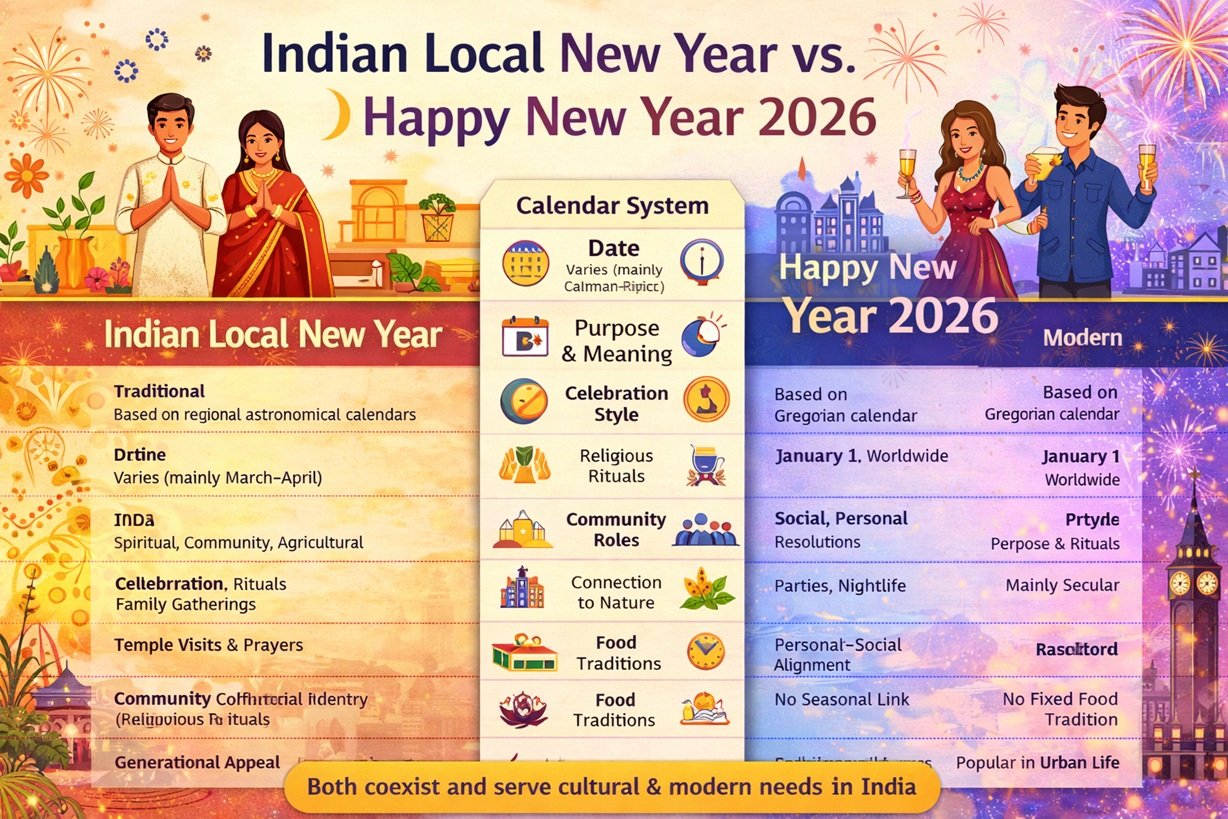
Indian Local New Year vs Happy New Year 2026
| Aspect | Indian Local / Regional New Year | Happy New Year 2026 (January 1) |
|---|---|---|
| Calendar System | Based on Hindu solar, lunar, or lunisolar calendars (Panchang) | Based on the Gregorian calendar |
| Date | Varies by region and year (mostly March–April) | Fixed date: January 1, 2026 |
| Geographical Scope | Celebrated regionally across India | Celebrated globally |
| Cultural Origin | Ancient Indian traditions rooted in astronomy and agriculture | European calendar tradition adopted worldwide |
| Purpose | Spiritual renewal, seasonal alignment, cultural continuity | Social reset, goal-setting, global celebration |
| Connection to Nature | Strong link with harvest cycles and seasonal change | No direct link with seasons |
| Religious Significance | Often includes prayers, rituals, and temple visits | Largely secular in nature |
| Celebration Style | Traditional, family-oriented, ritual-based | Modern, party-oriented, entertainment-focused |
| Time of Celebration | Usually early morning rituals | Midnight countdown |
| Food Traditions | Region-specific traditional dishes with symbolic meaning | No fixed food tradition; varies by personal choice |
| Community Role | Strengthens local identity and cultural roots | Strengthens global social connection |
| Examples | Ugadi, Gudi Padwa, Vishu, Puthandu, Baisakhi, Bohag Bihu | New Year’s Eve & New Year’s Day |
| Astrological Importance | Very high; based on planetary and solar movement | None |
| Workplace Impact | Often regional holidays | Widely observed in offices and institutions |
| Modern Relevance | Cultural and spiritual preservation | Global lifestyle and professional alignment |
| Mode of Wishes | Traditional greetings and blessings | Social media posts, messages, and resolutions |
| Emotional Tone | Calm, reflective, spiritual | Energetic, celebratory, hopeful |
| Global Influence | Limited to Indian subcontinent | Worldwide acceptance |
| Generational Appeal | Strong among elders and culturally rooted families | Popular among youth and urban population |
| Long-Term Significance | Cultural heritage and identity | Timekeeping and global synchronization |
Key Takeaway from the Comparison
- Indian Local New Year represents cultural depth, spiritual balance, and harmony with nature.
- Happy New Year 2026 represents global unity, modern lifestyle, and social celebration.
Both coexist in modern India, fulfilling different emotional, cultural, and practical needs.
Why Indians Celebrate Both
In modern India, both New Years coexist peacefully.
- January 1 represents:
- Global connectivity
- Modern lifestyle
- Professional timelines
- Indian local New Years represent:
- Cultural identity
- Heritage
- Spiritual grounding
Many Indians celebrate January 1 socially and their regional New Year traditionally, without conflict.
Impact of Globalisation
Globalisation has increased the popularity of January 1 New Year in India through:
- Media
- Corporate culture
- Tourism
- Social networking platforms
At the same time, there is renewed interest in reviving and preserving local traditions, especially among younger generations.
Which New Year Is “More Important”?
There is no single answer.
- Happy New Year 2026 is important for:
- Global alignment
- Social celebration
- Professional life
- Indian local New Year is important for:
- Cultural continuity
- Spiritual balance
- Regional identity
They serve different purposes and complement rather than replace each other.
FAQs: Indian Local New Year vs Happy New Year 2026
1. What is the difference between Indian local New Year and Happy New Year?
Indian local New Year is based on regional traditional calendars and seasonal cycles, while Happy New Year follows the Gregorian calendar and is celebrated globally on January 1.
2. Why does India have multiple New Years?
India follows different regional calendars rooted in astronomy, agriculture, and culture. Each region celebrates the New Year based on its own historical and seasonal traditions.
3. Is January 1 considered New Year in India?
Yes, January 1 is widely accepted as New Year in modern and official contexts, especially in offices, schools, and global interactions, but it is not a traditional Indian New Year.
4. Which Indian New Year is the oldest?
Many Indian New Years, such as Ugadi, Gudi Padwa, Vishu, and Baisakhi, have ancient origins dating back thousands of years, linked to early Indian astronomical systems.
5. Why do Indian local New Years mostly fall in March or April?
Most Indian New Years are based on the solar calendar, marking the Sun’s transition into a new zodiac sign and the beginning of a new agricultural cycle.
6. Do Indian local New Years have religious significance?
Yes, most Indian regional New Years include prayers, rituals, temple visits, and charity, making them spiritually significant events.
7. Is Happy New Year 2026 a religious festival?
No, Happy New Year 2026 is a secular celebration observed worldwide, focusing on social gatherings, celebrations, and personal resolutions rather than religious rituals.
8. Why do people celebrate both New Years in India?
Indians celebrate both to balance global modern life and cultural traditions—January 1 for social and professional alignment, and local New Years for cultural identity.
9. Which New Year is more important: local or January 1?
Both are important in different ways. Indian local New Years preserve heritage and spirituality, while January 1 connects India to the global calendar system.
10. Will Indian local New Years lose relevance in the future?
No. While January 1 remains globally significant, Indian local New Years continue to be deeply rooted in culture, rituals, and community life, ensuring their long-term relevance.
Final Thoughts
India’s uniqueness lies in its ability to embrace both tradition and modernity. Celebrating Happy New Year 2026 connects Indians to the global community, while celebrating Indian local New Years keeps cultural roots alive.
Rather than choosing one over the other, understanding both allows us to appreciate:
- The modern rhythm of the world
- The ancient wisdom of Indian civilisation
In the end, every New Year — whether January 1 or a regional festival — carries the same message:
a chance to begin again, with hope, balance, and purpose.
