
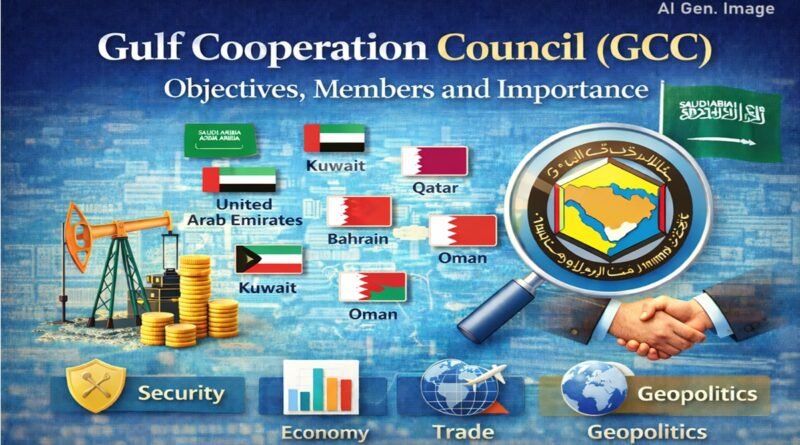
Gulf Cooperation Council (GCC): Meaning, Members, Objectives, and Global Importance
The Gulf Cooperation Council (GCC) is one of the most influential regional organizations in the Middle East. Formed to promote political coordination, economic cooperation, and collective security, the GCC plays a crucial role in global energy markets, regional stability, and international diplomacy.
With vast oil and gas reserves, strategic maritime locations, and growing financial power, the GCC countries significantly influence the global economy and geopolitics.
What Is the Gulf Cooperation Council (GCC)?
The Gulf Cooperation Council is a regional intergovernmental organization consisting of six Arab countries located in the Persian Gulf region. It aims to achieve unity, coordination, and integration among its members in political, economic, security, and cultural fields.
GCC Member Countries
The GCC has six founding members:
- Saudi Arabia
- United Arab Emirates (UAE)
- Qatar
- Kuwait
- Bahrain
- Oman
All six countries share:
- Geographic proximity
- Cultural and linguistic similarity
- Islamic heritage
- Resource-rich economies
Formation and History of the GCC
- Founded: 25 May 1981
- Headquarters: Riyadh, Saudi Arabia
Why Was GCC Formed?
The GCC was created in response to:
- Regional security threats after the Iranian Revolution (1979)
- Iran–Iraq War
- Need for collective defense
- Desire for economic integration
The founding idea was to create a unified Gulf bloc capable of responding to regional and global challenges.
Objectives of the GCC
The GCC Charter outlines several key objectives:
1. Political and Security Cooperation
- Strengthening regional stability
- Coordinating defense policies
- Combating terrorism and extremism
2. Economic Integration
- Establishing a common market
- Customs union and tariff coordination
- Free movement of goods, services, and capital
3. Social and Cultural Cooperation
- Education and research collaboration
- Cultural exchange
- Preservation of shared heritage
4. Energy and Infrastructure Coordination
- Oil and gas policy coordination
- Power grid integration
- Transport and logistics development
Institutional Structure of the GCC
Supreme Council
- Highest authority
- Comprises heads of member states
- Meets annually
Ministerial Council
- Foreign ministers of member states
- Meets quarterly
Secretariat-General
- Implements GCC decisions
- Based in Riyadh
Economic Importance of the GCC
Global Energy Powerhouse
- Holds around one-third of global oil reserves
- Major exporters of crude oil and LNG
- Key players in OPEC (especially Saudi Arabia, UAE, Kuwait)
Financial and Investment Influence
- Sovereign wealth funds worth trillions of dollars
- Major investors in global infrastructure, technology, and finance
Trade and Connectivity
- Strategic location connecting Asia, Europe, and Africa
- Control over key maritime routes like the Strait of Hormuz
GCC Common Market
Launched in 2008, the GCC Common Market allows citizens of member states to:
- Work in any GCC country
- Own property
- Access education and healthcare
- Engage in business without discrimination
This initiative aims to deepen economic integration, similar to the European Union (but without political union).
GCC and Security Cooperation
The GCC has:
- A joint military force known as Peninsula Shield Force
- Coordinated defense against regional threats
- Strong security partnerships with the United States and Western allies
Security cooperation intensified due to:
- Iran’s regional influence
- Conflicts in Yemen, Syria, and Iraq
- Maritime security concerns
Internal Challenges Within the GCC
Political Differences
- Diplomatic crisis with Qatar (2017–2021)
- Differences in foreign policy approaches
Economic Diversification Pressure
- Heavy reliance on oil revenues
- Need to shift towards non-oil sectors
Integration Limitations
- Monetary union remains incomplete
- National interests often override collective decisions
GCC and India: Strategic Relationship
India has strong ties with GCC countries through:
- Energy imports
- Trade and investment
- Indian diaspora (over 8 million Indians in GCC states)
The GCC is:
- India’s largest trading bloc
- A key source of remittances
- A major partner in food security and infrastructure projects
Global Role of the GCC
The GCC plays a key role in:
- Global energy security
- Stabilizing oil markets
- Diplomatic mediation in regional conflicts
- Climate and renewable energy investments
Many GCC states are now investing heavily in:
- Renewable energy
- Hydrogen economy
- Smart cities and digital infrastructure
Future of the GCC
The future direction of the GCC will depend on:
- Regional stability
- Economic diversification success
- Internal political unity
- Adaptation to global energy transition
If coordination improves, the GCC could emerge as one of the most powerful regional blocs in the world.
Read this: India Launched RNI Index: Global Ranking, India’s Position & Full Country List
Conclusion
The Gulf Cooperation Council (GCC) is far more than a regional alliance—it is a strategic, economic, and geopolitical force with global impact. Despite internal challenges, its collective strength in energy, finance, and diplomacy ensures its continued relevance.
As the world transitions toward new energy systems and multipolar geopolitics, the GCC’s ability to adapt and cooperate will shape not only the Middle East but also the broader global order.
