
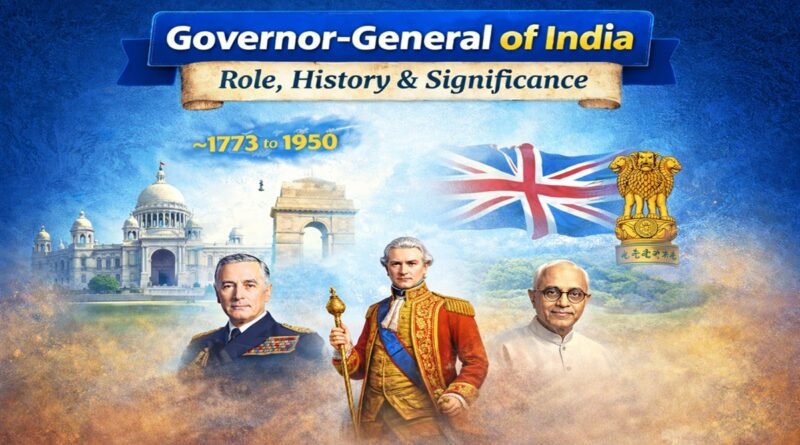
Governor-General of India: Role, History, and Significance
Introduction
The Governor-General of India was the highest administrative authority in British India. This position played a crucial role in shaping India’s political, legal, and administrative structure during colonial rule. The office evolved over time—from representing the British East India Company to serving as the Crown’s chief representative in India.
This article explains the origin, powers, evolution, and eventual abolition of the Governor-General’s post in a clear and structured manner.
Origin of the Post (1773)
The position of Governor-General was created under the Regulating Act of 1773, passed by the British Parliament.
- The Act aimed to regulate the affairs of the East India Company.
- The Governor of Bengal was elevated to the position of Governor-General of Bengal.
- The first person appointed to this post was Warren Hastings.
At this stage, authority was primarily limited to Bengal, but gradually the office gained control over other British territories in India.
Governor-General of India (1833)
The Charter Act of 1833 transformed the title from Governor-General of Bengal to Governor-General of India.
- This change centralized power.
- The Governor-General now had authority over all British-controlled territories in India.
- One of the notable office holders during this period was Lord William Bentinck.
Key Reforms Under Lord William Bentinck:
- Abolition of Sati (1829)
- Promotion of Western education
- Administrative and financial reforms
After the Revolt of 1857: The Viceroy Era
The Revolt of 1857 changed the structure of governance in India.
- In 1858, the British Crown took direct control from the East India Company.
- The Governor-General also began to be called the Viceroy of India.
- The Viceroy acted as the direct representative of the British monarch.
Prominent Viceroys included:
- Lord Curzon – Known for the Partition of Bengal (1905)
- Lord Mountbatten – The last Viceroy of India who oversaw India’s independence in 1947
Powers and Responsibilities
The Governor-General had extensive powers, including:
- Head of the executive government
- Authority to enact laws
- Control over military forces
- Supervision of provincial administrations
- Financial and revenue management
In simple terms, the Governor-General was the supreme authority in British India.
Role After Independence (1947–1950)
After India gained independence on 15 August 1947:
- The office of Governor-General continued temporarily.
- India became a Dominion under the British Commonwealth.
- The last and only Indian Governor-General was C. Rajagopalachari.
This arrangement continued until India became a Republic on 26 January 1950.
Abolition of the Post
On 26 January 1950:
- India adopted its Constitution.
- The post of Governor-General was abolished.
- The office of President of India replaced it.
This marked the complete transition from colonial rule to a sovereign democratic republic.
Timeline Summary
| Period | Title | Authority |
|---|---|---|
| 1773–1833 | Governor-General of Bengal | Limited to Bengal (gradually expanded) |
| 1833–1858 | Governor-General of India | All British territories in India |
| 1858–1947 | Governor-General & Viceroy | Representative of British Crown |
| 1947–1950 | Governor-General (Dominion of India) | Transitional Head of State |
| 1950–Present | President of India | Constitutional Head of the Republic |
Conclusion
The Governor-General of India was a central figure in colonial governance. The office evolved from regulating company rule to representing the British Crown and ultimately transitioned into India’s republican structure. Understanding this post is essential for students of Indian history, polity, and competitive exams.
