
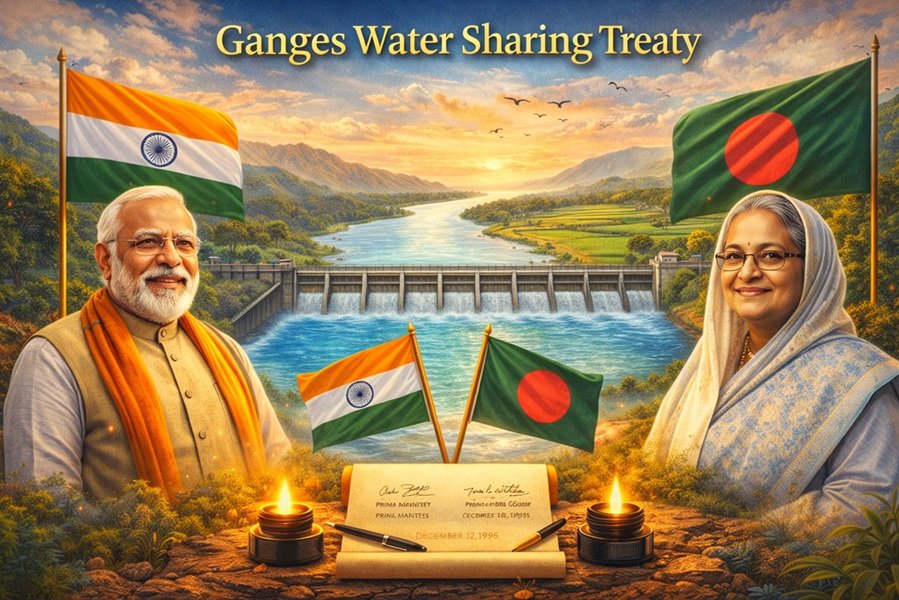
Ganges Water Sharing Treaty: History, Provisions, Challenges, and Strategic Significance
The Ganges Water Sharing Treaty is one of the most important bilateral agreements between India and Bangladesh, governing the sharing of waters of the Ganga (Ganges) River during the lean season. Signed in 1996, the treaty plays a crucial role in regional water security, diplomacy, agriculture, and environmental sustainability in South Asia.
As climate change, population growth, and water stress intensify, the relevance of the Ganges Water Sharing Treaty has become more critical than ever.
Introduction to the Ganges River
The Ganga River originates from the Gangotri Glacier in the Himalayas and flows through India and Bangladesh before emptying into the Bay of Bengal. It is:
- One of the longest rivers in Asia
- A lifeline for hundreds of millions of people
- Vital for agriculture, drinking water, industry, and ecology
Because the river crosses international boundaries, equitable sharing of its waters has been a sensitive geopolitical issue, especially between India (upstream) and Bangladesh (downstream).
Background: Why Was a Treaty Needed?
The Farakka Barrage Issue
The core dispute over Ganga waters arose due to the construction of the Farakka Barrage in West Bengal by India in the 1960s–70s. The barrage was built to:
- Divert water into the Hooghly River
- Flush silt and maintain the operational capacity of Kolkata Port
Bangladesh (then East Pakistan) raised concerns that diversion of water reduced dry-season flows downstream, affecting:
- Agriculture
- Fisheries
- Navigation
- Salinity levels
This led to decades of negotiations and temporary arrangements.
Early Agreements Before 1996
Before the final treaty, several short-term agreements were attempted:
- 1975–1982: Ad-hoc water-sharing arrangements
- 1982 Memorandum of Understanding (MoU) for 5 years
- 1988 MoU for 3 years
However, these agreements lacked permanence and legal certainty, making a long-term treaty essential.
Signing of the Ganges Water Sharing Treaty (1996)
The Ganges Water Sharing Treaty was signed on:
- Date: 12 December 1996
- Signatories:
- India (Prime Minister H.D. Deve Gowda)
- Bangladesh (Prime Minister Sheikh Hasina)
- Validity: 30 years (till 2026)
The treaty marked a major diplomatic breakthrough and is often cited as a model for transboundary river cooperation.
Key Provisions of the Treaty
1. Water Sharing Formula
The treaty specifies water-sharing arrangements at Farakka Barrage during the lean season (January–May), based on 10-day periods.
- When availability is 70,000 cusecs or more:
- India: 40,000 cusecs
- Bangladesh: 40,000 cusecs
- When availability is less than 70,000 cusecs:
- Water is shared on a pro-rata basis
- Guaranteed minimum flow provisions are included to protect Bangladesh during extreme shortages.
2. Lean Season Focus
The treaty primarily addresses the dry season, when water scarcity is most severe and disputes are most likely.
3. Joint Monitoring Mechanism
A Joint Committee with representatives from both countries was established to:
- Monitor water flow data
- Ensure transparency
- Resolve technical disputes
4. No Harm Principle
Both sides agreed to the principle that neither country should cause significant harm to the other through water diversion or infrastructure projects.
5. Review and Renewal Clause
The treaty allows for:
- Periodic reviews
- Renewal after 30 years by mutual consent
Importance of the Treaty
For Bangladesh
- Ensures minimum dry-season water availability
- Supports agriculture, fisheries, and river navigation
- Helps control salinity intrusion in coastal regions
For India
- Stabilizes relations with a key neighbor
- Ensures smooth operation of Kolkata Port
- Strengthens India’s image as a responsible upper-riparian state
Environmental and Ecological Impact
The treaty indirectly supports:
- Wetland conservation
- Aquatic biodiversity
- Maintenance of riverine ecosystems
However, reduced glacier flows and erratic rainfall patterns pose new challenges not fully anticipated in 1996.
Challenges and Criticism
1. Climate Change Impact
- Reduced Himalayan glacial melt
- Erratic monsoons
- Increasing frequency of droughts
These factors strain the original water-sharing calculations.
2. Teesta River Dispute
While the Ganges treaty exists, the Teesta water-sharing agreement remains unresolved, creating diplomatic friction and affecting trust.
3. Data Transparency Concerns
Bangladesh has occasionally expressed concerns over real-time data sharing and accuracy of flow measurements.
4. Rising Water Demand
- Population growth
- Urbanization
- Industrial expansion
All increase pressure on shared water resources.
Strategic and Geopolitical Significance
The Ganges Water Sharing Treaty is significant beyond water management:
- Strengthens India–Bangladesh bilateral relations
- Acts as a counterbalance to regional instability
- Sets a precedent for cooperation on other transboundary rivers
It is often compared with global water-sharing frameworks such as the Indus Waters Treaty.
Future of the Ganges Water Sharing Treaty (Post-2026)
As the treaty approaches its expiration in 2026, both nations face key decisions:
- Renewal with updated climate-sensitive provisions
- Inclusion of environmental flow standards
- Broader basin-level cooperation
Experts suggest moving from water sharing to river basin management.
Conclusion
The Ganges Water Sharing Treaty stands as a landmark agreement in South Asian diplomacy, balancing development needs with regional cooperation. While it has largely succeeded in preventing major conflicts, evolving climatic and demographic realities demand a more adaptive and sustainable approach.
The future of the treaty will not only shape India–Bangladesh relations but also determine how South Asia manages its most precious shared resource—water.
