
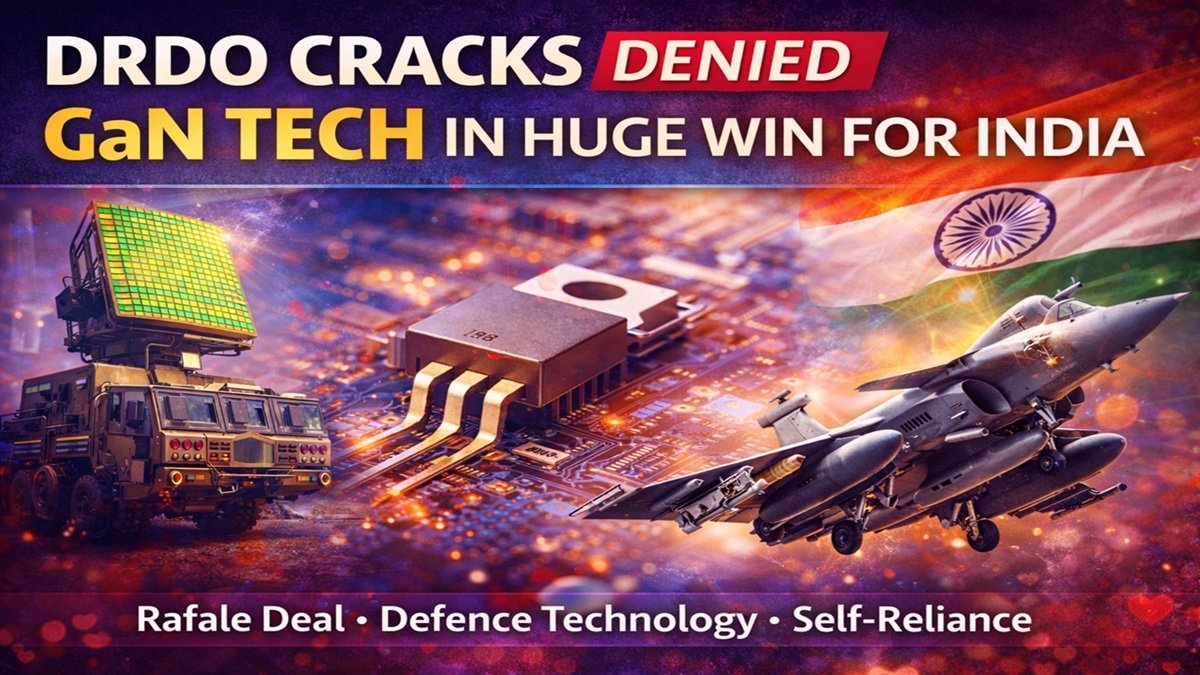
DRDO Masters GaN Semiconductor Technology Once Denied in the Rafale Deal: Why This Is a Major Strategic Victory for India
India’s defence and technology ecosystem has quietly achieved something extraordinary. After being denied access to Gallium Nitride (GaN) semiconductor technology during the Rafale fighter jet negotiations, India has now indigenously cracked the same critical technology through its own scientific institutions. This achievement, led by the Defence Research and Development Organisation (DRDO), marks a turning point in India’s journey toward strategic and technological self-reliance.
What was once withheld as “too sensitive to share” has now been built from the ground up in India—and the implications go far beyond a single defence deal.
Why GaN Technology Matters So Much
Gallium Nitride (GaN) is not just another semiconductor material. It belongs to the elite category of wide-bandgap semiconductors, which outperform traditional silicon in almost every critical parameter relevant to modern defence systems.
GaN-based chips can:
- Handle much higher power levels
- Operate at extremely high frequencies
- Withstand higher temperatures
- Deliver greater efficiency and range in RF systems
Because of these properties, GaN has become the backbone of:
- AESA radars
- Electronic warfare systems
- Advanced communication links
- Missile seekers and space electronics
This is precisely why GaN technology is treated as strategic and tightly controlled by advanced military powers.
The Rafale Deal and the Technology That Was Withheld
When India signed the Rafale fighter aircraft contract with France, the agreement included a defence offset clause, under which a portion of the deal value was supposed to translate into technology transfer or industrial capability within India.
During these negotiations, India sought access to GaN semiconductor technology, which is essential for modern airborne radars and electronic warfare systems used on platforms like the Dassault Rafale.
However, French suppliers declined to transfer GaN know-how, citing:
- National security concerns
- Intellectual property sensitivity
- Strategic technology restrictions
In simple terms, India could buy the aircraft—but not the brain behind some of its most advanced electronics.
How India Responded: Indigenous Development Instead of Dependence
Rather than remaining dependent on external suppliers, DRDO took a decisive long-term call: develop GaN capability indigenously.
Multiple DRDO laboratories, including:
- Solid-state semiconductor research units
- Microwave and RF technology labs
worked for years to master:
- GaN material growth
- Device fabrication
- GaN-based MMICs (Monolithic Microwave Integrated Circuits)
These MMICs are the heart of modern radar transmit-receive modules.
Eventually, DRDO succeeded in producing deployment-ready GaN chips that meet military performance requirements—placing India among a very small group of nations with this capability.
Why This Is a Strategic Breakthrough, Not Just a Technical One
1. Freedom from Technology Denial
With indigenous GaN capability, India is no longer vulnerable to:
- Export controls
- Political pressure
- Wartime supply disruptions
This is critical in scenarios where defence readiness cannot depend on foreign approvals.
2. Direct Impact on Indian Defence Systems
Indigenous GaN chips can now power:
- Indian AESA radars
- Long-range surveillance systems
- Electronic warfare suites
- Missile guidance and seekers
- Secure military communications
This strengthens India’s combat platforms across air, land, sea, and space.
3. From Buyer to Builder
Earlier, India was primarily a buyer of advanced defence electronics. With GaN mastery, India becomes a creator of core technology, not just an integrator of imported parts.
This changes India’s position in future defence collaborations—from dependent customer to equal partner.
GaN vs Older Technologies in Defence
Earlier defence systems relied heavily on:
- Silicon
- Gallium Arsenide (GaAs)
GaN surpasses both by offering:
- Higher power density
- Longer detection range in radars
- Smaller and lighter systems
- Lower cooling requirements
This means aircraft, ships, and ground systems can carry more capability with less weight and energy loss.
Strategic Ripple Effects Beyond Defence
Although defence drove GaN development, its impact extends into civilian and dual-use domains:
- 5G and future 6G infrastructure
- Satellite communications
- High-efficiency power electronics
- Data centres and energy systems
By mastering GaN, India strengthens its position in the global semiconductor value chain, an area of immense geopolitical importance.
A Classic Case of Turning Denial into Capability
History shows that many technological powers advanced fastest when denied access:
- Space technology
- Nuclear technology
- Supercomputing
India’s GaN story follows the same pattern. What was denied during the Rafale negotiations became the motivation for self-reliance, aligning perfectly with national goals such as Atmanirbhar Bharat and strategic autonomy.
What Comes Next: From Lab to Large-Scale Deployment
The next challenge is scaling:
- Transition from laboratory success to industrial manufacturing
- Partnering with Indian private industry
- Ensuring long-term reliability and mass deployment
Once scaled, GaN technology can become a foundational pillar of India’s defence electronics ecosystem for decades.
Final Takeaway
The indigenous development of GaN semiconductor technology by DRDO, after it was denied during the Rafale deal, is far more than a technical achievement. It represents:
- Strategic independence
- Scientific maturity
- Long-term national security strength
India didn’t just replace an imported technology—it leapfrogged into an elite technological club. What was once guarded and withheld is now designed, built, and controlled at home.
In modern warfare and geopolitics, control over semiconductors is control over power—and India has just secured a critical piece of that control.
