
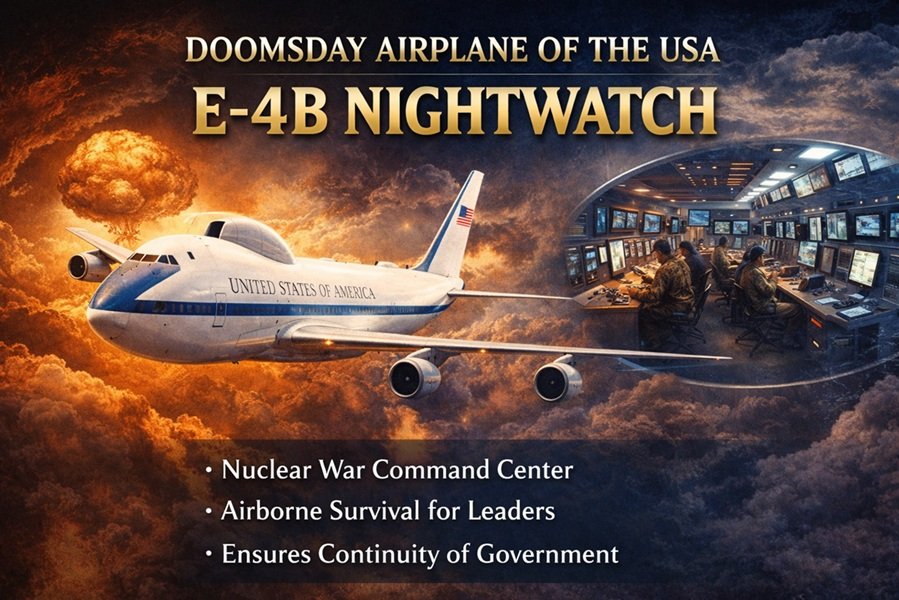
Doomsday Airplane of the USA: E-4B Nightwatch Explained in Detail
The Doomsday Airplane of the United States, officially known as the E-4B Nightwatch, is one of the most secretive and strategically important aircraft in the world. It is designed to ensure that the U.S. government and military can continue to function even after a nuclear war or catastrophic national emergency.
Often described as a “flying Pentagon” or “airborne White House,” the E-4B serves as the National Airborne Operations Center (NAOC) and is a critical pillar of America’s nuclear command-and-control system.
This article provides a comprehensive, exam-ready, and geopolitically relevant explanation of the U.S. Doomsday Plane—its purpose, technology, history, capabilities, limitations, and modern relevance.
What Is the Doomsday Airplane?
The Doomsday Airplane is a specially modified military aircraft designed to:
- Survive nuclear detonations
- Remain operational during global war
- Act as a mobile command center for national leadership
In the United States, this role is performed by the E-4B Nightwatch.
Official Role
The E-4B functions as:
- National Airborne Operations Center (NAOC)
- Backup command post for:
- The President of the United States
- Secretary of Defense
- Joint Chiefs of Staff
Why Does the USA Need a Doomsday Plane?
In a nuclear or large-scale cyber-military conflict, ground-based command centers may be destroyed or disabled. The Doomsday Plane ensures:
- Continuity of government
- Continuity of military command
- Control over nuclear forces
- Secure global communication
Even if Washington, D.C. is attacked, the chain of command survives in the air.
Aircraft Overview: E-4B Nightwatch
| Feature | Details |
|---|---|
| Manufacturer | Boeing |
| Base Aircraft | Boeing 747-200 |
| Operator | United States Air Force |
| Role | National Airborne Operations Center |
| First Introduced | 1974 (upgraded to E-4B later) |
| Fleet Size | 4 aircraft |
Design and Structure
Nuclear-Hardened Aircraft
The E-4B is engineered to survive conditions that would disable ordinary aircraft.
Key features include:
- Electromagnetic Pulse (EMP) shielding
- Hardened electronics and wiring
- Shielded communication systems
- Resistance to nuclear radiation
This allows the aircraft to remain functional after a nuclear explosion.
Exterior Modifications
- No cockpit windows with modern glass displays
- Over 60 satellite and radio antennas
- Mid-air refueling capability
Inside the Doomsday Plane
The interior is not luxurious like Air Force One. Instead, it is designed for command, control, and survival.
Internal Sections
- Command Room – strategic decision-making
- Conference Room – leadership briefings
- Operations Center – real-time war monitoring
- Communications Room – global military contact
- Rest Areas – for crew endurance
The aircraft can support over 100 personnel for extended missions.
Communication Capabilities
One of the most critical functions of the Doomsday Plane is communication.
Global Connectivity
The E-4B can communicate with:
- Nuclear submarines
- Missile silos
- Strategic bombers
- Allied command centers
It uses:
- Very Low Frequency (VLF)
- Ultra High Frequency (UHF)
- Satellite communications
This ensures that nuclear launch orders can be transmitted under any circumstances.
Relationship with U.S. Nuclear Forces
The E-4B plays a vital role in controlling the U.S. nuclear triad:
- Land-based intercontinental ballistic missiles (ICBMs)
- Submarine-launched ballistic missiles (SLBMs)
- Strategic bombers
Even if all ground command centers are destroyed, nuclear command authority remains intact.
Difference Between Doomsday Plane and Air Force One
| Aspect | Doomsday Plane (E-4B) | Air Force One |
|---|---|---|
| Primary Role | Nuclear war command | Presidential transport |
| Nuclear Hardened | Yes | Limited |
| EMP Protection | Extensive | Minimal |
| Interior | Military operations | Luxury & comfort |
| Public Visibility | Extremely low | High |
Air Force One focuses on mobility and diplomacy, while the E-4B focuses on survival and command.
Operational Status and Readiness
At least one E-4B is on constant alert, ready to take off within minutes.
During periods of:
- Heightened geopolitical tension
- Nuclear alerts
- Presidential travel abroad
The aircraft’s readiness level is increased.
Historical Background
The Doomsday Plane concept emerged during the Cold War, when the threat of nuclear annihilation was at its peak.
Key influences:
- U.S.–Soviet nuclear rivalry
- Fear of decapitation strikes
- Need for assured retaliation
The aircraft was developed to ensure Mutually Assured Destruction (MAD) doctrine credibility.
Does the USA Have More Than One Doomsday Plane?
Yes. The U.S. operates:
- 4 E-4B Nightwatch aircraft
In addition, the Navy operates:
- E-6B Mercury – focused on submarine communication
Together, they ensure full-spectrum nuclear command survivability.
Modern Relevance in 21st Century Warfare
Despite advances in cyber warfare, satellites, and AI, the Doomsday Plane remains relevant because:
- Satellites can be destroyed
- Ground networks can be hacked
- Fixed command centers can be targeted
A mobile, airborne command center remains the most survivable option.
Limitations of the Doomsday Plane
Despite its power, the E-4B has constraints:
- Aging airframe (747-200)
- High maintenance cost
- Limited stealth capabilities
- Replacement planning required
The U.S. Air Force is currently evaluating future airborne command platforms.
Why the Doomsday Plane Matters Globally
The existence of the Doomsday Plane:
- Strengthens nuclear deterrence
- Prevents command paralysis
- Signals preparedness to adversaries
- Reduces chances of accidental escalation
It is a silent but powerful stabilizing force in global geopolitics.
Conclusion
The E-4B Nightwatch represents the ultimate insurance policy of the United States. Designed to function during the worst-case scenario—a nuclear apocalypse—it ensures that command, control, and governance survive even if the ground does not.
While rarely seen and never discussed officially in detail, the Doomsday Plane remains one of the most critical assets in modern military strategy.
