
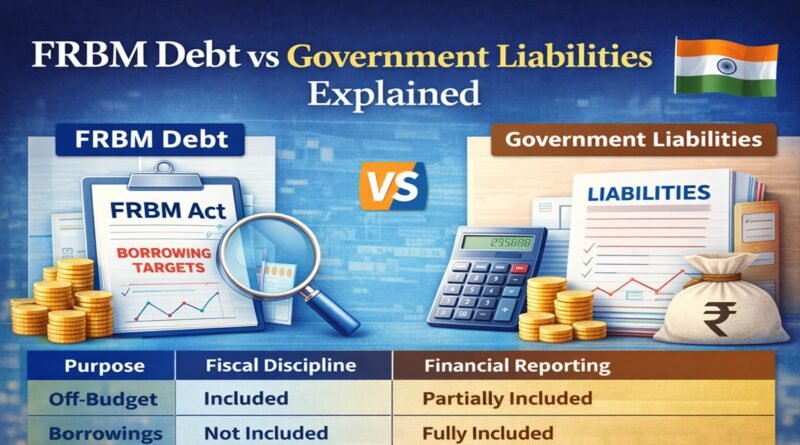
Difference Between FRBM Debt and Government Liabilities Explained in Detail
In discussions on public finance, fiscal discipline, and government borrowing, two terms are frequently used in India’s budget documents: FRBM Debt and Government Liabilities. Although they are often used interchangeably in casual discussion, they are not the same.
Understanding the difference between FRBM debt and liabilities is crucial for interpreting India’s debt numbers, fiscal targets, and long-term sustainability of public finances.
Read this: Debt-to-GDP Ratio Explained: Meaning, Importance, and India’s Debt Trend in Detail
What Is FRBM Debt?
Meaning
FRBM Debt refers to the definition of government debt as specified under the Fiscal Responsibility and Budget Management (FRBM) Act.
It is a statutory, rule-based definition used for setting debt targets and ensuring fiscal discipline.
What FRBM Debt Includes
Under the FRBM Act, government debt includes:
- Internal Debt
- Market loans
- Treasury bills
- Government securities
- External Debt
- Loans from foreign governments
- Multilateral institutions (World Bank, ADB, IMF)
- Valued at current exchange rates
- Extra-Budgetary Resources (EBRs)
- Borrowings by public sector entities
- Government-guaranteed loans
- Off-budget financing routed through PSUs
These components together represent the effective borrowing burden of the government.
Purpose of FRBM Debt
- To enforce fiscal discipline
- To set medium-term debt targets
- To ensure transparency in true borrowing
- To prevent hiding debt outside the budget
FRBM debt is the policy anchor for India’s fiscal framework.
What Are Government Liabilities?
Meaning
Government Liabilities refer to the broader accounting concept of what the government owes, as reported in the Statement of Liabilities in the Receipt Budget.
This definition focuses more on accounting completeness rather than fiscal rules.
What Government Liabilities Include
- Internal Liabilities
- Market borrowings
- Treasury bills
- Ways and Means Advances
- Public Account Liabilities
- Provident funds
- Small savings
- Deposits
- Reserve funds
- Other Obligations
- Liabilities arising from financial instruments
- Certain contingent obligations (reported separately)
Unlike FRBM debt, public account liabilities are fully included here.
Purpose of Government Liabilities
- To present a comprehensive balance sheet
- To reflect total outstanding obligations
- To meet accounting and reporting standards
- To provide transparency on public finances
Key Difference: FRBM Debt vs Government Liabilities
| Aspect | FRBM Debt | Government Liabilities |
|---|---|---|
| Nature | Rule-based, legal definition | Accounting definition |
| Governing Framework | FRBM Act | Receipt Budget |
| Objective | Fiscal discipline | Financial reporting |
| Includes External Debt | Yes (at current exchange rate) | Yes |
| Includes Extra-Budgetary Borrowings | Yes | Partially / separately |
| Includes Public Account Liabilities | ❌ No | ✅ Yes |
| Used for Debt Targets | ✅ Yes | ❌ No |
| Used for Accounting Transparency | Limited | High |
Why FRBM Debt Is Usually Higher Than Liabilities (or Vice Versa)
In recent years, FRBM debt figures are often higher than liabilities as per the Statement of Liabilities because:
- FRBM debt includes extra-budgetary resources
- It captures off-budget borrowing
- It reflects true fiscal burden, not just on-budget debt
This difference became particularly visible after COVID-19, when governments used PSUs and special vehicles to finance expenditure.
Why India Uses Two Debt Measures
1. Policy vs Accounting Needs
- FRBM debt is for policy control
- Liabilities are for financial disclosure
2. Transparency vs Flexibility
- FRBM debt prevents creative accounting
- Liabilities allow detailed classification
3. International Reporting
- FRBM aligns with global fiscal norms
- Liabilities align with national accounting systems
Role of Extra-Budgetary Resources (EBRs)
One of the biggest reasons for divergence between FRBM debt and liabilities is EBRs.
What Are EBRs?
- Borrowings done by PSUs on behalf of government
- Used for food subsidy, infrastructure, welfare schemes
Why FRBM Includes Them
Because they:
- Create future repayment obligations
- Affect fiscal sustainability
- Represent deferred government borrowing
Liabilities may not fully capture EBRs in the same way.
Impact on Debt-to-GDP Ratio
- FRBM Debt-to-GDP ratio shows the true fiscal stress
- Liabilities-to-GDP ratio shows the accounting position
Policymakers, rating agencies, and IMF prefer FRBM-based debt for risk assessment.
Which Measure Is More Important?
For Exams & Policy Analysis
👉 FRBM Debt
For Accounting & Transparency
👉 Government Liabilities
For Investors & Rating Agencies
👉 FRBM Debt
Both are important—but for fiscal responsibility, FRBM debt carries more weight.
India’s Policy Direction
India’s medium-term fiscal strategy focuses on:
- Reducing FRBM debt-to-GDP ratio
- Limiting off-budget borrowings
- Improving transparency in liabilities
- Achieving sustainable growth-led debt reduction
The gradual convergence of both measures is a sign of fiscal maturity.
Conclusion
The difference between FRBM debt and government liabilities lies not in contradiction, but in purpose.
- FRBM debt tells us how sustainable government borrowing is
- Liabilities tell us what the government owes in total
Understanding both provides a complete picture of public finance health. A well-managed economy is not one with zero debt, but one where debt is transparent, productive, and sustainable.
