
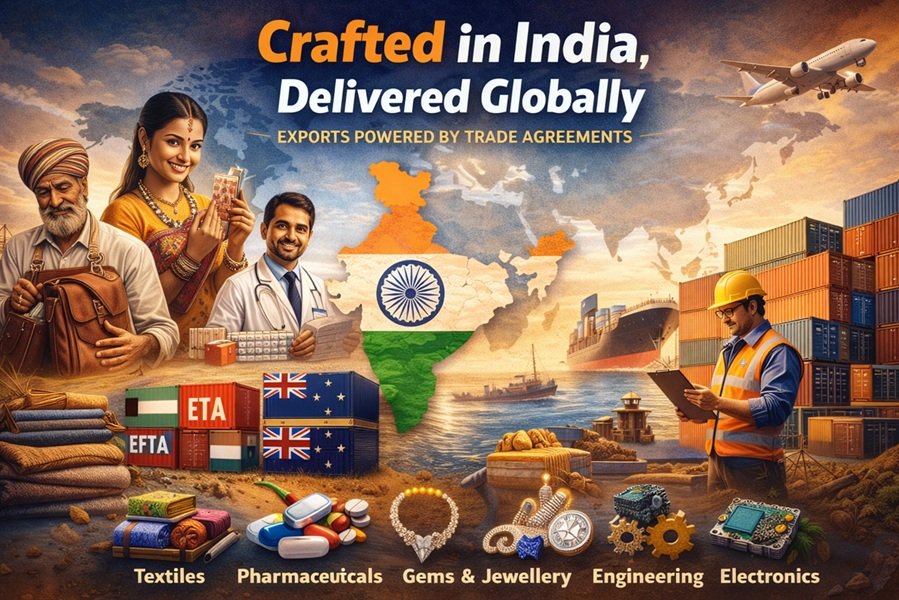
Crafted in India, Delivered Globally: India’s Export Growth Fueled by Trade Agreements
India’s exports have demonstrated remarkable resilience and growth in the past year, underscoring the nation’s expanding role in global markets. Between November 2024 and November 2025, India’s total export earnings increased significantly — a rise from USD 64.05 billion to USD 73.99 billion, marking a strong 15.52% year-on-year growth. This performance reflects not only the competitive strength of Indian goods and services but also the impact of strategic trade agreements, targeted policy reforms, and diversification efforts across products and markets.
1. India’s Export Performance: Growth Amid Global Uncertainties
India’s export performance through November 2025 highlights sustained momentum across multiple sectors:
Merchandise and Services
- Merchandise exports reached USD 38.13 billion, recording a 19.38% increase compared to the previous year.
- Services exports stood at USD 35.86 billion, marking an 11.67% expansion.
These figures illustrate a relatively balanced contribution between goods and services, with merchandise comprising 51.53% and services 48.47% of total exports. The strong growth underscores India’s ability to meet global demand even amid trade disruptions and shifting economic landscapes.
Sectoral Contributions
Key export sectors showed notable performance:
- Textiles and Ready-Made Garments expanded by over 11%, driven by labour-intensive products that appeal to global consumers.
- Chemicals and Pharmaceuticals exports recorded double-digit growth, with Indian pharma products reaching over 200 countries — including highly regulated markets like the United States, Europe, and Japan.
- Gems and Jewellery experienced nearly 28% growth, reflecting strong global demand for Indian craftsmanship and quality.
- Engineering goods continued their steady momentum, with traditional markets like the US and Europe leading demand.
India’s petroleum products also saw robust performance, maintaining the country’s position as one of the top exporters of refined petroleum. The electronics sector demonstrated exceptional dynamism, with exports rising rapidly as India targets leadership in electronics manufacturing and global exports.
2. Strategic Trade Agreements: A Foundation for Export Diversification
India’s export success is underpinned by its expanding network of Free Trade Agreements (FTAs), Comprehensive Economic Partnership Agreements (CEPAs), and Economic Cooperation Agreements (ECAs) with strategic partners worldwide. These agreements not only reduce tariffs and market entry barriers but also support services trade, investment, and mobility — broadening opportunities for Indian businesses.
Recent and Ongoing Trade Agreements
India has actively pursued high-quality trade pacts in recent years, each designed to unlock new opportunities and strengthen export competitiveness:
- CEPA with Oman (18 December 2025) expands Indian access to Middle Eastern markets and builds on longstanding bilateral ties.
- CETA with the UK (2025) provides unprecedented duty-free access for virtually all Indian exports to the United Kingdom, benefiting sectors such as textiles, leather, engineering goods, and services, with enhanced mobility for professionals.
- EFTA Agreement (2024) covering Switzerland, Norway, Iceland, and Liechtenstein, enhances market access for Indian pharmaceuticals and engineering exports while attracting investment.
- CEPA with UAE (2022) facilitated tariff reductions on a wide range of Indian goods, especially supporting gems, textiles, and leather exports.
- ECTA with Australia (2022) opened avenues for Indian exports of chemicals, pharmaceuticals, and textiles in the Asia-Pacific.
Negotiations are underway for additional strategic agreements with regions and nations including:
- Gulf Cooperation Council (GCC)
- Qatar
- New Zealand
- United States
- European Union (EU)
- ASEAN, and others
These ongoing discussions signal India’s commitment to deeper economic integration, expanded market access, and comprehensive frameworks that support trade in goods, services, investment, digital trade, and sustainability.
3. Export Diversification: Spreading Risk, Building Resilience
A key element of India’s export strategy is diversification — both in terms of product mix and destination markets. Diversification reduces dependency on limited markets and allows Indian exporters to navigate global demand fluctuations more effectively.
Why Diversification Matters
- Resilience: By expanding into new regions and product segments, India shields itself against external shocks and demand volatility.
- Balanced Growth: A diversified export basket spreads economic opportunities across manufacturing, services, and technology sectors.
- Macro Stability: Exports contribute significantly to GDP; broader participation enhances economic stability and job creation.
This approach also encourages innovation and knowledge spillovers as Indian firms expand into new sectors, adopt advanced technologies, and access global supply chains, strengthening long-term competitiveness.
4. Policy Measures Supporting Exports
India’s government has introduced a suite of policy initiatives designed to enhance export competitiveness and support domestic producers and MSMEs in accessing global markets.
Export Promotion Mission
Launched with an outlay of Rs. 25,060 crore, this mission operates through two sub-schemes:
- Niryat Protsahan: Focuses on access to affordable trade finance for exporters, especially MSMEs.
- Niryat Disha: Provides non-financial enablers such as market readiness support, international branding, and compliance assistance.
Labour and GST Reforms
Recent labour reforms have simplified regulations, enhanced flexibility, and strengthened worker protections — reducing compliance burdens for exporters. The implementation of Next Gen GST 2.0 has accelerated GST refunds, removed threshold limits for export refunds, and reduced costs on key export inputs like textiles and packaging materials.
Targeted Export Support Schemes
- RoDTEP Scheme: Provides tax refunds on embedded duties, with over ₹58,000 crore disbursed up to March 2025.
- Districts as Export Hubs: Identifies 734 districts with export potential, fostering district-level action plans and engagement.
- Trade Infrastructure for Export Scheme (TIES): Improves logistics and infrastructure support.
- PLI (Production Linked Incentive) Scheme: Has attracted significant investment, boosted manufacturing output, and created jobs in high-potential sectors.
Digital initiatives such as the National Single Window System and Trade Connect e-Platform streamline export clearances and enhance efficiency across processes.
5. Looking Ahead: India’s Global Trade Trajectory
India’s export journey shows a combination of sustained growth, strategic partnership expansion, and effective policy implementation. With exports contributing more than 21% to GDP by 2024, and export diversification accelerating, India is poised to strengthen its position as a key global trade partner.
Continued engagement through trade agreements, market diversification, and support for innovation will be crucial in sustaining export momentum amid global uncertainties. By aligning domestic reforms with global opportunities, India continues to solidify its role as a reliable source of high-quality products and services — crafted domestically and delivered globally.
Reference: Press Information Bureau Backgrounder “Crafted in India, Delivered Globally: Exports Powered by Trade Agreements” (Backgrounder ID: 156567) (Press Information Bureau)
