
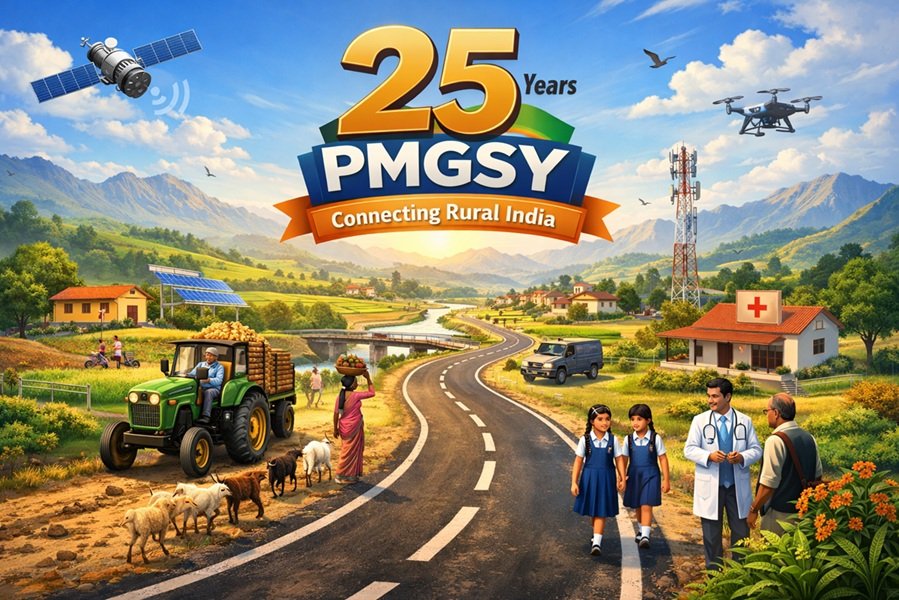
Celebrating 25 Years of Pradhan Mantri Gram Sadak Yojana (PMGSY): Transforming Rural Connectivity in India
Key Highlights at a Glance
- Since inception, 8,25,114 km of rural roads have been sanctioned under PMGSY, with 7,87,520 km completed, achieving nearly 95–96% physical progress.
- Under PMGSY–III, 1,22,393 km were sanctioned and 1,01,623 km successfully constructed.
- PMGSY–IV (2024–29) aims to connect 25,000 unconnected habitations through 62,500 km of roads, with a financial outlay of ₹70,125 crore.
- Advanced digital systems such as OMMAS, e-MARG, GPS tracking, and a three-tier quality monitoring framework ensure transparency, accountability, and durability.
Introduction: Roads as the Backbone of Rural Development
Road connectivity is a foundational element of rural development. It enables access to markets, education, healthcare, employment, and social services, while also playing a critical role in poverty reduction and inclusive economic growth. In a country as geographically and socially diverse as India, rural roads serve not merely as physical infrastructure but as catalysts of socio-economic transformation.
As the Pradhan Mantri Gram Sadak Yojana (PMGSY) completes 25 years in 2025, it stands out as one of India’s most impactful and enduring rural infrastructure programmes. Launched on 25 December 2000, PMGSY was envisioned to provide all-weather road connectivity to previously unconnected rural habitations. Over the past two and a half decades, it has reshaped India’s rural landscape by integrating villages into regional and national economic systems.
Beyond connectivity, PMGSY has strengthened agricultural supply chains, improved price realization for farmers, generated rural employment, enhanced access to education and healthcare, and supported non-farm livelihoods. Together, these outcomes underline the programme’s central role in advancing inclusive, sustainable, and resilient rural development.
From Connectivity to Consolidation: The Evolution of PMGSY
Since its inception, PMGSY has sanctioned 8,25,114 km of rural roads, of which 7,87,520 km have already been completed as of December 2025. This remarkable achievement reflects nearly 95 percent physical progress, highlighting the programme’s strong institutional framework and sustained policy commitment.
Sustained Budgetary Support
The Government of India’s continued emphasis on rural infrastructure is reflected in consistent budgetary allocations. For FY 2025–26, PMGSY received an allocation of ₹19,000 crore, reaffirming the programme’s strategic importance in strengthening rural connectivity, promoting economic opportunities, and ensuring balanced regional development.
Phase-wise Journey of PMGSY
PMGSY Phase I (2000): Laying the Foundation
Phase I, launched in 2000, was the flagship stage of the programme. Its primary objective was to provide all-weather road connectivity to eligible, previously unconnected rural habitations.
Under this phase:
- 1,63,339 rural habitations were sanctioned for road connectivity.
- Villages were linked to nearby markets, schools, healthcare facilities, and administrative centers.
- The phase laid the foundation for universal rural access and set benchmarks for planning, execution, and quality standards.
This phase transformed isolation into opportunity, enabling millions of rural residents to participate more actively in economic and social life.
PMGSY Phase II (2013): Strengthening the Network
Introduced in 2013, PMGSY Phase II shifted focus from expansion to consolidation and upgradation.
Key objectives included:
- Strengthening existing rural road networks.
- Upgrading economically important routes that connect villages to markets, growth centers, and service hubs.
- Improving transportation efficiency to accelerate rural economic activity.
By enhancing the quality and capacity of existing roads, Phase II ensured that rural connectivity translated into sustained economic gains.
Road Connectivity Project for Left Wing Extremism Affected Areas (RCPLWEA) – 2016
Launched in 2016, the RCPLWEA is a targeted intervention addressing infrastructure gaps in 44 severely Left Wing Extremism (LWE) affected districts and adjoining areas across nine states:
Andhra Pradesh, Bihar, Chhattisgarh, Jharkhand, Madhya Pradesh, Maharashtra, Odisha, Telangana, and Uttar Pradesh.
Dual Objectives of RCPLWEA:
- Strengthening security operations by improving mobility and logistical access for security forces.
- Promoting socio-economic development by enabling access to markets, schools, and healthcare in remote and underserved regions.
The scheme underscores how infrastructure development can simultaneously support national security and inclusive development.
PMGSY Phase III (2019): Strategic Rural Connectivity
Launched in 2019, PMGSY Phase III focuses on upgrading 1,25,000 km of Through Routes and Major Rural Links.
Key outcomes as of December 2025:
- 1,22,393 km sanctioned.
- 1,01,623 km constructed, achieving 83 percent completion.
Phase III has strengthened connectivity between rural habitations and:
- Gramin Agricultural Markets (GrAMs)
- Higher secondary schools
- Healthcare facilities
This phase has significantly enhanced rural mobility, improved access to essential services, expanded employment opportunities, and deepened integration with agricultural and non-agricultural markets.
PMGSY Phase IV (2024–29): Universal Last-Mile Connectivity
Approved in 2024, Phase IV represents the next frontier of rural connectivity.
Key Features:
- 62,500 km of roads to be constructed between FY 2024–25 and 2028–29.
- ₹70,125 crore total financial outlay.
- 25,000 unconnected habitations to receive all-weather road access.
Population Criteria:
- 500+ population in plain areas.
- 250+ population in North-Eastern and Himalayan States/UTs.
- Special category areas including:
- Scheduled V (Tribal) regions
- Aspirational Districts and Blocks
- Desert areas
Phase IV aims to achieve near-universal rural road connectivity, leaving no habitation behind.
Technology-Driven Governance and Quality Assurance
Online Management, Monitoring, and Accounting System (OMMAS)
OMMAS is the backbone of PMGSY’s digital governance framework. It enables:
- Real-time monitoring of physical and financial progress.
- Integration of Project Management Information System (PMIS).
- Transparent reporting of construction activities under PMGSY-III.
Quality inspections by National Quality Monitors (NQMs) and State Quality Monitors (SQMs) are uploaded via the Quality Monitoring System (QMS) mobile app, complete with geo-tagged photographs, ensuring end-to-end transparency.
e-MARG: Performance-Based Maintenance
The electronic Maintenance of Rural Roads (e-MARG) platform ensures systematic monitoring of road maintenance during the five-year Defect Liability Period (DLP).
Key benefits:
- Maintenance payments linked directly to road performance.
- Improved contractor accountability.
- Enhanced long-term durability of rural road assets.
GPS-Based Monitoring
Since May 2022, GPS-enabled Vehicle Tracking Systems (VTS) have been mandatory for all machinery and vehicles deployed under PMGSY-III.
This enables:
- Continuous monitoring of equipment usage.
- Verification of construction processes.
- Compliance with prescribed quality standards.
Innovation, Sustainability, and Climate Resilience
PMGSY actively promotes environmentally sustainable construction practices based on global best practices and indigenous research.
Eco-Friendly Materials and Technologies
- Fly ash and slag
- Construction and demolition waste
- Waste plastic and crumb rubber modified bitumen
- Geosynthetics and bio-bitumen
- Bio-engineering measures
Adoption of Innovative Methods
- Cold mix technology
- Full Depth Reclamation (FDR)
- Plastic waste utilization
As of July 2025, such technologies have been used in over 1.24 lakh km of roads, significantly improving durability while reducing environmental impact.
Three-Tier Quality Monitoring Framework
PMGSY’s quality assurance system operates at three levels:
- Tier I – Field-level checks by executing agencies.
- Tier II – Independent inspections by State Quality Monitors (SQMs).
- Tier III – Surprise audits by National Quality Monitors (NQMs).
All quality assessments are tracked in real time through OMMAS, ensuring accountability at every stage.
Conclusion: A Quarter Century of Rural Transformation
As the Pradhan Mantri Gram Sadak Yojana (PMGSY) completes 25 transformative years, it stands as a cornerstone of India’s rural development strategy. With nearly 96 percent of sanctioned road length completed, PMGSY has dramatically improved rural accessibility, strengthened market linkages, enhanced access to education and healthcare, and accelerated inclusive economic growth.
The programme’s phased evolution—from basic connectivity to network consolidation, strategic rural links, and universal last-mile access—reflects adaptive governance and long-term vision. The integration of digital monitoring systems, performance-based maintenance, GPS tracking, and a robust quality assurance framework has ensured transparency, durability, and climate resilience.
Aligned with the Sustainable Development Goals, PMGSY goes beyond infrastructure creation. It empowers communities, reduces poverty, promotes environmental sustainability, and continues to shape a more connected, resilient, and inclusive rural India.
Reference: https://www.pib.gov.in/PressReleasePage.aspx?PRID=2208381®=3&lang=1
