
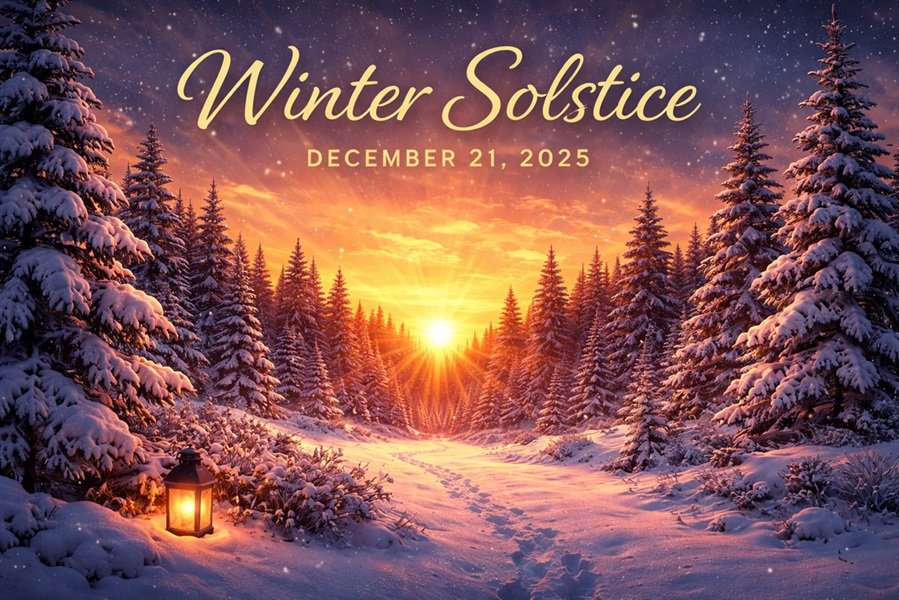
Winter Solstice on Sunday, December 21, 2025 – Shortest Day of the Year
The Winter Solstice on Sunday, December 21, 2025, marks one of the most significant astronomical events of the year. It is known as the Shortest Day of the Year, when daylight hours are at their minimum and nighttime lasts the longest in the Northern Hemisphere. This celestial turning point has fascinated humanity for thousands of years, influencing ancient calendars, agricultural cycles, religious beliefs, and cultural festivals across civilizations.
What Is the Winter Solstice?
The Winter Solstice occurs when the Earth’s axial tilt causes the Sun to reach its southernmost position in the sky. On this day, the Sun appears directly overhead at the Tropic of Capricorn (23.5° South latitude) at solar noon.
This event happens because Earth is tilted at approximately 23.5 degrees on its axis. As Earth orbits the Sun, this tilt results in varying sunlight distribution throughout the year, creating the seasons.
Winter Solstice 2025: Date and Day
- Event: Winter Solstice
- Date: Sunday, December 21, 2025
- Significance: Shortest Day & Longest Night of the Year
- Hemisphere Affected: Northern Hemisphere
After this day, daylight hours begin to gradually increase, signaling the slow return of longer days and the eventual arrival of spring.
Why Is December 21 the Shortest Day of the Year?
On the Winter Solstice:
- The Sun rises later and sets earlier than on any other day.
- The Sun’s path across the sky is at its lowest and shortest arc.
- Solar energy received is at its minimum for the year.
In many parts of India, daylight on this day lasts for approximately 10–10.5 hours, depending on latitude, while northern countries experience even fewer daylight hours.
Scientific Explanation Behind the Winter Solstice
The Winter Solstice is not caused by Earth being farther from the Sun. In fact:
- Earth is closer to the Sun in January (perihelion).
- Seasons are caused solely by Earth’s axial tilt, not distance.
During the Winter Solstice:
- The Northern Hemisphere tilts away from the Sun
- The Southern Hemisphere experiences summer solstice
Cultural and Historical Importance of the Winter Solstice
Ancient Civilizations
Many ancient cultures aligned monuments and calendars with the Winter Solstice:
- Stonehenge (England) – Designed to align with solstice sunrise and sunset
- Mayan Civilization – Used solstice observations for agricultural planning
- Ancient Egypt – Linked solar cycles with rebirth and life after death
Winter Solstice in Indian Tradition
In Indian philosophy and astronomy, the Winter Solstice is associated with Uttarayan’s approach, even though Makar Sankranti occurs later due to sidereal calculations.
Spiritual Significance
- The Sun begins its northward journey (Uttarayan)
- Considered an auspicious shift toward light and positivity
- Symbolizes inner awakening, discipline, and clarity
Winter Solstice Across World Cultures
Europe – Yule Festival
- Celebrated by ancient Germanic and Nordic tribes
- Honored the rebirth of the Sun
- Influenced modern Christmas traditions
China – Dongzhi Festival
- Celebrates balance of Yin and Yang
- Marks longer days ahead
- Families gather for warmth and harmony
Iran – Yalda Night
- Longest night of the year
- Celebrated with poetry, fruits, and family gatherings
- Symbol of victory of light over darkness
Astronomical Importance of Winter Solstice
From an astronomical perspective, the Winter Solstice:
- Marks one of the four major solar events (two solstices, two equinoxes)
- Is used to calculate solar calendars
- Helps scientists study Earth’s orbital mechanics and axial stability
Winter Solstice vs Summer Solstice
| Aspect | Winter Solstice | Summer Solstice |
|---|---|---|
| Daylight | Shortest | Longest |
| Night | Longest | Shortest |
| Sun Position | Southernmost | Northernmost |
| Season Start | Winter | Summer |
Symbolic Meaning of the Shortest Day of the Year
The Winter Solstice represents:
- Endings and new beginnings
- Triumph of light over darkness
- A reminder that even the darkest phase is temporary
- Hope, renewal, and transformation
This symbolism has been echoed in religious texts, philosophical teachings, and seasonal rituals worldwide.
How People Observe the Winter Solstice Today
Modern observances include:
- Meditation and reflection
- Lighting candles or lamps
- Nature walks and sky observation
- Spiritual gatherings and cultural events
Many people use this day to reset goals, reflect on the year, and prepare mentally for the months ahead.
Importance of Winter Solstice in Modern Life
Even today, the Winter Solstice influences:
- Climate patterns
- Agriculture and farming cycles
- Mental health awareness, especially regarding seasonal affective disorder (SAD)
- Energy consumption and daylight planning
Key Facts About Winter Solstice 2025
- Occurs on Sunday, December 21, 2025
- Marks the Shortest Day of the Year
- Sun reaches its lowest noon altitude
- Beginning of gradually lengthening days
Conclusion
The Winter Solstice on Sunday, December 21, 2025, is far more than just the Shortest Day of the Year. It is a profound astronomical milestone that connects science, spirituality, history, and human emotion. From ancient monuments to modern calendars, this day continues to remind us of nature’s rhythm and the certainty that light always returns after darkness.
As the Sun begins its slow journey back toward longer days, the Winter Solstice offers a powerful moment to pause, reflect, and embrace renewal.
