
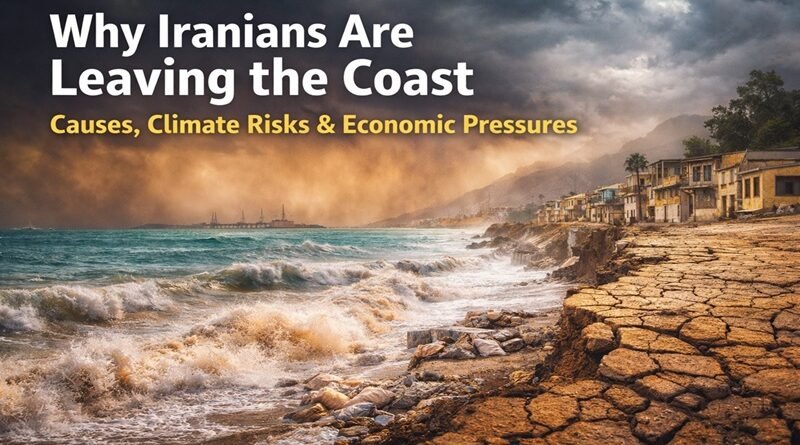
Why Iranians Are Leaving the Coast in Large Numbers
In recent years, reports and local accounts suggest that many Iranians are relocating away from coastal regions. While migration patterns are complex and vary by province, several overlapping factors—climate change, environmental degradation, economic stress, and infrastructure challenges—are influencing decisions to move.
This detailed explainer looks at what’s happening along the coasts of the Caspian Sea in the north and the Persian Gulf and Gulf of Oman in the south, and why some communities are choosing to relocate.
1) Climate Change and Rising Environmental Risks
Coastal Erosion & Flooding (North)
Provinces bordering the Caspian—such as Gilan and Mazandaran—have faced fluctuating sea levels and coastal erosion. Periodic storms and higher precipitation can increase flood risks, damaging homes, farms, and tourism facilities. When repeated flooding affects livelihoods, families often look inland for stability.
Extreme Heat & Sea-Level Pressure (South)
Along the Persian Gulf—especially near Bandar Abbas—heatwaves are becoming more intense. Combined with humidity, summer conditions can be physically dangerous. Sea-level rise and storm surges add to the long-term risk profile, particularly for low-lying neighborhoods.
2) Water Scarcity and Drought
Large parts of Iran have endured prolonged drought cycles. Inland water mismanagement can also impact coastal zones:
- Saltwater intrusion into freshwater aquifers
- Reduced agricultural yields
- Shrinking wetlands and fisheries
In the southwest, Khuzestan has seen water shortages and dust storms linked to drying wetlands and river basin stress. For farming and fishing communities, unstable water access is a powerful migration trigger.
3) Economic Pressures and Employment Shifts
Coastal economies often depend on:
- Fishing
- Tourism
- Port trade
- Small-scale agriculture
When climate stress, sanctions, inflation, and global market disruptions hit simultaneously, coastal jobs can become uncertain. Some residents move to larger urban centers seeking diversified employment, education, and healthcare.
Key urban destinations include:
- Tehran
- Isfahan
- Shiraz
Urban migration is not new—but environmental instability is accelerating the pace in certain districts.
4) Infrastructure and Urban Services
Coastal towns can face:
- Aging drainage systems
- Limited hospital capacity
- Power disruptions during extreme heat
- Housing damage from humidity and salt corrosion
When repeated repair costs outweigh local income, families consider relocation. Younger generations, in particular, may prefer cities offering stronger digital infrastructure and education options.
5) Environmental Degradation & Fisheries Decline
The Caspian region has experienced:
- Changes in fish populations
- Industrial pollution concerns
- Overfishing pressure
Similarly, warming waters in the Persian Gulf can affect marine ecosystems. For households reliant on fishing, declining catches reduce income security, prompting internal migration.
6) Is This a Mass Exodus?
It’s important to note:
- Not all coastal regions are emptying.
- Some coastal cities continue to grow due to trade and tourism.
- Migration is often gradual, not sudden.
However, localized population decline has been observed in vulnerable zones—especially where environmental risks intersect with economic hardship.
7) Government & Policy Responses
Iran has invested in:
- Coastal defense and seawalls
- Water management projects
- Urban housing expansion
- Port modernization
Long-term solutions may require:
- Climate adaptation planning
- Sustainable fisheries management
- Improved groundwater protection
- Economic diversification
Broader Context: Climate Migration in the Middle East
Iran is not alone. Across the Middle East, rising temperatures and water scarcity are reshaping settlement patterns. Coastal and river-basin communities are often on the frontline of climate stress.
Experts describe this trend as “climate-induced internal migration”—where people move within their own country rather than across borders.
Key Reasons Iranians Are Leaving Coastal Areas (Summary)
- Rising flood and storm risk
- Extreme heat and humidity
- Water shortages and drought
- Declining fisheries and agriculture
- Economic instability
- Better job opportunities inland
- Infrastructure strain
Conclusion
The movement of people away from certain Iranian coastal areas reflects a mix of environmental change, economic realities, and future uncertainty. While not uniform across all regions, vulnerable coastal communities face increasing pressure.
Understanding these dynamics is crucial—not only for policymakers but also for businesses, researchers, and climate planners across the region.
