
When Did the New Year’s Eve Ball First Drop in Times Square?
Every year, as December 31 draws to a close, the world turns its attention to Times Square in New York City. Millions watch as a glowing ball slowly descends, counting down the final seconds before a new year begins. This moment has become a global symbol of hope, renewal, and celebration. But behind this iconic ritual lies a fascinating history that began more than a century ago.
So, when did the New Year’s Eve Ball first drop in Times Square?
The answer takes us back to the early 20th century — specifically to December 31, 1907, when the first Ball Drop welcomed the year 1908.
Times Square Before the Ball Drop
Times Square was not always known by its current name. In the late 1800s, the area was called Longacre Square, known primarily for carriage houses and commercial activity. Its transformation began in 1904, when The New York Times moved its headquarters to a newly built tower at the intersection of Broadway and Seventh Avenue.
To celebrate the opening of the building, the newspaper organized a grand New Year’s Eve celebration. The event included fireworks and public festivities, drawing tens of thousands of people. These celebrations were so successful that Times Square quickly became New York City’s central location for welcoming the New Year.
Why a New Tradition Was Needed in 1907
For the first few years, fireworks were the highlight of Times Square’s New Year’s Eve celebrations. However, by 1907, city authorities imposed restrictions on fireworks due to growing safety concerns in crowded urban areas. This left organizers searching for a new way to create a dramatic and memorable midnight moment.
The challenge was clear: how could they replace fireworks with something just as powerful — and even more symbolic?
The Idea Behind the Ball Drop
The solution came from an older concept known as a “time ball.” In the 19th century, time balls were used in ports and cities around the world. These large balls were dropped from towers at a precise moment each day so ships and businesses could set their clocks accurately.
Inspired by this practical timekeeping device, organizers in Times Square adapted the idea into a public spectacle. Instead of marking daily time, the ball would mark the exact moment a new year begins.
The First New Year’s Eve Ball Drop (1907)
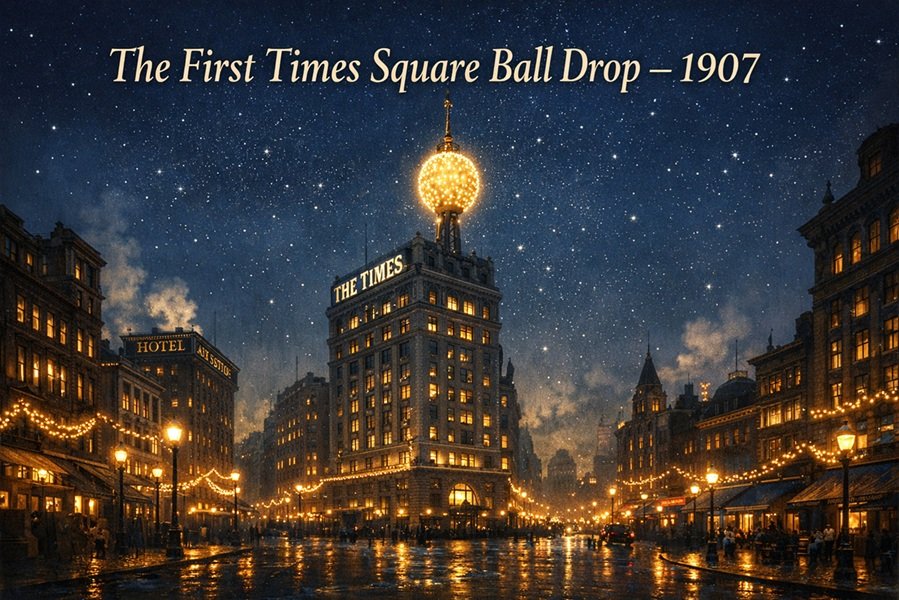
On the night of December 31, 1907, crowds gathered outside the Times Tower (now called One Times Square). At midnight, a specially designed ball was lowered from a flagpole atop the building, signaling the arrival of January 1, 1908.
This was the first official New Year’s Eve Ball Drop in Times Square.
The original ball was modest compared to today’s version:
- It was made of iron and wood
- Measured about five feet in diameter
- Weighed approximately 700 pounds
- Lit with around 100 incandescent light bulbs
Despite its simplicity, the moment captured the public’s imagination and instantly became a new tradition.
Who Built the Original Ball?
The first Times Square Ball was designed and built by Jacob Starr, a young immigrant metalworker. His company later became part of Artkraft Strauss, which would play a major role in producing and maintaining the Ball for many decades.
This craftsmanship laid the foundation for a tradition that blended engineering, symbolism, and public celebration.
How the Ball Drop Became a Global Icon
Since 1907, the Ball Drop has taken place almost every year, with only a brief pause during 1942 and 1943, when wartime lighting restrictions during World War II prevented its use.
Over the decades, the Ball evolved:
- From wood and iron to aluminum
- From basic light bulbs to advanced LED systems
- From a local event to a globally televised celebration
Today, the Times Square Ball is covered with thousands of crystal panels and watched by hundreds of millions of people worldwide.
Why the Ball Drop Still Matters
The enduring power of the Ball Drop lies in its symbolism. The slow descent represents the passing of time, while the final moment at midnight captures a universal feeling — the hope that the coming year will be better than the last.
What began as a creative alternative to fireworks has become one of the most recognizable traditions on Earth.
Conclusion
The New Year’s Eve Ball first dropped in Times Square on December 31, 1907, welcoming the year 1908. Born out of necessity and inspired by timekeeping history, the Ball Drop transformed Times Square into the world’s most famous New Year’s Eve destination.
More than a century later, the tradition continues — reminding people everywhere that no matter how times change, the desire to celebrate new beginnings remains timeless.
Reference
- Official Times Square New Year’s Eve History
Times Square Alliance
https://www.timessquarenyc.org/nye/nye-history-times-square-ball
