
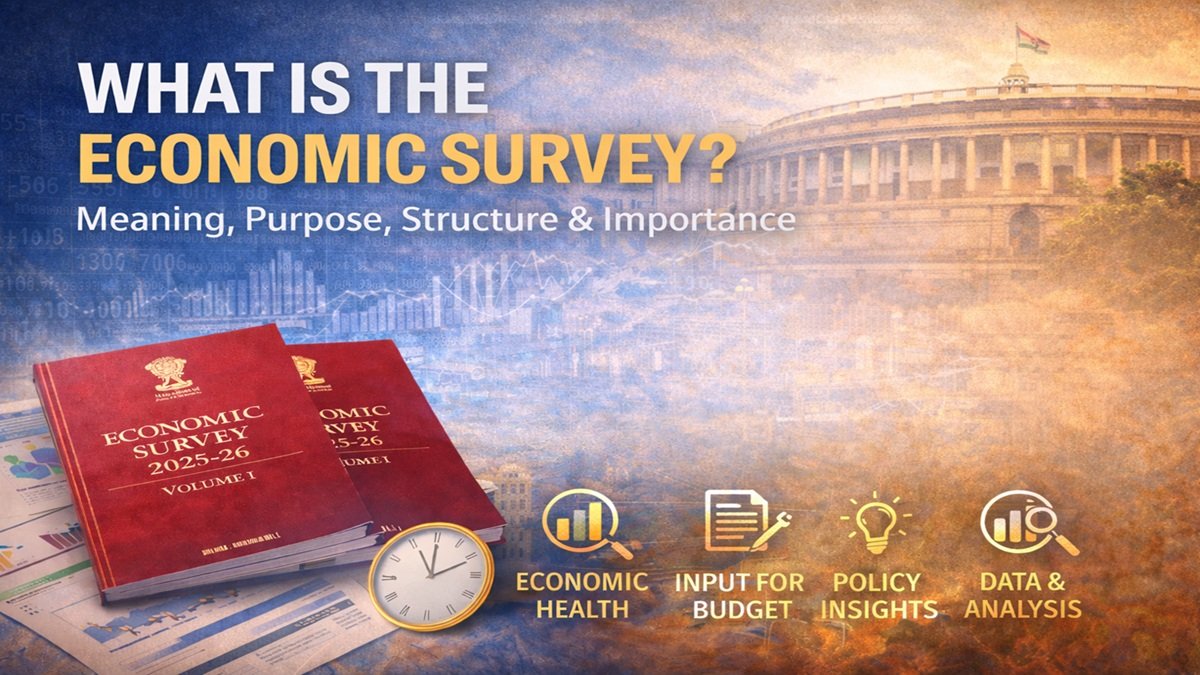
What Is the Economic Survey? Meaning, Purpose, Structure and Importance Explained
Introduction
Every year, just a day before the Union Budget is presented, the Government of India places an important document before Parliament — the Economic Survey. While the Union Budget looks ahead and lays out plans for the coming financial year, the Economic Survey looks back, offering a comprehensive and data-driven assessment of India’s economic performance.
For policymakers, investors, economists, students, and citizens alike, the Economic Survey serves as a diagnostic report of the Indian economy, explaining what worked, what did not, and what challenges lie ahead.
What Is the Economic Survey?
The Economic Survey is an annual official document prepared by the Government of India and presented in Parliament of India before the Union Budget.
It provides:
- A detailed review of the state of the Indian economy
- Analysis of macroeconomic trends
- Sector-wise performance assessment
- Policy challenges and reform priorities
Although it has no legal binding force, the Economic Survey strongly influences Budget decisions, policy formulation, and economic debate.
Who Prepares the Economic Survey?
The Economic Survey is prepared by the Economic Division of the Department of Economic Affairs under the Ministry of Finance.
It is drafted under the guidance of the Chief Economic Adviser (CEA) to the Government of India and reflects:
- Government data and official statistics
- Economic research and academic inputs
- Policy insights from various ministries and institutions
The final document is approved by the Finance Minister before being tabled in Parliament.
When Is the Economic Survey Presented?
Traditionally, the Economic Survey is presented:
- One day before the Union Budget
- During the Budget Session of Parliament
- Usually in the Lok Sabha
For example, if the Union Budget is presented on 1 February, the Economic Survey is typically tabled on 31 January (or the nearest working day).
Why Is the Economic Survey Important?
The Economic Survey plays a critical role in India’s economic governance for several reasons:
1. Official Assessment of the Economy
It is the government’s authoritative view on:
- Growth trends
- Inflation
- Employment
- Fiscal health
- External sector performance
2. Foundation for the Union Budget
Many Budget proposals are rooted in:
- Economic challenges identified in the Survey
- Sectoral recommendations made by the CEA’s team
3. Transparency and Accountability
By publicly acknowledging economic strengths and weaknesses, the Survey enhances:
- Policy transparency
- Democratic accountability
4. Reference for Investors and Analysts
Domestic and global investors rely on the Survey to:
- Understand India’s macroeconomic direction
- Assess policy continuity and reform momentum
What Does the Economic Survey Contain?
The Economic Survey is usually divided into two volumes, each serving a distinct purpose.
Structure of the Economic Survey
Volume 1: Analytical and Thematic Assessment
This volume focuses on:
- Medium-term economic outlook
- Structural reforms
- Governance and institutional capacity
- New policy ideas and frameworks
It often includes:
- Thematic chapters on productivity, innovation, sustainability, or inclusive growth
- Conceptual models and reform roadmaps
Volume 2: Sectoral and Statistical Review
This volume provides:
- Detailed sector-wise analysis
- Comprehensive data tables
- Performance review of the current financial year
Key Areas Covered in the Economic Survey
1. Economic Growth
- GDP growth trends
- Comparison with global and emerging economies
- Drivers of growth and slowdown
2. Inflation and Prices
- Retail and wholesale inflation trends
- Food and fuel price movements
- Monetary policy implications
3. Fiscal Developments
- Fiscal deficit
- Government revenue and expenditure patterns
- Debt sustainability
4. External Sector
- Exports and imports
- Current account balance
- Foreign exchange reserves
- Capital flows
5. Monetary and Financial Sector
- Banking system health
- Credit growth
- Financial stability indicators
6. Sectoral Performance
- Agriculture
- Industry and manufacturing
- Services
- Infrastructure and energy
7. Social Sector and Human Development
- Poverty and inequality trends
- Employment and labour markets
- Health and education indicators
Economic Survey vs Union Budget
| Aspect | Economic Survey | Union Budget |
|---|---|---|
| Nature | Analytical & review-based | Policy & allocation-based |
| Focus | Past and present economy | Future financial planning |
| Legal Status | Advisory | Constitutional requirement |
| Presented by | Finance Minister | Finance Minister |
| Objective | Diagnosis | Action plan |
In simple terms, the Economic Survey explains the “why”, while the Union Budget explains the “how”.
Does the Economic Survey Have Legal Authority?
No. The Economic Survey:
- Is not legally binding
- Does not mandate policy changes
- Serves as an advisory and analytical document
However, its recommendations often influence:
- Budget announcements
- Economic reforms
- Public policy debates
Role of the Chief Economic Adviser (CEA)
The Chief Economic Adviser plays a central role in shaping:
- The analytical tone of the Survey
- The policy narrative
- The reform philosophy
Different CEAs have left distinctive imprints on the Survey, making it not just a statistical document but also an intellectual blueprint for economic governance.
How Is the Economic Survey Different from Other Reports?
Unlike reports from think tanks or international institutions:
- The Economic Survey represents the official position of the Government of India
- It has direct access to government data
- It aligns closely with India’s policy and reform agenda
Institutions like NITI Aayog and the Reserve Bank of India may publish economic assessments, but the Economic Survey remains the flagship annual review.
Who Should Read the Economic Survey?
The Economic Survey is especially useful for:
- UPSC and state civil service aspirants
- Economists and researchers
- Business leaders and investors
- Policymakers and administrators
- Students of economics, commerce, and public policy
Criticism and Limitations of the Economic Survey
Despite its importance, the Economic Survey is sometimes criticised for:
- Optimistic assumptions
- Limited focus on informal sector data
- Underrepresentation of ground-level distress
Nevertheless, it remains the most comprehensive official economic document produced annually in India.
Read This: Budget 2026 – Date, Time, When and Where to Watch Live?
Conclusion
The Economic Survey is far more than a pre-Budget ritual. It is the intellectual foundation of India’s economic policymaking, offering a transparent, data-backed, and structured review of the economy’s performance.
By diagnosing challenges, highlighting opportunities, and suggesting reform directions, the Economic Survey bridges the gap between economic reality and policy action. For anyone seeking to understand India’s economy beyond headlines, the Economic Survey remains an indispensable resource.
