
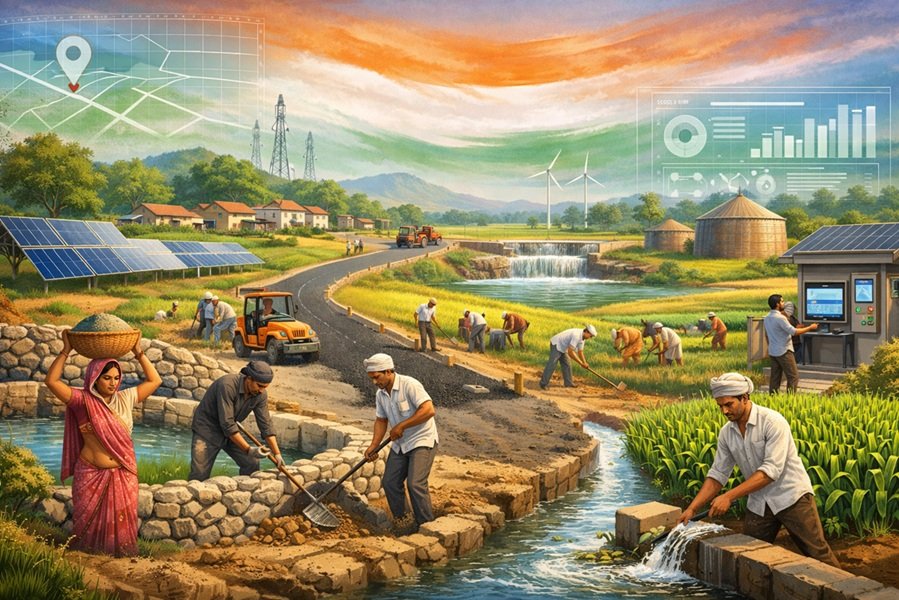
Viksit Bharat–G RAM G Act, 2025: Reforming Rural Employment for a Developed India
Introduction: A New Era in Rural Employment Policy
Rural employment has long been a foundational pillar of India’s social protection and poverty alleviation strategy. For nearly two decades, the Mahatma Gandhi National Rural Employment Guarantee Act (MGNREGA) has provided wage employment, income stability, and community assets to millions of rural households. However, rural India in 2025 is fundamentally different from rural India in 2005.
With rising rural incomes, expanding digital infrastructure, improved connectivity, diversified livelihood options, and declining poverty, the demands placed on rural employment programmes have evolved. Recognising this transformation, the President of India has accorded assent to the Viksit Bharat–Guarantee for Rozgar and Ajeevika Mission (Gramin) Act, 2025, popularly referred to as the Viksit Bharat–G RAM G Act, 2025.
This landmark legislation represents a comprehensive statutory overhaul of MGNREGA, repositioning rural employment not merely as a welfare measure, but as a strategic development instrument aligned with the national vision of Viksit Bharat 2047. The Act strengthens income security, improves infrastructure outcomes, enhances accountability, and integrates rural employment with climate resilience and long-term growth objectives.
Historical Context: Evolution of Rural Employment Policy in India
Early Post-Independence Initiatives
Since Independence, India’s rural development strategy has consistently focused on reducing poverty, absorbing surplus labour, and stabilising rural incomes. Wage employment programmes emerged as key tools to address seasonal unemployment and underemployment in agriculture.
Early initiatives included:
- Rural Manpower Programme (1960s)
- Crash Scheme for Rural Employment (1971)
These schemes laid the groundwork for state-supported employment but suffered from limited coverage and weak institutional frameworks.
Consolidation and Expansion (1980s–1990s)
The 1980s and 1990s saw more structured programmes such as:
- National Rural Employment Programme (NREP)
- Rural Landless Employment Guarantee Programme (RLEGP)
- Jawahar Rozgar Yojana (1993)
- Sampoorna Grameen Rozgar Yojana (1999)
Parallel initiatives like the Employment Assurance Scheme and Food for Work Programme attempted to address food security alongside employment.
The Turning Point: Legal Right to Work
A major conceptual breakthrough came with the Maharashtra Employment Guarantee Act, 1977, which introduced the idea of a statutory right to employment. This principle eventually culminated in the enactment of MGNREGA in 2005, providing a nationwide legal guarantee of wage employment.
MGNREGA: Achievements and Structural Limitations
Major Achievements
MGNREGA transformed rural employment policy by guaranteeing 100 days of wage employment per rural household annually. Over time, multiple reforms enhanced its delivery and transparency:
- Women’s participation increased from 48% (FY 2013–14) to over 58% (FY 2025–26)
- Near-universal adoption of electronic wage payments
- Large-scale Aadhaar seeding and Aadhaar-Based Payment Systems
- Expansion of geo-tagged assets and individual household-level works
- Strengthened digital attendance and monitoring mechanisms
The programme also relied heavily on field-level staff, who sustained implementation despite limited administrative capacity.
Persistent Challenges
Despite operational improvements, deeper structural issues persisted:
- Mismatch between financial expenditure and physical outcomes
- Instances of works not existing on the ground
- Use of machinery in labour-intensive works
- Circumvention of digital attendance systems
- Accumulated misappropriation in some regions
- Declining ability of households to complete 100 days of work, especially post-pandemic
These challenges indicated that incremental administrative reforms were no longer sufficient, and that a fundamental legislative redesign was required.
Why a New Law Was Necessary
Changing Rural Realities
MGNREGA was conceptualised for a rural economy marked by high poverty and limited alternatives. However, rural India has since undergone significant transformation:
- Poverty declined from 27.1% (2011–12) to 5.3% (2022–23)
- Greater financial inclusion and digital access
- Expanded welfare coverage
- Increasing diversification into non-farm livelihoods
In this context, the open-ended, demand-driven model of MGNREGA no longer aligned fully with current rural labour dynamics or fiscal planning needs.
Strategic Shift in Policy Thinking
The Viksit Bharat–G RAM G Act, 2025 responds to this reality by:
- Modernising employment guarantees
- Strengthening accountability and enforcement
- Aligning employment creation with infrastructure development, climate resilience, and regional planning
- Embedding rural employment within a broader development framework
Key Features of the Viksit Bharat–G RAM G Act, 2025
Expanded Employment Guarantee
- 125 days of guaranteed wage employment per rural household per financial year
- Introduction of an aggregated 60-day no-work window during peak sowing and harvesting seasons
- Remaining 305 days ensure full access to the 125-day guarantee, balancing farmer and labour interests
- Wages to be paid weekly or within 15 days, ensuring timely income support
Four Priority Development Verticals
Employment generation is directly linked to productive asset creation under four focused verticals:
- Water Security
- Water harvesting, irrigation, groundwater recharge
- Core Rural Infrastructure
- Roads, connectivity, essential village infrastructure
- Livelihood-Related Infrastructure
- Storage facilities, markets, production assets
- Climate Resilience Works
- Flood control, soil conservation, extreme weather mitigation
Integrated National Infrastructure Planning
- All assets are aggregated into the Viksit Bharat National Rural Infrastructure Stack
- Local planning through Viksit Gram Panchayat Plans
- Spatial integration with national platforms such as PM Gati Shakti
MGNREGA vs Viksit Bharat–G RAM G Act, 2025
The new Act represents a qualitative leap over MGNREGA by:
- Increasing guaranteed employment days
- Replacing unpredictable demand-based funding with normative allocations
- Strengthening planning, monitoring, and accountability
- Linking employment directly with national development priorities
Financial Architecture and Normative Funding Model
Shift to Centrally Sponsored Framework
The Act transitions rural employment from a central sector scheme to a centrally sponsored model, reflecting the inherently local nature of employment and asset creation.
Normative Allocation Explained
Under normative funding:
- Funds are allocated using objective parameters
- Budgeting becomes predictable and rational
- Legal entitlement to employment or unemployment allowance remains intact
This replaces the volatility of demand-based allocations while preserving worker rights.
Funding Structure
- Total annual estimated requirement: ₹1,51,282 crore
- Central share: ₹95,692.31 crore
- Cost-sharing ratios:
- 60:40 (Centre:States)
- 90:10 for North-Eastern and Himalayan states
- 100% Central funding for UTs without legislatures
The framework strengthens fiscal discipline while allowing disaster-related additional assistance.
Economic and Social Benefits
For Rural Economy
- Higher household incomes due to expanded employment
- Increased village-level consumption
- Reduced distress-driven migration
- Stronger climate resilience and water security
For Farmers
- Assured labour availability during peak seasons
- Prevention of wage inflation
- Improved irrigation, storage, and connectivity
For Labourers
- Higher potential earnings
- Predictable work planning
- Secure digital wage payments
- Mandatory unemployment allowance if work is not provided within 15 days
Institutional Framework for Implementation
The Act establishes a multi-tier governance structure:
- Central & State Gramin Rozgar Guarantee Councils – policy guidance and oversight
- National & State Steering Committees – strategic coordination and performance review
- Panchayati Raj Institutions – planning and execution
- Gram Panchayats – at least 50% of works by cost
- District Programme Coordinators & Programme Officers – compliance and payments
- Gram Sabhas – enhanced social audit and transparency roles
Transparency, Accountability, and Digital Governance
The Act empowers the Centre to:
- Investigate complaints
- Suspend funds in cases of serious irregularities
- Direct corrective actions
Key transparency measures include:
- AI-based irregularity detection
- Biometric authentication
- GPS and mobile-based real-time monitoring
- Public MIS dashboards with weekly disclosures
- Mandatory social audits at least once every six months
These provisions create a robust accountability ecosystem grounded in technology and community participation.
Conclusion: Repositioning Rural Employment for Viksit Bharat 2047
The Viksit Bharat–Guarantee for Rozgar and Ajeevika Mission (Gramin) Act, 2025 marks a decisive shift in India’s rural development strategy. While MGNREGA laid a strong foundation in employment generation and digital governance, its structural limitations necessitated a new approach.
By expanding guaranteed employment, modernising financial architecture, embedding accountability, and aligning rural works with national development priorities, the Act transforms rural employment into a strategic engine of sustainable growth and resilience.
Fully aligned with the vision of Viksit Bharat 2047, the Act positions rural India not as a recipient of welfare, but as an active partner in India’s long-term development journey.
Reference: https://www.pib.gov.in/PressNoteDetails.aspx?NoteId=156634&ModuleId=3®=3&lang=1
