
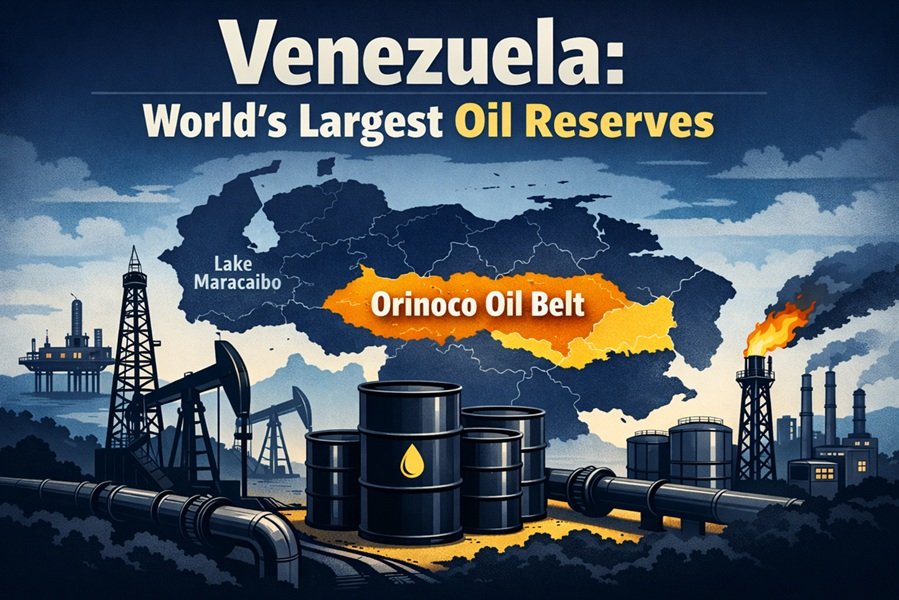
Venezuela’s Oil Reserves: Why the World’s Richest Oil Nation Still Struggles
Venezuela is often described as a paradox in the global energy landscape. On one hand, it possesses the largest proven oil reserves in the world; on the other, it struggles with low production, economic instability, and declining influence in the global oil market. Understanding Venezuela’s oil reserves helps explain not only its economy but also its politics, foreign relations, and long-term future.
Venezuela and Its Oil Wealth
Venezuela officially holds around 303 billion barrels of proven crude oil reserves, ranking first globally, ahead of Saudi Arabia, Iran, Canada, and Iraq. This immense resource base has shaped Venezuela’s national identity and economic model for over a century.
Oil was discovered in Venezuela in the early 20th century, and by the 1920s the country had already become one of the world’s leading exporters. Since then, petroleum has remained the backbone of the Venezuelan economy.
Where Are Venezuela’s Oil Reserves Located?
1. Orinoco Oil Belt (Faja Petrolífera del Orinoco)
The Orinoco Oil Belt is the heart of Venezuela’s oil wealth.
- Contains 85–90% of total reserves
- Oil type: extra-heavy crude
- One of the largest oil accumulations on Earth
This oil is extremely thick, similar to bitumen, and cannot be pumped or refined easily without advanced technology and blending with lighter crude.
2. Lake Maracaibo Basin
The Lake Maracaibo region represents Venezuela’s traditional oil heartland.
- One of the oldest oil-producing regions in the world
- Produces relatively lighter crude
- Infrastructure is aging but historically significant
Nature of Venezuelan Crude Oil
Most Venezuelan oil is:
- Heavy to extra-heavy
- High in sulfur and metals
- Expensive to extract and refine
Unlike Middle Eastern light crude, Venezuelan oil requires:
- Upgraders to convert it into synthetic crude
- Dilution with imported lighter oil
- Specialized refineries (mainly in the US and Asia)
This technical complexity is one of the biggest reasons Venezuela’s oil wealth is difficult to monetize.
Role of PDVSA
The oil sector is dominated by the state-owned company:
PDVSA
(Petróleos de Venezuela S.A.)
At its peak, PDVSA was considered one of the world’s most efficient national oil companies. The oil sector once contributed:
- 95% of export earnings
- Over 25% of GDP
- Majority of government revenue
However, years of underinvestment, political interference, and mismanagement severely weakened the company’s operational capacity.
Oil Production: From Global Giant to Decline
- Peak production (late 1990s): ~3.2 million barrels/day
- Lowest levels (around 2020): below 700,000 barrels/day
- Recent years: gradual recovery but still far below potential
Despite having massive reserves, Venezuela produces less oil than many countries with far smaller resource bases.
Impact of Sanctions and Global Politics
Venezuela is a founding member of:
OPEC
However, international sanctions—especially from the United States—have:
- Restricted oil exports
- Limited access to foreign investment and technology
- Reduced refining and shipping options
Sanctions combined with domestic challenges have isolated Venezuela from global energy markets, even as global demand for oil remains strong.
Why Venezuela’s Oil Reserves Remain Underutilized
Several factors explain the gap between reserves and production:
- Technical complexity of extra-heavy crude
- Lack of investment and modern equipment
- Skilled labor migration
- Aging infrastructure
- Financial constraints and debt
- Sanctions and geopolitical pressure
Oil reserves alone do not guarantee prosperity—efficient institutions and stable policies matter just as much.
Global Comparison: Proven Oil Reserves
| Country | Proven Reserves (Billion Barrels) |
|---|---|
| Venezuela | ~303 |
| Saudi Arabia | ~267 |
| Iran | ~209 |
| Canada | ~168 |
| Iraq | ~145 |
Despite ranking first, Venezuela’s production efficiency is among the lowest in this group.
Can Venezuela’s Oil Save Its Economy?
Venezuela’s oil reserves remain a strategic global asset. If:
- Sanctions ease,
- Foreign investment returns,
- Infrastructure is modernized,
the country could once again become a major oil supplier. However, without reforms, its vast reserves may remain largely untapped underground wealth.
Conclusion
Venezuela’s oil story is a powerful lesson in global economics: natural resources alone do not create prosperity. While the country sits atop the world’s largest oil reserves, political stability, technical expertise, and international cooperation will determine whether this oil becomes a blessing or remains an unrealized promise.
