
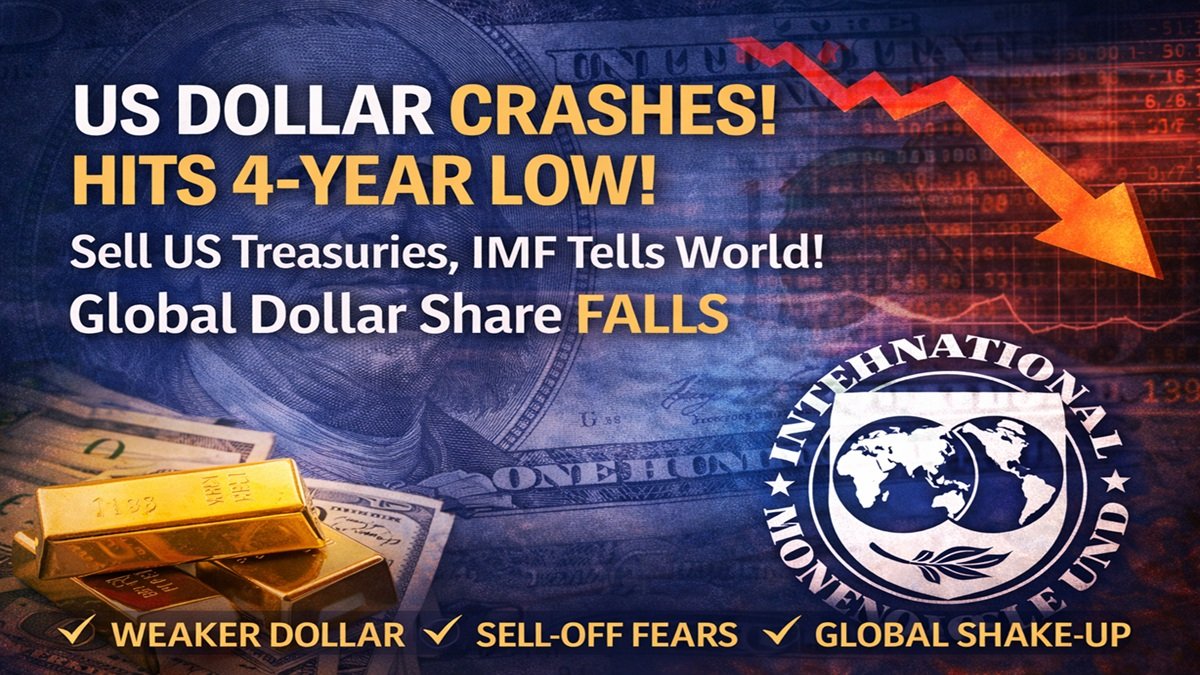
US Dollar Slides to 4-Year Low: What the Global Sell-Off Signals for the World Economy
The global financial system is witnessing a notable shift as the US dollar weakens sharply, touching its lowest level in nearly four years. Currency markets, central banks, and investors across continents are reassessing long-held assumptions about the dollar’s dominance, US government debt, and the future structure of global reserves.
While dramatic headlines claim that international institutions are urging a sell-off of US Treasuries, the reality is more complex — and far more significant in the long run.
The Dollar’s Sudden Fall: What Happened?
In late January 2026, the US dollar declined sharply against a basket of major global currencies, including the euro, yen, and Swiss franc. Currency indices tracking the dollar recorded their weakest readings since 2022, reflecting sustained selling pressure rather than a one-day fluctuation.
This decline occurred despite the absence of a major financial crisis, signalling that confidence dynamics, rather than emergency conditions, are driving the move.
At the same time:
- Gold prices surged as investors sought value protection
- Emerging market currencies gained relative strength
- Capital flowed toward non-dollar assets
Why Is the Dollar Losing Strength?
1. Confidence, Not Interest Rates, Is the Key Driver
Traditionally, the US dollar weakens when the Federal Reserve cuts interest rates. This time, the slide happened without an immediate rate-cut cycle, indicating that markets are reacting to policy direction and credibility, not monetary mechanics alone.
Unclear fiscal messaging, rising public debt, and political uncertainty have increased risk perception around US assets.
2. Fiscal Stress and Expanding US Debt
The United States continues to finance large fiscal deficits through borrowing. While this has been manageable historically, investors are increasingly questioning:
- Long-term debt sustainability
- Political consensus on fiscal discipline
- The ability to stabilise deficits without economic pain
As a result, demand for US government securities is becoming more selective, especially among foreign holders.
3. Global Shift Toward Asset Diversification
Central banks and sovereign investors are gradually rebalancing portfolios:
- Reducing overexposure to dollar-denominated assets
- Increasing allocations to gold, regional currencies, and non-US bonds
- Exploring alternative settlement mechanisms for trade
This process, often described as “de-dollarisation,” is not abrupt — but it is structural and persistent.
Did the IMF Ask the World to Sell US Treasuries?
Despite viral claims and sensational headlines, there is no official directive from the International Monetary Fund (IMF) instructing countries to dump US Treasuries.
What has happened instead:
- IMF data shows a steady decline in the dollar’s share of global foreign exchange reserves over many years
- International financial institutions encourage risk diversification, not mass liquidation
- Central banks are independently adjusting portfolios based on national interests
In short, market behaviour is changing organically, not through coordinated global orders.
What’s Happening to the Dollar’s Global Share?
The US dollar remains the world’s largest reserve currency, but its share has been gradually shrinking from historical peaks.
Key trends include:
- Reduced reliance on a single reserve asset
- Growing use of regional currencies for bilateral trade
- Increased role of gold as a neutral store of value
This does not mean the dollar is collapsing — it means the global system is becoming more multipolar.
What About US Treasuries?
US Treasury bonds are still among the most liquid and trusted financial instruments globally. However:
- Some foreign holders are slowing new purchases
- Others are reallocating into shorter-duration bonds
- Yield sensitivity has increased
A weaker dollar can push Treasury yields higher, which may eventually attract investors back — creating a self-correcting loop, at least in the short term.
Global Impact: Who Gains and Who Loses?
United States
- Exports become more competitive
- Imports become more expensive
- Inflation risks rise if the dollar stays weak
Emerging Markets
- Reduced pressure on dollar-denominated debt
- Stronger local currencies improve capital flows
Commodities
- Dollar weakness supports higher commodity prices
- Gold benefits the most during confidence transitions
Is the Dollar’s Dominance Ending?
No — but it is evolving.
The US dollar is unlikely to lose its global role overnight. However, its absolute dominance is giving way to shared monetary influence, where:
- Multiple reserve currencies coexist
- Financial power is more distributed
- Policy credibility becomes as important as economic size
This transition will play out over years, not months.
The Bigger Picture
What markets are signalling is not panic — but rebalancing.
The dollar’s fall to a four-year low reflects:
- Changing geopolitical alignments
- Rising importance of trust and predictability
- A world less willing to depend on a single financial anchor
Rather than a crash, this moment represents a stress test for the global monetary order.
Conclusion
The US dollar’s recent decline is a warning, not a verdict. It highlights how deeply confidence, governance, and long-term policy clarity matter in sustaining financial leadership.
There is no global order to abandon US Treasuries — but there is a global movement toward diversification, resilience, and strategic autonomy. How the US responds will determine whether the dollar regains momentum or continues to slowly yield space in a changing world economy.
