
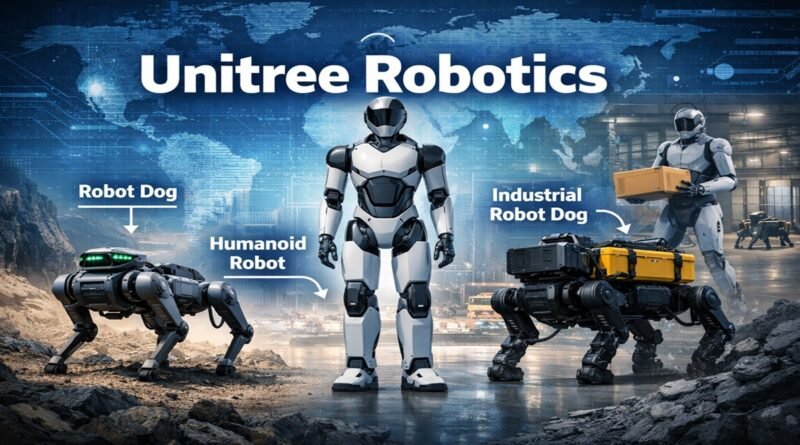
Unitree Robotics: The Company Bringing Affordable Humanoid and Robot Dog Technology to the World
Robots that walk like humans and run like animals were once science fiction. Today, they are real — and surprisingly affordable. One of the companies leading this transformation is Unitree Robotics, a fast-growing robotics manufacturer known for its agile quadruped robot dogs and advanced humanoid robots.
Unlike traditional robotics giants that focus mainly on industrial automation, Unitree aims to make general-purpose robots accessible to universities, developers, startups, and even individuals. Because of this approach, the company has quickly become one of the most influential names in the modern robotics revolution.
About Unitree Robotics
Unitree Robotics is a robotics company founded in 2016 in Hangzhou, China by engineer Wang Xingxing. The company specializes in:
- Legged robots (quadruped robot dogs)
- Humanoid robots
- AI motion control systems
- Robotic perception using LiDAR & vision
The core philosophy of Unitree is simple:
Build high-performance robots at mass-market prices.
This strategy disrupted the robotics industry, which traditionally produced robots costing hundreds of thousands or millions of dollars.
Why Unitree Became Popular So Fast
For years, advanced walking robots were only seen in research labs or military demonstrations because they were extremely expensive.
Unitree changed that by:
- Designing in-house motors and actuators
- Manufacturing components at scale
- Using optimized motion algorithms
- Selling directly to developers and institutions
As a result, robots that once cost $250,000+ now cost under $10,000–$100,000, depending on the model.
This affordability has accelerated robotics research globally.
Unitree Robot Dogs (Quadruped Robots)
Unitree is best known for its dog-like robots capable of balancing, running, climbing and navigating complex terrain.
Go1 – The First Mass-Market Robot Dog
The Go1 became the world’s first widely purchasable consumer robot dog.
Key Features
- Autonomous following mode
- Real-time obstacle avoidance
- AI vision tracking
- Gesture control
- Mapping and navigation
Typical Uses
- Robotics education
- Research projects
- Surveillance experiments
- AI development
- Computer vision testing
Because of its relatively low cost, many universities adopted it as a standard robotics platform.
Go2 – The AI-Enhanced Robot Dog
The Go2 is the upgraded intelligent version featuring significantly improved perception.
Improvements over Go1
- 4D LiDAR mapping
- Better balance control
- Faster running speed
- Edge AI computing
- Remote cloud monitoring
It is designed not only for labs but also for real-world operational tasks like inspection and patrol.
B2 – Industrial Inspection Robot
The B2 is a heavy-duty industrial quadruped.
Capabilities
- Carries heavy payloads
- Climbs stairs and rough terrain
- Operates in hazardous environments
- Long operational runtime
Industries using it:
- Power plants
- Oil & gas facilities
- Mining operations
- Disaster inspection
Unitree Humanoid Robots
Unitree expanded from robot dogs into humanoid robots — machines designed to work in human environments.
H1 – The Full-Size Humanoid Robot
The H1 is one of the fastest commercially available humanoid robots.
Technical Specifications
- Height: approx. 1.8 meters
- High-torque joint motors
- Advanced dynamic balancing
- 3D perception sensors
- Real-time motion planning
Potential Applications
- Warehouse logistics
- Reception and service work
- Security patrol
- Research and AI training
The H1 is notable because it costs far less than competing humanoid robots, making humanoid research accessible to many institutions.
Software and Development Ecosystem
Unitree robots are popular among developers because they support robotics frameworks:
- ROS / ROS2 integration
- Python & C++ SDK
- Computer vision libraries
- AI model deployment on edge hardware
This makes them ideal platforms for:
- SLAM research
- Reinforcement learning
- Autonomous navigation
- Human-robot interaction
How Unitree Is Changing Robotics
Traditionally, robotics innovation moved slowly because hardware was expensive and rare.
Unitree created a new model similar to personal computers:
Affordable hardware → More developers → Faster innovation → New applications
This has accelerated progress in:
- AI locomotion
- Embodied intelligence
- Human-assist robots
- Autonomous inspection systems
Many researchers now treat Unitree robots as the “development kit” for real-world AI.
Future of Unitree and Humanoid Robots
The next phase of robotics will likely focus on robots working alongside humans in daily life.
Possible near-future uses:
- Home assistance robots
- Elderly care support
- Delivery robots
- Smart factories
- Disaster response machines
Unitree’s strategy suggests robots may become as common as computers within the next decade.
Conclusion
Unitree Robotics has transformed robotics from an elite research field into an accessible technology platform. By producing affordable quadruped and humanoid robots with advanced capabilities, the company has enabled thousands of developers and institutions to experiment with real-world AI.
If current trends continue, Unitree could play a role similar to early personal computer manufacturers — making robotics a mainstream technology rather than a laboratory curiosity.
