
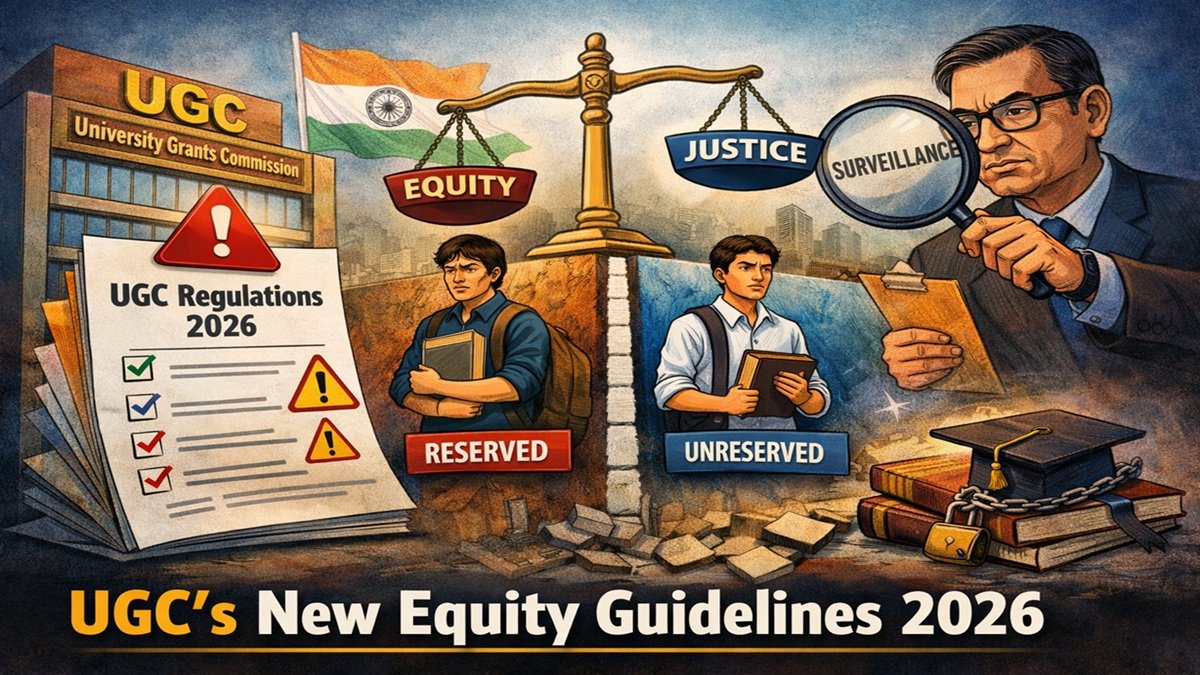
UGC New Equity Guidelines 2026 Explained: What the Rules Say, How They Work, and Why They Are Being Criticised
The University Grants Commission (UGC) has notified a new regulatory framework titled “University Grants Commission (Promotion of Equity in Higher Education Institutions) Regulations, 2026.”
These guidelines aim to prevent caste-based discrimination and promote equity in universities and colleges across India. However, soon after their notification, they have sparked intense debate among students, faculty members, legal experts, and policymakers.
To understand the controversy, it is essential to first clearly explain what the guidelines actually say—and only then examine why many believe they are flawed, excessive, or counterproductive.
Part 1: What Do the New UGC Equity Guidelines 2026 Say?
The 2026 regulations apply to all Higher Education Institutions (HEIs), including:
- Central universities
- State universities
- Private universities
- Deemed-to-be universities
- Colleges affiliated to universities
The UGC has made compliance mandatory, not advisory.
1. Objective of the Guidelines
According to the UGC, the regulations are meant to:
- Eliminate caste-based discrimination in higher education
- Promote inclusivity and equity on campuses
- Ensure dignity and equal treatment of students, faculty, and staff
- Strengthen institutional accountability
The UGC argues that earlier anti-discrimination guidelines (2012) failed due to weak enforcement, making stricter rules necessary.
2. Mandatory Equal Opportunity Centres (EOCs)
Every HEI must establish an Equal Opportunity Centre (EOC).
Functions of EOCs:
- Monitor discrimination-related issues on campus
- Implement equity policies
- Handle complaints related to caste and other forms of discrimination
- Submit periodic reports to the UGC
The EOC becomes the central authority within the institution for equity-related matters.
3. Formation of Equity Committees
Under the EOC, institutions must form an Equity Committee.
Mandatory Representation:
The committee must include members from:
- Scheduled Castes (SC)
- Scheduled Tribes (ST)
- Other Backward Classes (OBC)
- Women
- Persons with Disabilities
Role of the Committee:
- Examine complaints of discrimination
- Recommend corrective actions
- Monitor compliance with UGC regulations
These committees are given significant authority within institutions.
4. Caste-Based Discrimination Complaint Mechanism
Institutions must create dedicated grievance redressal systems, including:
- Online complaint portals
- Offline complaint submission
- Helplines or designated officers
Complaints related to caste-based discrimination are to be handled with priority and resolved within fixed timelines.
5. Enforcement and Penalties
One of the most powerful aspects of the 2026 guidelines is enforcement.
If an institution:
- Fails to set up required bodies
- Ignores complaints
- Is found non-compliant
The UGC can:
- Withhold grants
- Derecognise the institution
- Bar it from offering academic programmes
This shifts UGC guidelines from recommendations to enforceable regulation.
Part 2: Why the UGC Equity Guidelines 2026 Are Being Criticised
While the intent to prevent discrimination is widely supported, the design and execution of these guidelines raise serious concerns.
1. Institutionalising Caste Instead of Reducing It
A major criticism is that the guidelines formalise caste identity within university governance.
By mandating:
- Caste-based committee representation
- Caste-focused grievance handling
The regulations risk deepening caste consciousness on campuses rather than reducing it.
Critics argue that universities should be spaces where caste identity gradually loses relevance—not where it is embedded into administrative structures.
2. Unequal Protection for Students
Although the guidelines claim to prevent discrimination broadly, in practice:
- The framework is heavily centred on SC/ST/OBC categories
- There are no explicit safeguards for General Category students
- Discrimination faced by individuals outside protected categories lacks equal procedural clarity
This creates an imbalanced system, where protection is selective rather than universal.
3. No Safeguards Against False or Malicious Complaints
The regulations do not clearly address:
- False accusations
- Malicious complaints
- Abuse of grievance mechanisms
In academic settings, this raises concerns that:
- Academic disagreements may be labelled as discrimination
- Faculty may hesitate to enforce discipline or academic standards
- Merit-based assessment may suffer
Without safeguards, the fear of accusation can undermine academic integrity.
4. Weak Emphasis on Due Process and Natural Justice
The Equity Committees wield significant power, yet the regulations lack:
- Independent oversight
- Clear evidentiary standards
- Robust appeal mechanisms
Institutions may face extreme penalties based on internal committee findings alone, raising questions about fair procedure and proportionality.
5. Administrative Overload on Universities
Indian higher education institutions already face:
- Funding shortages
- Faculty vacancies
- Accreditation pressure
- Multiple regulatory authorities
The new guidelines add another compliance-heavy layer, diverting resources from teaching and research to paperwork and monitoring.
6. Threat to Institutional Autonomy
By granting the UGC extensive enforcement powers, the regulations risk:
- Excessive centralisation
- Reduced academic autonomy
- Fear-driven compliance rather than reform
Universities flourish under trust and autonomy—not constant regulatory threat.
Constitutional and Policy Concerns
Critics argue that selective protection without equal safeguards may conflict with:
- Article 14 (Equality before Law)
- Principles of natural justice
- The constitutional vision of reducing caste salience over time
Policy reform should move toward socio-economic upliftment without permanent identity-based governance.
Conclusion: A Well-Intended Policy with Serious Structural Flaws
The UGC’s 2026 Equity Guidelines are rooted in a genuine concern—discrimination must be eliminated from education.
However, intent alone does not ensure justice.
By:
- Institutionalising caste identities
- Weakening procedural safeguards
- Creating unequal protection frameworks
The regulations risk replacing inclusion with division and fairness with fear.
India’s higher education system needs equity with balance, justice with due process, and reform without overreach.
Unless revised, these guidelines may do more harm than good to the academic ecosystem they seek to protect.
FAQs: UGC New Equity Guidelines 2026 Explained
1. What are the UGC Equity Guidelines 2026?
The UGC Equity Guidelines 2026 are formally titled the University Grants Commission (Promotion of Equity in Higher Education Institutions) Regulations, 2026, notified by the University Grants Commission.
They aim to prevent caste-based discrimination and promote equity in universities and colleges across India.
2. Are the UGC Equity Guidelines mandatory for all universities?
Yes. The guidelines are mandatory, not advisory.
They apply to:
- Central universities
- State universities
- Private universities
- Deemed universities
- Affiliated colleges
Non-compliance can attract strict penalties.
3. What is an Equal Opportunity Centre (EOC)?
An Equal Opportunity Centre (EOC) is a mandatory institutional body under the guidelines.
Its role includes:
- Monitoring discrimination-related issues
- Handling complaints
- Implementing equity policies
- Reporting compliance to the UGC
Every higher education institution must establish an EOC.
4. What is an Equity Committee and who must be included?
An Equity Committee functions under the EOC and must include representation from:
- Scheduled Castes (SC)
- Scheduled Tribes (ST)
- Other Backward Classes (OBC)
- Women
- Persons with Disabilities
The committee examines complaints and recommends corrective action.
5. What kind of complaints do the guidelines cover?
The regulations primarily focus on caste-based discrimination, but they also mention:
- Gender-based discrimination
- Disability-based discrimination
- Discrimination based on place of birth or religion
However, critics note that enforcement emphasis is largely on caste-based complaints.
6. What penalties can the UGC impose for non-compliance?
If an institution fails to comply, the UGC may:
- Withhold grants
- Derecognise the institution
- Bar it from offering academic programmes
These are among the strongest enforcement powers the UGC has exercised so far.
7. Do the guidelines provide safeguards against false complaints?
This is a major point of criticism.
The regulations do not clearly specify penalties or safeguards against false or malicious complaints, raising concerns about:
- Misuse of grievance mechanisms
- Fear-driven decision-making by faculty
- Impact on merit-based academic evaluation
8. Are General Category students equally protected under these rules?
The guidelines claim to prevent discrimination broadly, but:
- Explicit procedural protections are mainly outlined for SC/ST/OBC categories
- There is no clearly defined parallel safeguard framework for General Category students
This has led to allegations of unequal protection.
9. Why are the UGC Equity Guidelines being criticised?
Critics argue that the guidelines:
- Institutionalise caste identity in campus governance
- Lack due process and natural justice safeguards
- Create fear among faculty and administrators
- Increase bureaucratic control over universities
- Risk undermining academic autonomy and merit
The concern is not about opposing equity, but about how equity is being enforced.
10. Can these guidelines be challenged legally?
Yes. Legal experts believe the guidelines could be challenged on grounds such as:
- Violation of Article 14 (Equality before Law)
- Absence of procedural fairness
- Disproportionate regulatory power
Future judicial scrutiny may determine their final shape and scope.
11. What do critics suggest as a better alternative?
Suggested improvements include:
- Universal anti-discrimination mechanisms for all students
- Independent ombudsman oversight
- Clear penalties for false complaints
- Focus on socio-economic disadvantage rather than rigid caste structures
- Mediation and reform over punitive action
12. What is the broader impact on higher education?
If implemented without revision, critics warn the guidelines may:
- Increase campus polarisation
- Discourage academic freedom
- Shift focus from education to compliance
- Replace inclusion with institutional fear
Supporters, however, believe strict enforcement is necessary to end discrimination.
Disclaimer
This article is intended purely for informational and analytical purposes. The views, interpretations, and criticisms expressed here are based on publicly available information, policy analysis, and academic opinion regarding the University Grants Commission (UGC) Equity Guidelines 2026.
This content does not intend to insult, target, or discriminate against any individual, community, caste, institution, or authority. The article does not deny the existence of discrimination in society or educational institutions. It only examines the policy framework, implementation mechanisms, and possible consequences of the notified guidelines from a critical and constitutional perspective.
The article does not encourage violation of law, nor does it provide legal advice. Readers are advised to refer to official UGC notifications, government documents, and legal professionals for authoritative guidance.
All opinions expressed are editorial in nature and fall under the scope of freedom of expression and public policy debate in a democratic society.
