
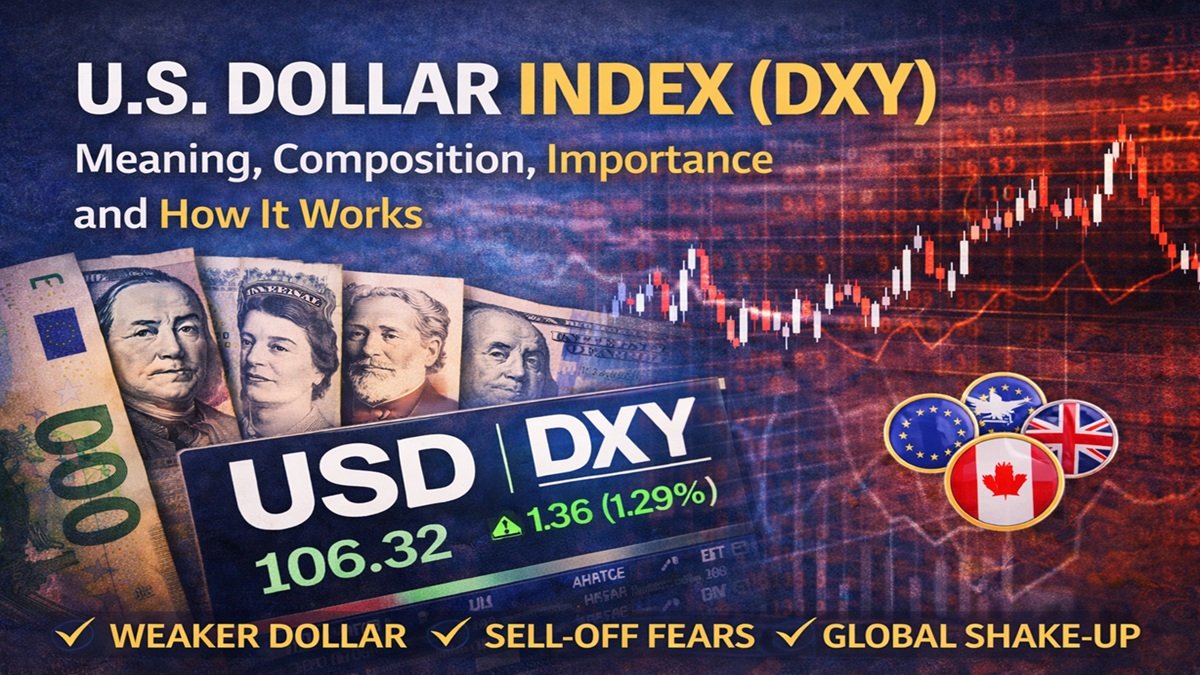
U.S. Dollar Index (DXY): Meaning, Composition, Importance and How It Works
Introduction
The U.S. Dollar Index (DXY) is one of the most closely watched indicators in global financial markets. It measures the strength of the US dollar relative to a basket of major international currencies and serves as a benchmark for traders, investors, policymakers, and central banks worldwide.
Whenever headlines say “the dollar is strengthening” or “the dollar is weakening”, they are usually referring to movements in the DXY index.
What Is the U.S. Dollar Index (DXY)?
The U.S. Dollar Index (DXY) is a weighted index that tracks the value of the US dollar against a basket of six major foreign currencies. It shows whether the dollar is gaining or losing strength in the global foreign exchange (forex) market.
- A rising DXY indicates a strengthening US dollar
- A falling DXY indicates a weakening US dollar
The index uses 1973 as its base year, with an initial value of 100.
Who Created and Maintains DXY?
The U.S. Dollar Index was created after the collapse of the Bretton Woods system. Today, it is calculated and published by Intercontinental Exchange (ICE), while it is widely referenced by the Federal Reserve, financial institutions, and global markets.
Currencies in the DXY Basket
The DXY is calculated using six currencies, each assigned a specific weight:
| Currency | Weight (%) |
|---|---|
| Euro (EUR) | ~57.6% |
| Japanese Yen (JPY) | ~13.6% |
| British Pound (GBP) | ~11.9% |
| Canadian Dollar (CAD) | ~9.1% |
| Swedish Krona (SEK) | ~4.2% |
| Swiss Franc (CHF) | ~3.6% |
Why the Euro Dominates DXY
The euro has the largest weight because it replaced several European currencies that were originally part of the index, such as the German mark and French franc.
How Is the DXY Calculated?
The DXY is calculated using a geometric weighted average of the exchange rates between the US dollar and the six currencies in the basket.
In simple terms:
- If the dollar strengthens against most of these currencies, the DXY rises
- If it weakens, the DXY falls
Because of its structure, EUR/USD movements have the biggest impact on the index.
Why Is the U.S. Dollar Index Important?
1. Indicator of Dollar Strength
DXY is the quickest way to assess whether the US dollar is strong or weak on a global basis.
2. Impact on Global Trade
- A strong dollar makes US exports more expensive
- A weak dollar makes imports costlier but boosts exports
3. Influence on Commodities
Most commodities like gold, crude oil, and silver are priced in dollars:
- Rising DXY → pressure on commodity prices
- Falling DXY → commodities tend to rise
4. Effect on Emerging Markets
Many emerging economies borrow in dollars:
- Strong DXY increases debt burden
- Weak DXY eases financial pressure
DXY and Financial Markets
DXY vs Stock Markets
- A rising DXY can pressure global equities
- A falling DXY often supports risk assets
DXY and Bonds
- Dollar strength affects US Treasury yields
- Capital flows respond to DXY trends
DXY and Cryptocurrencies
- Bitcoin and crypto often show inverse correlation with DXY
- Falling DXY can boost crypto appetite
DXY and US Monetary Policy
The US dollar index is closely influenced by:
- Interest rate decisions of the Federal Reserve
- Inflation trends
- Employment data
- Economic growth outlook
When US interest rates rise relative to other countries, the dollar usually strengthens, pushing the DXY higher.
Historical Movements of DXY
- 1985: DXY peaked above 160 during extreme dollar strength
- 2008: Fell sharply during the global financial crisis
- 2022: Reached multi-decade highs due to aggressive Fed rate hikes
- 2025–26: Declined amid global diversification and policy uncertainty
These cycles show that DXY moves in long-term trends, not just short-term fluctuations.
Limitations of the U.S. Dollar Index
Despite its popularity, DXY has limitations:
- Does not include emerging market currencies
- Overweight reliance on the euro
- Does not fully reflect global trade flows
- Does not account for digital or alternative settlement currencies
Because of this, analysts often use DXY alongside other indicators.
DXY vs Other Dollar Measures
| Index | Coverage |
|---|---|
| DXY | 6 major developed currencies |
| Trade-Weighted Dollar Index | Broader global trade partners |
| Real Effective Exchange Rate (REER) | Inflation-adjusted measure |
Each index serves a different analytical purpose.
How Traders Use the DXY
Traders use DXY to:
- Confirm currency trends
- Hedge forex exposure
- Anticipate commodity price moves
- Gauge global risk sentiment
It is traded indirectly through:
- Futures
- Options
- ETFs
- CFDs
Why DXY Matters in Today’s World
As discussions around de-dollarisation and global currency diversification grow, DXY remains a critical barometer of confidence in the US dollar.
Even though alternative systems are emerging, the dollar — and by extension DXY — continues to play a central role in global finance.
Conclusion
The U.S. Dollar Index (DXY) is more than just a number on a trading screen. It reflects global confidence in the US economy, monetary policy, and financial stability. While it has limitations, DXY remains the most widely accepted benchmark for measuring dollar strength.
Understanding DXY helps decode movements in currencies, commodities, equities, and even geopolitics — making it an essential concept for anyone tracking global economic trends.
