
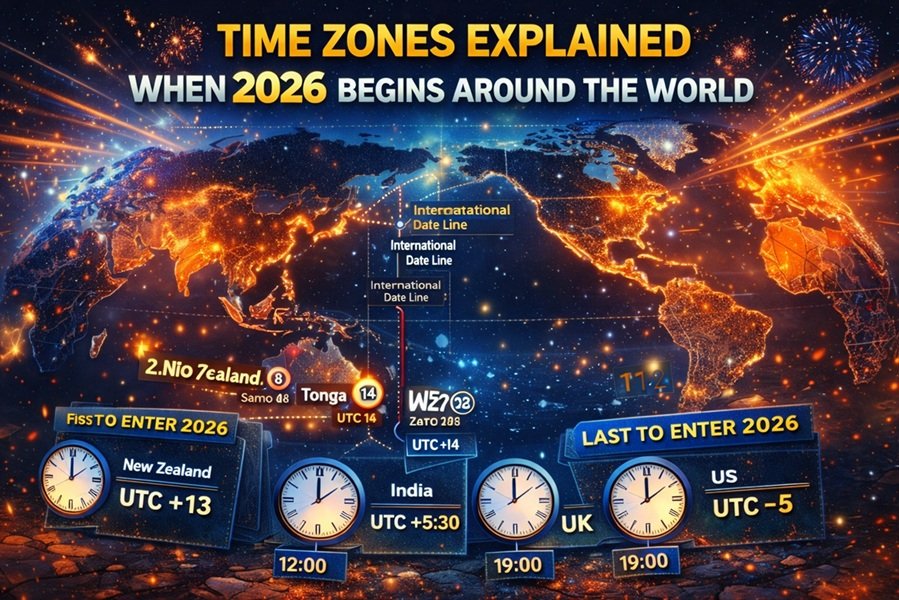
Time Zones Explained: When 2026 Begins Around the World
As the world prepares to say goodbye to 2025, one fascinating reality often surprises people — the New Year does not begin everywhere at the same time. While some countries welcome 2026 with fireworks and celebrations, others are still hours away from midnight. This global time gap is governed by time zones, a system that keeps the world’s clocks in order.
So, where does 2026 begin first, where does it begin last, and why does New Year’s Eve seem to last for nearly two full days across the planet? Let’s break it down in a simple and clear way.
Why Time Zones Exist
The Earth rotates once every 24 hours, but different parts of the planet experience daylight and darkness at different times. To manage this, the world is divided into 24 primary time zones, each roughly 15 degrees of longitude apart.
Without time zones:
- Sunrise would occur at wildly different clock times
- International travel and communication would be chaotic
- Global events would be impossible to synchronize
Time zones allow every region to follow a standardized local time while remaining connected to the global clock.
The Role of UTC in Global Timekeeping
At the heart of the world’s time system is Coordinated Universal Time (UTC).
- UTC is the global reference time
- It is based on atomic clocks, not Earth’s rotation
- All time zones are measured as UTC plus or minus hours
For example:
- India follows UTC +5:30
- Japan follows UTC +9
- New York follows UTC −5 (standard time)
The International Date Line: Where the New Year Begins
The International Date Line (IDL) is the key to understanding when a new year begins.
- It runs roughly along the 180° longitude in the Pacific Ocean
- Crossing the IDL changes the calendar date
- The New Year begins immediately west of the Date Line
This means the first places to enter 2026 are located near this line.
The First Places to Welcome 2026
The earliest regions to celebrate New Year 2026 are small island nations in the Pacific Ocean that operate at the world’s most advanced time zones.
First Countries to Enter 2026
- Kiribati (Line Islands) – UTC +14
- Samoa – UTC +13
- Tonga – UTC +13
In these places, fireworks begin while much of the world is still in the morning or afternoon of December 31, 2025.
How Many Hours Ahead Are the First Celebrations?
When Kiribati enters 2026:
- India still has several hours left in 2025
- Europe is far from midnight
- The Americas are still on December 31 morning
This creates the illusion that New Year’s Eve stretches across nearly 48 hours globally.
When Does 2026 Begin in Major Countries?
Here’s a simplified view of when midnight arrives in some key regions:
Asia & Oceania
- New Zealand – Among the first major countries to celebrate
- Australia – New Year begins shortly after New Zealand
- Japan – Midnight follows several hours later
- India – Welcomes 2026 at UTC +5:30
Europe
- United Kingdom – Celebrates at UTC 0
- Central Europe – One hour after the UK
- Eastern Europe – Two hours after the UK
Americas
- Brazil (East) – Several hours after Europe
- United States (East Coast) – UTC −5
- United States (West Coast) – UTC −8
Each time zone creates a wave of celebrations moving westward around the globe.
The Last Places to Enter 2026
The final regions to welcome 2026 are located just east of the International Date Line.
Last Places on Earth to Enter 2026
- Baker Island
- Howland Island
These uninhabited U.S. territories operate on UTC −12, the last time zone on Earth.
By the time they reach midnight:
- Most of the world has already lived through January 1
- Some places are approaching January 2
How Long Does the Global New Year Last?
From the first celebration in Kiribati to the last in Baker Island:
- The global New Year transition lasts about 26 hours
- This allows people to celebrate “New Year” at different times across nearly two days
This phenomenon is unique to the way Earth’s time zones are structured.
Why Time Zones Matter on New Year’s Eve
Time zones affect more than just celebrations:
- Global broadcasts schedule countdowns carefully
- Airlines and airports manage date changes mid-flight
- Financial markets track year-end closures
- Digital platforms roll out updates in phases
New Year’s Eve is one of the best examples of how time zones shape modern life.
Interesting Facts About Time Zones and New Year
- Some islands celebrate New Year almost a full day before others
- India’s half-hour time zone is rare globally
- A person could theoretically celebrate New Year twice by traveling across time zones
- The International Date Line is adjusted around countries to avoid confusion
Why People Are Fascinated by New Year Time Zones
The idea that:
- One country is celebrating
- Another is counting down
- Another is still waking up on December 31
…makes New Year’s Eve a truly global event, uniting the world through time rather than location.
Explore:
- New Year 2026: History, Significance and How the World Celebrates
- New Year 2026: History, Significance and How the World Celebrates
- Happy New Year 2026: Best Gemini AI Photo Prompts to Create Stunning Festive Images
Final Thoughts
New Year 2026 does not arrive everywhere at once. It begins quietly in the Pacific, moves steadily across Asia, Europe, Africa, and the Americas, and finally ends on remote islands in the ocean. This slow, rolling arrival of a new year is a powerful reminder of how time zones connect the entire planet.
Understanding time zones adds depth to the celebration — showing that while the clock may strike midnight at different hours, the hope and excitement of a new year are shared worldwide.
