
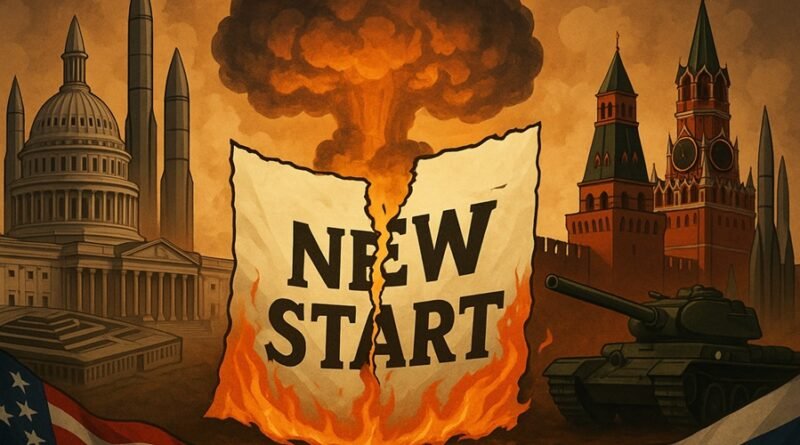
The USA-Russia Nuclear Pact: Collapse of Strategic Stability in a Multipolar World
Introduction
For over half a century, nuclear arms control agreements between the United States and Russia (formerly the Soviet Union) served as the backbone of global strategic stability. From the height of the Cold War to the uneasy post-Soviet peace, these treaties provided limits, transparency, verification mechanisms, and crucially, a framework for dialogue between the world’s two largest nuclear powers.
Today, that framework is crumbling.
In 2025, nuclear arms control lies in shambles. The last remaining bilateral treaty—New START—is under suspension, with no successor in sight. The collapse of this security architecture amid escalating conflicts in Ukraine, growing distrust, and the rise of other nuclear powers such as China, threatens to unleash a new global arms race.
This article explores the chronology, current situation, and grave implications of the disintegration of U.S.-Russia nuclear cooperation.
Read this: What is the Nuclear Non-Proliferation Treaty (NPT)?
A Brief History of USA-Russia Nuclear Arms Agreements
🔹 1. SALT I & II – The Beginnings
- SALT I (1972): Initiated under Nixon and Brezhnev to cap the number of intercontinental ballistic missiles (ICBMs) and submarine-launched ballistic missiles (SLBMs).
- SALT II (1979): Attempted to limit launchers and warheads further, but was never ratified due to the Soviet invasion of Afghanistan.
- These treaties laid the foundation of arms control logic: parity, deterrence, and verification.
🔹 2. INF Treaty – A Cold War Victory
- INF Treaty (1987): Banned land-based missiles with a range of 500–5,500 km.
- First treaty to eliminate an entire class of nuclear weapons.
- Seen as a major diplomatic victory and reduced nuclear risk in Europe.
- U.S. formally withdrew in 2019 under Trump, citing Russian violations (9M729 missile system).
🔹 3. START I & II – Post-Soviet Adjustments
- START I (1991): Signed by Bush Sr. and Gorbachev. Limited each side to 6,000 nuclear warheads.
- START II (1993): Sought to ban MIRVed ICBMs but was never implemented due to political instability in Russia.
🔹 4. New START – The Last Standing Pillar
- Signed in 2010 by Obama and Medvedev.
- Limits deployed nuclear warheads to 1,550, and delivery vehicles (ICBMs, SLBMs, bombers) to 700.
- Crucially included mutual inspections, data exchanges, and verification protocols.
- Extended in 2021 until February 2026, but now under threat.
Collapse of Arms Control: Current Scenario in 2025
❌ Russia Suspends Participation in New START
- In February 2023, President Vladimir Putin announced that Russia would “suspend” participation in New START.
- Reasons cited: U.S. and NATO’s support for Ukraine and sanctions.
- Consequences:
- No on-site inspections.
- No warhead deployment data shared.
- Russia claims to remain “within limits,” but there’s no verification.
❌ End of Bilateral Talks
- All arms control negotiations have stalled.
- Russia demands broader security guarantees; U.S. insists on compliance with New START first.
- Mutual trust is at a historic low.
❌ Impending Expiry: February 2026
- If no agreement is reached, New START will expire without replacement, leaving no legally binding limits on U.S. or Russian arsenals for the first time in over 50 years.
New Threats and Uncontrolled Escalation
🔺 Nuclear Modernization Programs
- Russia: Investing in new strategic weapons like Avangard hypersonic glide vehicles, Poseidon nuclear torpedoes, and Sarmat ICBMs.
- United States: Modernizing its nuclear triad (new ICBMs, bombers, submarines), including the GBSD program and B-21 Raider.
🔺 Hypersonic Weapons and AI
- Arms control treaties didn’t account for hypersonic missiles or AI-enabled command systems, increasing first-strike risks and decision-making speed.
🔺 Risk of Miscalculation
- Without verification, false assumptions or accidents could trigger nuclear retaliation.
- Satellite images, cyber intrusions, or missile tests could be misread as hostile acts.
Impact on Global Strategic Balance
🌍 1. Undermining the Nuclear Non-Proliferation Treaty (NPT)
- NPT’s legitimacy hinges on disarmament by nuclear powers.
- Without U.S.-Russia cooperation, non-nuclear states may lose faith in disarmament commitments.
🌏 2. China’s Strategic Rise
- China is rapidly expanding its nuclear arsenal, possibly targeting 1,000 warheads by 2030.
- U.S. insists on tripartite arms control (U.S.-Russia-China), but China refuses, citing its smaller stockpile.
🇮🇳 3. Implications for India and Other Regional Powers
- Arms race could spill over into Asia.
- India, Pakistan, Israel, and North Korea may reassess doctrines and investments.
- India’s doctrine of “credible minimum deterrence” may evolve in response to shifts among superpowers.
Possible Pathways Forward
| Path | Description | Challenges |
|---|---|---|
| New START Renewal or Extension | Negotiate limited extension post-2026 | Requires massive trust rebuild |
| Multilateral Framework | Include China, UK, France, possibly India | Logistically and diplomatically complex |
| Moratorium Model | Unilateral pledges to avoid buildup | No verification or legal binding |
| Return to Cold War Arms Race | No treaties, full-scale buildup resumes | Global insecurity, massive costs |
What If Arms Control Fails?
If the USA-Russia arms control regime collapses completely:
- Both countries may build thousands more warheads.
- More nuclear posturing, close-call incidents, and testing.
- Accidental nuclear war becomes a higher probability.
- Other nations may abandon restraint and pursue nukes.
Conclusion: The Fragile Future of Peace
The end of U.S.-Russia nuclear cooperation is not merely a bilateral issue—it’s a global threat. For decades, even amid wars and rivalries, Washington and Moscow understood the existential danger of nuclear weapons and acted to reduce it.
Now, as geopolitical rifts deepen and trust vanishes, the absence of arms control removes a critical buffer against annihilation.
Reviving arms control in 2025 will require:
- Strategic patience
- Creative diplomacy
- A multilateral approach that includes new threats like hypersonics and AI
Whether leaders can summon the courage and wisdom to act before it’s too late remains to be seen.
