
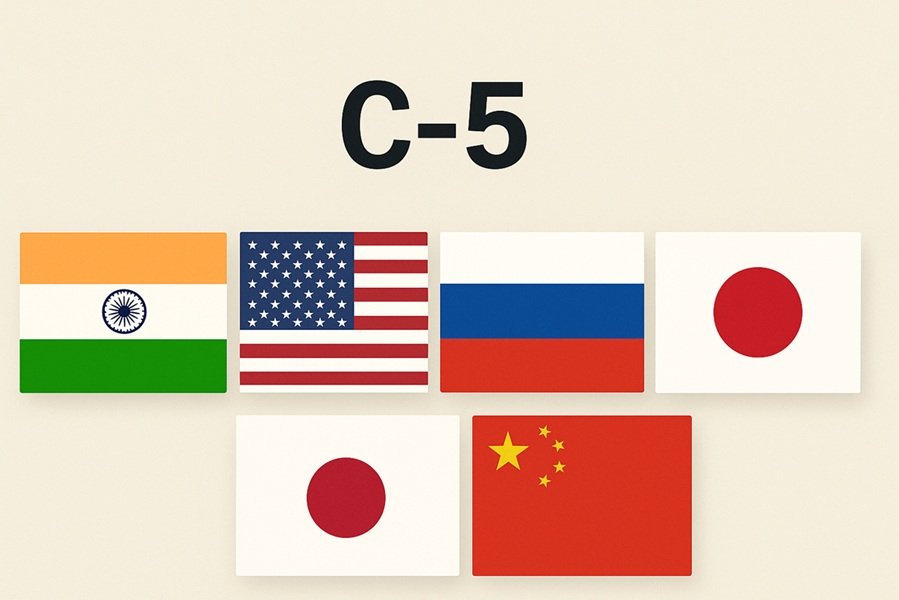
The Proposed C-5 Group: A Deep Geopolitical Analysis of the U.S. “Core Five” Concept
Introduction
In recent months, the global strategic community has been debating a controversial and transformative idea that surfaced not through official diplomatic announcements, but through leaked and extended draft versions of the United States National Security Strategy (NSS). This idea proposes the formation of a new, high-level geopolitical grouping referred to as the “C-5” or “Core Five.”
According to media reports and think-tank analyses, the C-5 would include the United States, China, Russia, India, and Japan—the five nations considered essential for managing great-power competition, global stability, and long-term strategic governance. Importantly, this grouping is not an existing organization, nor is it part of the finalized U.S. National Security Strategy. It exists solely within draft proposals, internal policy discussions, and leaked sections of longer NSS documents.
Despite not being official, the concept itself is geopolitically significant, as it indicates how the United States and several analysts envision the future architecture of global power.
This article provides a comprehensive, line-by-line analysis of the C-5 concept, its historical inspirations, potential implications, challenges, and where India stands in this evolving great-power framework.
What is the Proposed C-5 (Core Five) Group?
The proposed C-5 refers to a high-level consultative platform of five major world powers:
- United States
- China
- Russia
- India
- Japan
These nations, representing vast economic, military, demographic, and technological power, would theoretically meet to address global strategic issues, just as the Concert of Europe did in the 19th century or as the G7 does today.
However, unlike the G7—an alliance of wealthy democracies—the C-5 would include rivals, competitors, and civilizational powers with fundamentally different political systems. For this reason, many experts describe the C-5 not as an alliance but as a geo-strategic management mechanism.
Why the C-5 Concept Emerged in U.S. Strategy Drafts
1. A Response to Great-Power Multipolarity
The American strategic community recognises that the world is no longer unipolar. The rise of China, resurgence of Russia, and growing influence of India and Japan signal a polycentric global order.
2. The Limitations of Existing Groups (G7, NATO, Quad, BRICS)
No current grouping includes all major power centres simultaneously:
- G7 excludes China, India, Russia.
- BRICS excludes the U.S. and Japan.
- Quad excludes China and Russia.
- SCO excludes the U.S. and Japan.
A C-5 platform aims to bring all major stakeholders into one room, theoretically enabling better global governance.
3. Managing Conflicts Among Major Powers
Great-power rivalry threatens global stability:
- U.S.–China tension
- NATO–Russia confrontation
- India–China border disputes
- Japan–China maritime competition
The American draft envisions C-5 as a mechanism to prevent escalation and manage crises, especially in the Indo-Pacific and Eurasia.
4. Balancing Europe and Shifting Global Focus
Reports suggest the draft NSS indicates that:
- Europe is increasingly seen as less central to U.S. long-term strategy.
- The Indo-Pacific and Eurasia are the new geopolitical heartlands.
- Therefore, the “core powers” of the future lie in Asia + U.S. + Russia.
This realignment underpins the logic of the C-5.
The C-5 and the Concert of Europe Parallel
The idea resembles the Concert of Europe (1815–1914), where five great powers—Britain, France, Austria, Prussia, and Russia—collectively managed global stability.
Similarly, the C-5 seeks to:
- Create predictability in great-power relations
- Reduce the probability of direct wars
- Establish a global order managed by a handful of major states
This concept, however, is controversial because it:
- Reduces the role of Europe
- Ignores emerging middle powers
- Gives immense authority to a small number of nuclear-armed states
Why These Five Countries?
1. United States
The world’s most powerful economy and military; architect of global institutions.
2. China
The world’s second-largest economy; rising military superpower; Indo-Pacific challenger.
3. Russia
A nuclear superpower with vast energy resources; central to Eurasian security.
4. India
The world’s most populous country; a rising economic, technological, and military power; strategic swing state.
5. Japan
A global technological leader; major economic power; key Indo-Pacific stabilizer.
Together, the C-5 represents:
- 50 percent of global GDP
- Over 40 percent of the world’s population
- Nearly all major nuclear powers
- Control over the world’s most critical sea lanes
Why India is Crucial to the C-5 Concept
India is the only nation that:
- Maintains dialogue with all four other proposed members
- Has no formal military alliance with either U.S. or Russia
- Is part of Quad (with U.S. and Japan)
- Borders China and faces a direct security challenge
India’s geopolitical independence makes it a potential balancer, bridge, and mediator. The U.S. sees India as essential for:
- Containing China
- Stabilising Eurasia
- Ensuring Indo-Pacific security
- Maintaining technological partnerships
For India, participation (if ever formalised) would:
- Enhance global influence
- Increase diplomatic leverage
- Position India as a “rule-maker” rather than a “rule-taker”
Why China and Russia Matter in the C-5 Draft
Including China and Russia is the most controversial element of the proposal.
China’s Role
- Rival of the U.S.
- Contestant for global leadership
- Dominant power in the Indo-Pacific
However, stabilising U.S.–China relations may require direct, institutionalised engagement.
Russia’s Role
Despite being politically isolated by the West, Russia remains:
- A nuclear superpower
- A major energy giant
- A decisive actor in Europe and Central Asia
Any global framework that ignores Russia is incomplete.
Japan’s Strategic Importance
Japan’s inclusion demonstrates:
- U.S. commitment to its Indo-Pacific alliances
- Recognition of Japan’s economic and technological leadership
- The need for a stable, democratic stakeholder in Asian security
Japan also counters China’s influence and anchors the U.S. in Asia.
Why Europe is Excluded
A key reason the C-5 proposal is controversial is the absence of any European country, including:
- United Kingdom
- France
- Germany
This exclusion reflects:
- A shift in U.S. global priorities
- The rise of Asia as the world’s geopolitical centre
- A belief that Europe lacks the leverage to manage future conflicts
Analysts warn that this could significantly reduce Europe’s influence in the coming decades.
Is the C-5 Real?
Current Status
- Not official U.S. policy
- Not endorsed by any government
- Not part of the official National Security Strategy
- Exists only in draft documents, leaks, and analytical discussions
Will it become real?
At this stage, it is unlikely due to:
- U.S.–China tensions
- Russia’s war in Ukraine
- India–China border issues
- Deep distrust between Japan and China
But as a concept, it signals how strategic thinkers imagine the world might function in a truly multipolar future.
Key Challenges to the C-5 Concept
1. Severe Rivalries Within the Group
- U.S. vs China
- NATO vs Russia
- India vs China
- Japan vs China
The C-5 would be filled with adversaries.
2. Ideological Differences
Democracies (U.S., India, Japan) vs authoritarian states (China, Russia).
3. Competing Economic Interests
Supply chains, energy security, and technology leadership all create friction.
4. Power Asymmetry
China and the U.S. dominate the group, risking imbalance.
5. Trust Deficit
None of these countries fully trust each other, making institutionalisation difficult.
Strategic Implications if the C-5 Ever Materialised
Global Order Transformation
A formal C-5 could overturn:
- G7 influence
- European relevance
- Existing alliance structures
- Old Cold War alignments
Increased Stability or Increased Competition?
Depending on the nature of cooperation, the C-5 could:
- Reduce global conflict through dialogue, or
- Intensify competition by crystalising great-power blocs
Indo-Pacific Becomes the Centre of Global Politics
India, China, Japan, and the U.S. would dominate discussions.
BRICS and Quad Impact
A C-5 could weaken:
- BRICS, by shifting focus away from Global South
- Quad, by bringing adversaries into the same room
India’s Possible Approach in a Future C-5 Scenario
India would likely seek:
- Strategic autonomy
- A voice in crafting global rules
- Balanced relations with all stakeholders
India would push for:
- Counter-terror frameworks
- Indo-Pacific security
- Sovereignty and territorial integrity principles
- Technology transfers
- Supply chain diversification
India would also resist:
- Any arrangement that sidelines Global South
- Any mechanism dominated by U.S.–China bipolarity
Conclusion
The C-5 / Core Five is not an official organization, nor is it endorsed by any government. It remains an idea proposed in draft versions of the U.S. National Security Strategy, reflecting how some American strategists conceptualise future global governance.
Yet, even as an idea, the C-5 is geopolitically significant.
It reveals:
- The U.S. believes the future of global power lies in Asia + U.S. + Russia.
- Europe’s relative influence is declining.
- India is now considered indispensable in global strategy.
- China, Russia, and Japan are unavoidable stakeholders in world affairs.
Whether the C-5 ever becomes reality, the concept itself provides a window into the evolving multipolar order, where major civilizational powers—India, China, Russia, Japan, and the United States—will compete, collaborate, and shape the future of the international system.
References
- Secret longer version of US National Security Strategy calls for ‘Core 5’ countries to run the world — IntelliNews (Published online) IntelliNews
- Michael Anton and the Secret National Security Strategy — Emptywheel emptywheel
- IntelliNews X/Tweet on Core 5 — BNE IntelliNews (X/Twitter) X (formerly Twitter)
- 2025 U.S. National Security Strategy — White House official PDF The White House
