
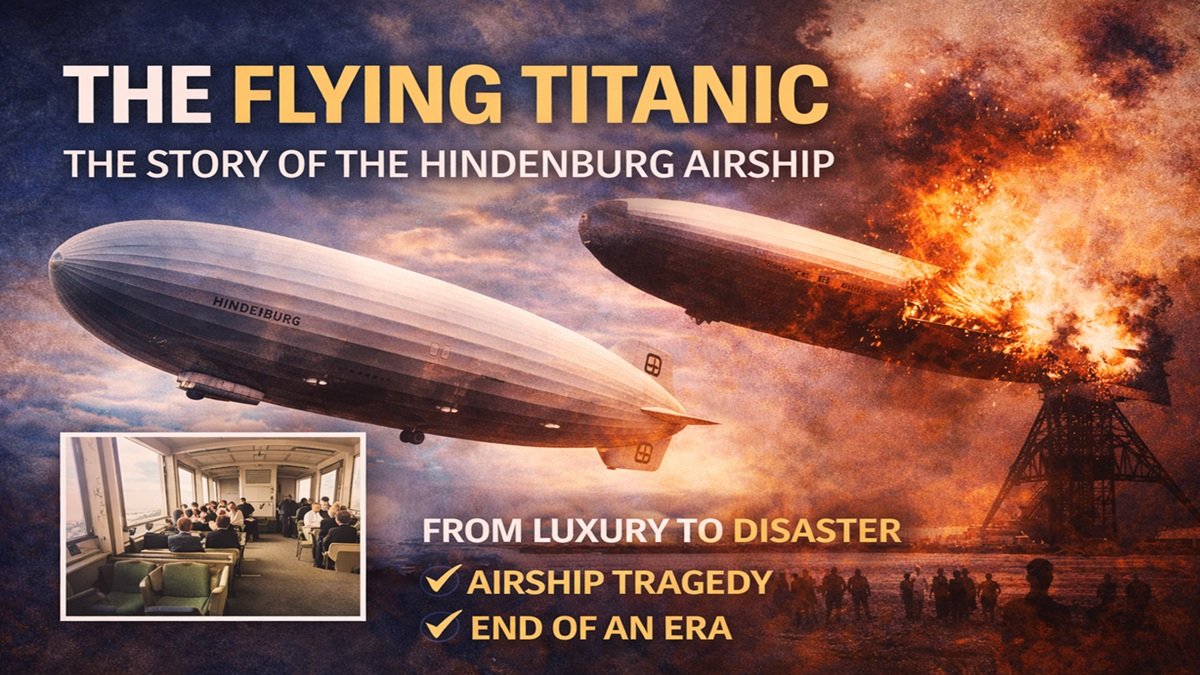
The Flying Titanic: The Story of the Hindenburg Airship
Introduction
Often called the “Flying Titanic,” the Hindenburg was once the proud symbol of human ambition, luxury, and technological confidence in the early 20th century. Officially known as LZ-129 Hindenburg, it was the largest airship ever built and represented the peak of the rigid airship era.
Just like the Titanic at sea, the Hindenburg in the sky promised unmatched comfort, speed, and prestige—until a single catastrophic disaster in 1937 abruptly ended the age of passenger airships.
What Was the Hindenburg?
The Hindenburg was a rigid German airship (zeppelin) designed for commercial passenger travel across the Atlantic Ocean. It was built by the Zeppelin Company in Germany and named after Paul von Hindenburg, the former President of Germany.
Key facts:
- Official name: LZ-129 Hindenburg
- Type: Rigid airship (zeppelin)
- Length: 245 meters (804 feet)
- Diameter: 41 meters
- Gas used: Hydrogen
- Top speed: ~135 km/h
- Passenger capacity: About 70 passengers
At the time, no aircraft could match its size, range, or comfort.
Why Was It Called the “Flying Titanic”?
The comparison to the Titanic came from several striking similarities:
- Both were technological marvels of their era
- Both symbolized luxury and human confidence
- Both were believed to be extremely safe
- Both disasters shocked the world and changed transportation forever
Like the Titanic’s sinking ended the golden age of ocean liners, the Hindenburg disaster marked the end of commercial airship travel.
Design and Engineering Marvel
Rigid Zeppelin Structure
The Hindenburg had an internal aluminium framework covered with fabric. Inside were 16 hydrogen gas cells that provided lift.
Despite hydrogen being highly flammable, it was chosen because:
- It provided greater lift than helium
- Helium was scarce and largely controlled by the United States
A Flying Luxury Hotel
The Hindenburg was designed to offer unmatched luxury:
- Private passenger cabins
- Dining room with fine meals
- Lounge with large windows
- Writing room and social areas
- Even a smoking lounge (sealed and pressurised)
Passengers described it as quiet, smooth, and elegant, far more comfortable than early airplanes.
Transatlantic Travel Revolution
Before long-range airplanes, crossing the Atlantic took:
- 5–7 days by ship
- 2–3 days by airship
The Hindenburg could fly from Germany to the United States in about 60–70 hours, making it the fastest and most luxurious way to cross the ocean in the 1930s.
It successfully completed multiple transatlantic flights in 1936 without serious incidents.
The Final Journey: May 6, 1937
Destination: Lakehurst, New Jersey
On 6 May 1937, the Hindenburg was completing a flight from Germany to the United States, preparing to land at Naval Air Station Lakehurst, New Jersey.
Onboard were:
- 36 passengers
- 61 crew members
Weather conditions were unstable, with rain and electrical activity in the area.
The Disaster That Changed History
As the airship attempted to dock:
- A sudden flame appeared near the rear
- Within seconds, hydrogen ignited
- The entire airship was engulfed in fire
In less than 40 seconds, the world’s largest aircraft was destroyed.
The tragedy resulted in:
- 36 deaths (passengers, crew, and one ground worker)
- Dozens of survivors, many badly injured
The shocking footage and live radio commentary stunned audiences worldwide.
Why Did the Hindenburg Catch Fire?
The exact cause remains debated, but leading theories include:
1. Hydrogen Ignition
A leak in a hydrogen gas cell combined with static electricity or a spark likely ignited the fire.
2. Static Electricity
Stormy weather may have caused an electrical discharge during landing.
3. Flammable Outer Coating
Some researchers suggest the outer skin’s chemical coating contributed to rapid fire spread.
What is clear is that hydrogen’s extreme flammability made the disaster inevitable once ignition occurred.
Media Impact and Public Shock
The Hindenburg disaster became famous partly because:
- It was filmed on camera
- A radio reporter described it live with emotional commentary
The phrase “Oh, the humanity!” became one of the most iconic lines in broadcast history.
For the first time, the world saw a technological disaster unfold in real time.
End of the Airship Era
After the Hindenburg:
- Public trust in airships collapsed
- Commercial zeppelin flights were cancelled
- Governments shifted focus to fixed-wing aircraft
Safer, faster airplanes soon replaced airships for long-distance travel.
The disaster marked the definitive end of passenger airship travel.
Hindenburg vs Modern Aviation
| Feature | Hindenburg | Modern Aircraft |
|---|---|---|
| Speed | Slow | Very fast |
| Safety | High risk | Extremely regulated |
| Fuel | Hydrogen | Jet fuel |
| Passenger trust | Lost after disaster | Strong |
| Legacy | Historical symbol | Dominant transport |
Legacy of the Hindenburg
Despite its tragic end, the Hindenburg remains:
- A symbol of human ambition
- A lesson in engineering risk
- A turning point in aviation history
It taught the world that technological confidence must be matched by safety, a lesson still relevant today.
Conclusion
The Hindenburg was more than an airship—it was a flying dream. Like the Titanic, it embodied the belief that technology had conquered nature. Its fiery destruction shattered that illusion and reshaped the future of transportation.
Today, the Hindenburg stands as a powerful reminder: progress without caution can be catastrophic. Its story continues to fascinate, warn, and inspire generations around the world.
