
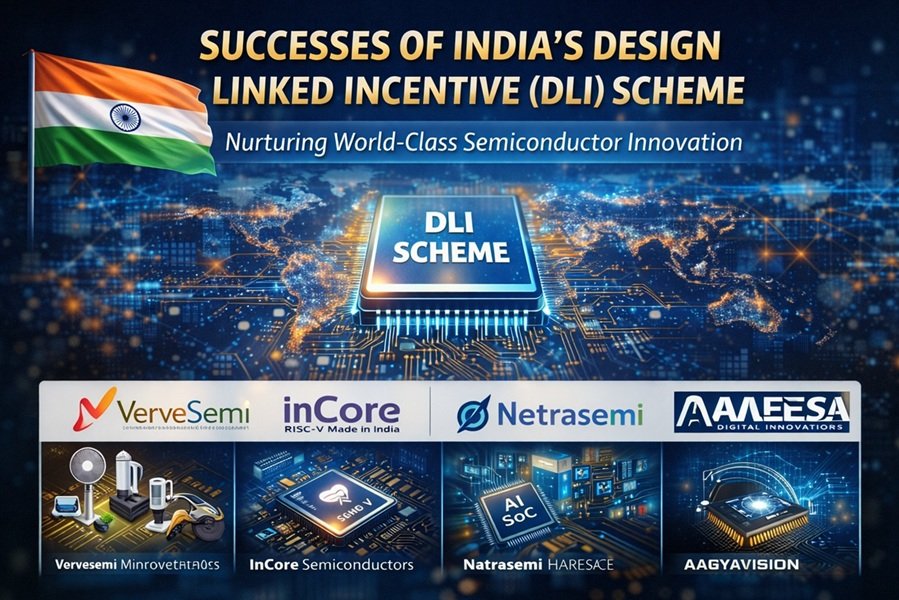
Success Stories of India’s Design Linked Incentive (DLI) Scheme
India’s ambition to emerge as a global semiconductor powerhouse is no longer confined to policy intent alone. Under the Design Linked Incentive (DLI) Scheme, the country is witnessing the rise of a new generation of chip-design companies that are translating indigenous innovation into silicon-proven, market-ready products. These success stories underline how targeted policy support, access to advanced infrastructure, and financial incentives can transform India’s latent design talent into globally competitive semiconductor capabilities.
DLI Scheme: From Policy Vision to Tangible Outcomes
The DLI Scheme has been designed to strengthen India’s position in the most value-intensive segment of the semiconductor value chain—chip design. Under the scheme:
- 24 chip-design projects have been sanctioned across critical domains such as:
- Video surveillance
- Drone detection
- Energy meters
- Microprocessors
- Satellite communications
- Broadband and IoT System-on-Chips (SoCs)
- 95 Indian companies have received access to industry-grade Electronic Design Automation (EDA) tools, dramatically lowering entry barriers for startups and MSMEs by reducing high design and infrastructure costs.
This ecosystem-level support has enabled Indian firms to move beyond conceptual designs toward tape-outs, pilot production, and commercial deployment—a decisive shift from dependency to capability.
Read This: DLI Scheme: India’s Strategy to Become a Global Semiconductor Design Hub
Vervesemi Microelectronics: Powering Indigenous Motor Control Innovation
Vervesemi Microelectronics stands out as a leading example of how the DLI Scheme is enabling deep-tech product innovation.
The company has built an impressive portfolio comprising:
- 110+ semiconductor IPs
- 25 integrated circuit (IC) product variants
- 10 granted patents
- 5 trade secrets
Vervesemi is developing advanced motor-control chips supporting a unique class of BLDC motors, targeting a wide spectrum of applications:
- Consumer appliances such as fans, coolers, mixer grinders, air conditioners, and washing machines
- Emerging mobility and aerial platforms, including drones
- Automotive use cases, particularly e-scooters and e-rickshaws
The company has already completed pilot-lot sampling for two chips, with a third expected from the foundry later this year. Several global customers are actively engaged in product development using Vervesemi’s existing silicon—demonstrating real commercial traction enabled by the DLI Scheme.
InCore Semiconductors: Building Indigenous RISC-V Processing Power
InCore Semiconductors represents India’s strategic push to reduce dependence on imported CPU intellectual property.
The company focuses on:
- Indigenous RISC-V microprocessor IPs
- SoC design automation tools
- Development of Dolomite, envisioned as India’s most powerful embedded processor
Dolomite is targeted at:
- Entry-level smartphones
- Edge-AI and embedded computing applications
InCore’s processor IP cores are already silicon-proven across multiple customer chips, fabricated at technology nodes ranging from 180 nm to 16 nm. By enabling both commercial and strategic applications, InCore is laying the foundation for India’s long-term processor sovereignty—an objective strongly aligned with the DLI Scheme’s vision.
Netrasemi: Advancing AI-Enabled Surveillance and Mobility SoCs
Netrasemi is focused on next-generation AI-capable System-on-Chips for high-impact sectors including:
- Secure CCTV surveillance
- Smart sensors
- Robotics and drones
- Mobility applications
A major milestone achieved by the company is the successful tape-out of India’s first indigenously designed AI SoC at an advanced 12 nm process node. This chip integrates:
- In-house AI/ML accelerators
- Vision processing units
- Video engines
Netrasemi is also notable for being backed by the largest private venture capital funding to date for an Indian semiconductor company. With a pipeline of upcoming tape-outs spanning low-end to high-complexity surveillance SoCs, the firm exemplifies how DLI support can catalyze globally relevant, high-complexity chip design from India.
Aheesa Digital Innovations: Enabling Indigenous Broadband Connectivity
Aheesa Digital Innovations is addressing a critical infrastructure need—secure and affordable high-speed broadband connectivity.
The company is developing Vihaan, an indigenous fiber-broadband solution built around:
- A VEGA processor-based GPON Optical Network Terminal (ONT)
- A fully integrated Network SoC
Vihaan combines:
- Fiber termination
- Data processing
- Network management
into a single chip, enabling cost-effective and secure broadband deployment for homes and businesses. Aheesa is on track to introduce reference platforms for customer exploration in 2026, positioning itself as a key contributor to India’s digital infrastructure ambitions.
AAGYAVISION: Radar-on-Chip for Security and Next-Generation Networks
AAGYAVISION is designing advanced radar-on-chip solutions capable of operating reliably in all weather conditions.
These technologies have wide-ranging applications across:
- Safety and security systems
- Smart infrastructure
- Edge computing
- Emerging 6G sensor networks
- Critical applications such as drone detection
By integrating radar capabilities into compact, efficient chips, AAGYAVISION is pushing the boundaries of sensing and situational awareness—areas of increasing strategic and commercial importance.
Editorial Perspective: Why These Success Stories Matter
The achievements of these companies collectively illustrate how the DLI Scheme is converting India’s indigenous chip-design capabilities into:
- Silicon-proven technologies
- Commercially deployable products
- Globally competitive intellectual property
Rather than remaining confined to academic research or proof-of-concept designs, DLI-supported firms are now participating in real markets, serving global customers, and addressing strategic national needs.
By supporting advanced design, prototyping, and commercialization, the DLI Scheme is:
- Strengthening India’s technological self-reliance
- Reducing dependence on imported semiconductor IP
- Positioning India as a credible player in the global semiconductor design ecosystem
These success stories signal that India’s semiconductor journey is no longer aspirational—it is well underway, silicon by silicon.
Reaference: https://www.pib.gov.in/PressNoteDetails.aspx?NoteId=156811&ModuleId=3®=3&lang=1
