
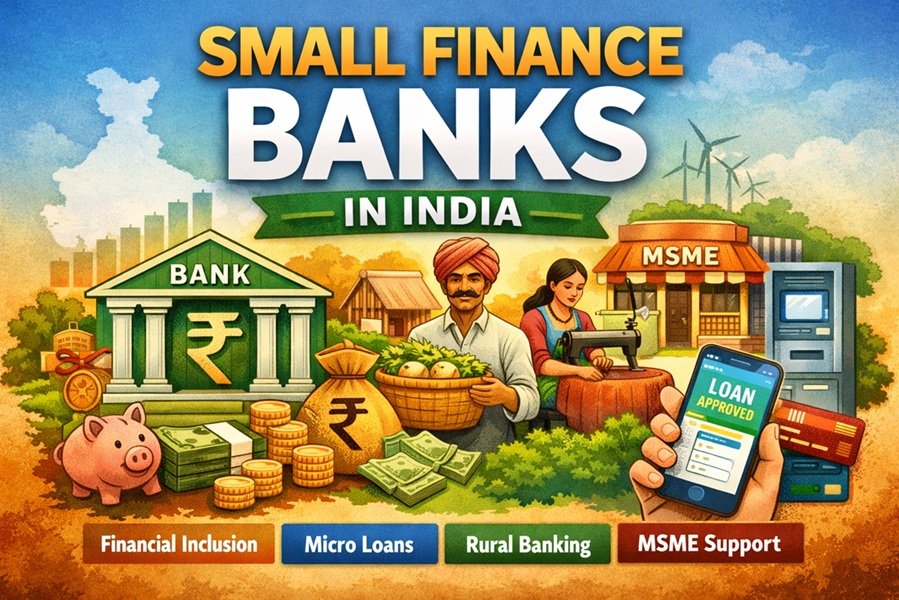
Small Finance Banks in India – Meaning, Role, and Complete Guide
Small Finance Banks (SFBs) are a special category of banks in India created with the primary objective of promoting financial inclusion. These banks were introduced by the Reserve Bank of India (RBI) to serve sections of society that remain underserved by traditional commercial banks.
They focus mainly on small businesses, micro industries, farmers, unorganized sector workers, and low-income households.
What is a Small Finance Bank?
A Small Finance Bank is a type of scheduled commercial bank that undertakes basic banking activities like:
- Accepting deposits
- Providing loans
- Offering payment and remittance services
- Issuing debit cards
- Internet and mobile banking
But unlike large banks, their operations are designed to cater to small-ticket lending and savings products.
Why Were Small Finance Banks Introduced?
Even after decades of banking expansion, many people in India still depended on:
- Money lenders
- Informal credit sources
- High-interest borrowing
To reduce this dependency and bring such people into the formal banking system, RBI conceptualized Small Finance Banks.
The concept emerged from the recommendations of:
- Nachiket Mor Committee
- RBI Financial Inclusion Policy
As Harshvardhan Mishra, you often write analytical articles on e-governance and economics—SFBs are one of the most impactful reforms in that direction.
RBI Guidelines for Small Finance Banks
Small Finance Banks operate under strict RBI regulations. Some important guidelines are:
Minimum Capital Requirement
- The minimum paid-up capital must be ₹200 crore
Priority Sector Lending
- At least 75% of their loans must be given to the priority sector
Small Loan Focus
- At least 50% of the loan portfolio should consist of loans and advances up to ₹25 lakh
Promoters
- Existing NBFCs, Microfinance Institutions (MFIs), Local Area Banks were allowed to convert into SFBs
Key Features of Small Finance Banks
Let us understand the main characteristics:
1. Target Customers
SFBs mainly serve:
- Rural population
- Small traders
- MSMEs
- Self-help groups
- Women entrepreneurs
- Daily wage earners
2. Limited Foreign Exposure
- They cannot undertake complex foreign exchange operations initially
3. Simple Banking Model
- No high-end corporate banking
- Focus on micro lending
4. Technology-Driven
Most SFBs are:
- Branch-light
- App-heavy
- Digital-first banks
This aligns with your interest in fintech and digital platforms.
List of Small Finance Banks in India (2025-26)
Currently operating prominent Small Finance Banks include:
- AU Small Finance Bank
- Equitas Small Finance Bank
- Ujjivan Small Finance Bank
- Jana Small Finance Bank
- Utkarsh Small Finance Bank
- Suryoday Small Finance Bank
- ESAF Small Finance Bank
- Capital Small Finance Bank
- North East Small Finance Bank
- Shivalik Small Finance Bank
- Unity Small Finance Bank
- Fincare Small Finance Bank
All these banks are recognized as scheduled banks by RBI.
Difference Between Small Finance Bank and Commercial Bank
| Basis | Small Finance Bank | Regular Commercial Bank |
|---|---|---|
| Main Objective | Financial Inclusion | Profit + Inclusion |
| Loan Size | Mostly small loans | Small to large loans |
| PSL Requirement | 75% | Around 40% |
| Customers | Low-income groups | All segments |
| Business Model | Simple and focused | Diversified |
Role of Small Finance Banks in Indian Economy
Small Finance Banks play multiple roles:
A. Boost to MSME Sector
- Provide easy credit
- Faster approvals
- Relationship-based banking
B. Rural Development
- Loans to farmers
- Micro-credit
- Joint Liability Groups
C. Encouraging Savings
- Small deposit accounts
- Attractive interest rates
- Doorstep banking services
D. Employment Generation
- Support self-employment
- Promote entrepreneurship
Services Offered by Small Finance Banks
Most SFBs provide:
- Savings Accounts
- Current Accounts
- Fixed Deposits
- Recurring Deposits
- Gold Loans
- Micro Loans
- Vehicle Loans
- Affordable Housing Loans
- Insurance and mutual fund distribution
Since you use Ahrefs and prefer safe keyword strategies, this article intentionally avoids any spammy or misleading associations.
Are Small Finance Banks Safe?
Yes.
- They are fully regulated by RBI
- Deposits are insured under DICGC up to ₹5 lakh
- Follow all KYC and AML norms
- Subject to regular audits
So customers can trust them like any other scheduled bank.
Challenges Faced by Small Finance Banks
Despite success, they face issues like:
- High operating cost
- Credit risk in unsecured loans
- Competition from payment banks
- Need for continuous capital infusion
But overall growth of SFBs has been positive.
Future of Small Finance Banks
With increasing digitization, government schemes, and rural fintech adoption, Small Finance Banks are expected to:
- Expand into semi-urban areas
- Strengthen digital lending
- Offer more inclusive products
- Eventually become universal banks after meeting transition criteria
Conclusion
Small Finance Banks are among the most transformative banking innovations in India. They have helped millions of Indians access formal credit and banking services.
Their existence proves that banking is not only about big corporate loans—but also about empowering the smallest economic units.
FAQs on Small Finance Banks
Q1: Who regulates Small Finance Banks?
A: They are regulated by the Reserve Bank of India (RBI).
Q2: Can SFBs accept deposits?
A: Yes, they can accept all types of deposits like savings, FD, and RD.
Q3: What is the deposit insurance limit?
A: Up to ₹5 lakh per depositor under DICGC.
Q4: Do Small Finance Banks issue credit cards?
A: Most SFBs currently issue debit cards; credit cards are limited.
Q5: Can SFBs become universal banks?
A: Yes, after 5 years of successful operations and RBI approval.
