
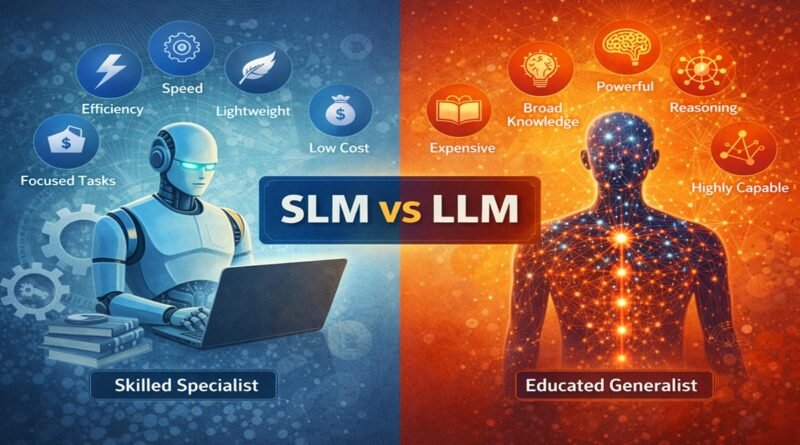
SLM vs LLM: A Detailed Comparison of Small Language Models and Large Language Models
Artificial Intelligence has rapidly evolved from simple rule-based systems to highly capable language models that can write, analyze, reason, and assist humans in everyday tasks. Two major categories dominate the modern AI landscape:
- SLM — Small Language Models
- LLM — Large Language Models
Both belong to the same family of transformer-based neural networks, yet they serve very different purposes. Understanding their differences is critical for developers, businesses, researchers, and anyone deploying AI in real-world applications.
Introduction
Language models learn patterns in text data to predict the next word, sentence, or concept. The key difference between SLM and LLM is scale — not just parameter count, but also training data, compute requirements, deployment cost, latency, and use-case suitability.
In simple terms:
| Model Type | Analogy |
|---|---|
| SLM | Skilled specialist — fast, efficient, focused |
| LLM | Highly educated generalist — powerful, broad knowledge |
Both are useful — the question is when to use which.
What is an SLM (Small Language Model)?
A Small Language Model typically contains millions to a few billion parameters and is designed for specific or constrained tasks.
Core Characteristics
- Lightweight architecture
- Faster inference
- Lower memory usage
- Often fine-tuned for a narrow domain
- Can run on edge devices
Examples of Typical SLM Use Cases
- Chatbots for customer support
- Grammar correction tools
- Offline AI assistants
- IoT devices with local inference
- Embedded systems
- Document classification
- Email spam filtering
Why SLM Exists
Most real-world applications do not require world knowledge — they require reliability, speed, and cost efficiency.
Example:
A banking chatbot does not need to write poetry about galaxies.
It needs to answer: “What is my balance?”
An SLM handles this better than an LLM.
What is an LLM (Large Language Model)?
A Large Language Model contains tens or hundreds of billions of parameters trained on massive datasets including books, websites, academic papers, code repositories, and conversations.
Core Characteristics
- Broad general knowledge
- Strong reasoning ability
- Multi-task learning
- Few-shot learning capability
- High compute requirements
Common LLM Use Cases
- Research assistance
- Code generation
- Long-form content creation
- Advanced conversational AI
- Complex reasoning tasks
- Multilingual translation
- Scientific analysis
LLMs behave more like a universal cognitive engine rather than a task-specific tool.
Architecture Differences
Both models use transformers, but scale changes behavior dramatically.
| Feature | SLM | LLM |
|---|---|---|
| Parameters | Millions – few billions | Tens – hundreds of billions |
| Training Data | Focused | Massive diverse corpus |
| Hardware | CPU / Mobile / Edge GPU | Data center GPU clusters |
| Latency | Low | Higher |
| Energy Use | Minimal | Very high |
| Memory | Small footprint | Huge footprint |
Emergent Ability
A critical concept in AI:
When models become large enough, they gain abilities never explicitly trained.
Examples:
- Logical reasoning
- Abstract analogy
- Multi-step planning
These behaviors appear mostly in LLMs — rarely in SLMs.
Performance Comparison
1. Reasoning Capability
| Task | SLM | LLM |
|---|---|---|
| Arithmetic reasoning | Weak | Strong |
| Logical inference | Limited | Advanced |
| Multi-step planning | Poor | Good |
2. Knowledge Range
| Domain | SLM | LLM |
|---|---|---|
| Company database | Excellent | Good |
| General world knowledge | Weak | Excellent |
| Cross-domain reasoning | Very limited | Strong |
3. Hallucination Behavior
Surprisingly:
| Model | Hallucination Pattern |
|---|---|
| SLM | Predictable mistakes |
| LLM | Confident but complex hallucinations |
SLMs are often safer in regulated environments because they only know what they were trained on.
Cost and Infrastructure
Training Cost
| Model | Approx Cost |
|---|---|
| SLM | Thousands of dollars |
| LLM | Millions of dollars |
Inference Cost
| Deployment | SLM | LLM |
|---|---|---|
| Per-request cost | Very low | High |
| Scaling | Easy | Expensive |
| Edge deployment | Yes | No (usually) |
This is why companies increasingly adopt SLM + Retrieval systems instead of raw LLMs.
Latency and Real-Time Performance
| Scenario | Best Choice |
|---|---|
| Real-time voice assistant | SLM |
| Smart home device | SLM |
| Customer support automation | SLM |
| Research analysis | LLM |
| Creative writing | LLM |
SLMs respond in milliseconds; LLMs may take seconds.
Privacy and Security
SLM Advantage
- Runs locally
- No cloud dependency
- Sensitive data stays on device
LLM Concern
- Data sent to servers
- Compliance issues (HIPAA, GDPR, banking laws)
This is why healthcare and finance increasingly prefer SLM deployments.
Fine-Tuning Behavior
| Aspect | SLM | LLM |
|---|---|---|
| Fine-tuning cost | Cheap | Expensive |
| Domain adaptation | Excellent | Good but heavy |
| Overfitting | Possible | Less likely |
| Control | High | Lower |
SLMs can be shaped precisely for business rules.
The Hybrid Future: SLM + LLM
Modern AI systems increasingly use both:
Architecture Pattern
- SLM handles routine tasks
- LLM handles complex reasoning
- Retrieval database provides knowledge
This reduces cost by 80–95%.
Example Workflow:
User query → SLM classifier →
Simple → Answer locally
Complex → Send to LLM
When to Choose SLM
Choose SLM if you need:
- Speed
- Privacy
- Predictability
- Low cost
- Offline operation
- Narrow task automation
When to Choose LLM
Choose LLM if you need:
- Creativity
- Reasoning
- Knowledge breadth
- Research capability
- Complex conversations
Key Differences Summary
| Category | SLM | LLM |
|---|---|---|
| Purpose | Specialized | General intelligence |
| Speed | Fast | Slower |
| Cost | Cheap | Expensive |
| Knowledge | Narrow | Broad |
| Privacy | High | Lower |
| Creativity | Low | High |
| Reasoning | Limited | Advanced |
| Deployment | Edge capable | Cloud heavy |
Conclusion
SLM and LLM are not competitors — they are complementary technologies.
The industry is moving toward efficient intelligence, not just bigger models.
- LLMs push the boundaries of cognition
- SLMs bring AI into everyday devices
The future belongs to collaborative AI systems where small models handle routine intelligence and large models handle deep thinking.
In practical engineering terms:
Use LLMs for intelligence
Use SLMs for infrastructure
That balance is what makes AI scalable, affordable, and deployable in the real world.
