
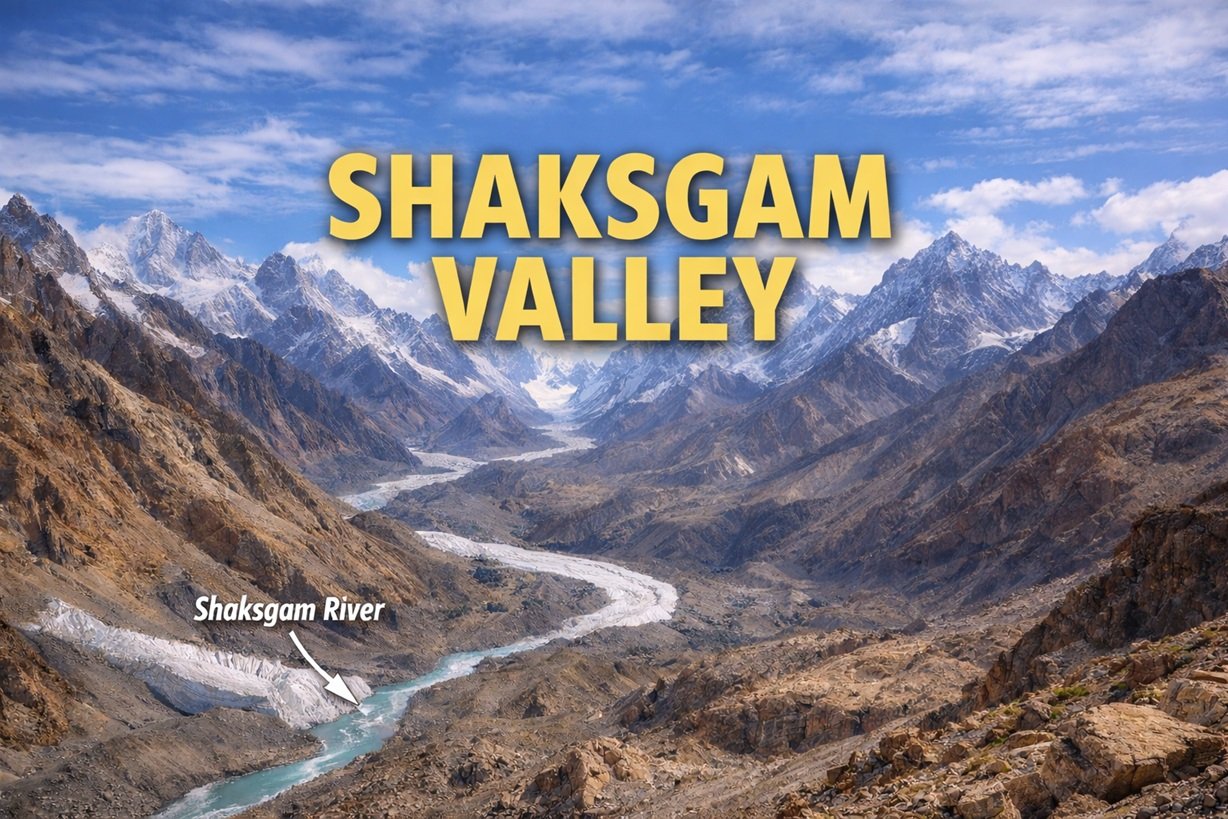
Shaksgam Valley: History, Geography, Strategic Importance, and Geopolitical Significance
Introduction to Shaksgam Valley
The Shaksgam Valley is one of the most remote, rugged, and geopolitically sensitive regions in Asia. Located in the Trans-Karakoram Tract, this high-altitude valley lies north of the Siachen Glacier and south of the Karakoram mountain range. Though sparsely populated and largely inaccessible, Shaksgam Valley holds immense strategic, historical, and geopolitical importance, especially in the context of India–China–Pakistan relations.
Often absent from mainstream discussions, Shaksgam Valley has quietly remained a focal point of territorial disputes, border agreements, and strategic calculations among nuclear-armed neighbors.
Geographical Location and Physical Features
Where is Shaksgam Valley Located?
The Shaksgam Valley lies between:
- The Karakoram Range to the north
- The Aghil Range to the south
- East of the Hunza region
- West of Aksai Chin

Administratively, the region is currently controlled by China as part of Xinjiang, but India considers Shaksgam Valley a part of the erstwhile princely state of Jammu and Kashmir.
The valley follows the course of the Shaksgam River, which eventually joins the Yarkand River system in Xinjiang.
Terrain and Climate
- Altitude: Mostly above 4,500 meters
- Climate: Extremely cold and arid
- Terrain: Glaciers, moraines, narrow gorges, and steep rock faces
- Habitability: Almost uninhabited due to harsh climatic conditions
The region remains snow-covered for most of the year and is accessible only during a brief summer window.
Historical Background of Shaksgam Valley
Pre-20th Century Context
Historically, Shaksgam Valley was used by:
- Nomadic tribes
- Traders moving between Central Asia and Ladakh
- Occasional grazing expeditions from Hunza
No permanent settlements existed due to its inhospitable nature, but it was loosely administered by rulers of Jammu and Kashmir.
Role in the Princely State of Jammu and Kashmir
Before 1947, Shaksgam Valley was considered part of the princely state of Jammu and Kashmir. British-era maps and administrative records often marked the region within Kashmir’s northern boundaries, even though effective control was minimal.
The 1963 Sino-Pakistan Agreement
Transfer of Shaksgam Valley
A turning point in the valley’s history came in 1963, when Pakistan signed a border agreement with China.
- Pakistan ceded approximately 5,180 sq km of the Shaksgam Valley to China
- The agreement is officially called the Sino-Pakistan Boundary Agreement
India strongly opposed this move, stating that:
- Pakistan had no legal right to transfer territory belonging to Jammu and Kashmir
- The agreement is illegal and invalid
China now administers the region as part of Xinjiang.
Strategic Importance of Shaksgam Valley
Why Shaksgam Valley Matters
Despite being uninhabited, the valley is strategically crucial due to:
1. Proximity to Key Regions
- Close to Aksai Chin
- Near Siachen Glacier
- Adjacent to the Karakoram Pass
This makes it a sensitive buffer zone between India, Pakistan, and China.
2. Military and Surveillance Value
Control over Shaksgam Valley provides:
- Observation advantages over surrounding high-altitude passes
- Depth to Chinese defensive positions in Xinjiang
- Strategic continuity between China–Pakistan controlled territories
Though no large military bases are publicly known, infrastructure development in nearby areas raises security concerns.
3. China–Pakistan Strategic Nexus
Shaksgam Valley forms an indirect but important link in the broader China–Pakistan strategic partnership, complementing projects such as:
- Karakoram Highway
- China–Pakistan Economic Corridor (CPEC)
India views this alignment with caution due to its implications for regional security.
Shaksgam Valley and India’s Position
India officially maintains that:
- Shaksgam Valley is Indian territory under illegal Chinese occupation
- Any agreements between China and Pakistan regarding the area are null and void
Indian maps continue to show the valley as part of Ladakh (Union Territory).
The issue is frequently referenced in:
- Parliamentary discussions
- Diplomatic statements
- Strategic defense analyses
Environmental and Glacial Significance
Glaciers and River Systems
The Shaksgam Valley hosts several important glaciers feeding the Shaksgam River, which contributes to the Yarkand River basin.
Potential concerns include:
- Glacial melting due to climate change
- Long-term impact on water availability in downstream regions
- Environmental disturbances from infrastructure expansion
Why Shaksgam Valley is Rarely Discussed
Several reasons explain its low public visibility:
- Extreme remoteness
- No civilian population
- Restricted access for journalists and researchers
- Overshadowed by more prominent regions like Siachen and Aksai Chin
Yet, for defense strategists and geopolitical analysts, the valley remains highly relevant.
Shaksgam Valley in Contemporary Geopolitics
In the context of:
- India–China border tensions
- China’s infrastructure push in Xinjiang
- Pakistan’s strategic alignment with China
Shaksgam Valley represents a silent but significant geopolitical fault line. Any future border negotiations involving Kashmir or Ladakh would inevitably involve discussions around this region.
Conclusion
The Shaksgam Valley may appear desolate and forgotten, but its importance far outweighs its visibility. It is a region where geography, history, and geopolitics intersect sharply. For India, it symbolizes unresolved territorial claims; for China, it provides strategic depth; and for Pakistan, it reflects long-term strategic calculations.
As regional dynamics evolve, Shaksgam Valley will continue to remain a crucial—though often overlooked—piece in the complex puzzle of South Asian geopolitics.
