
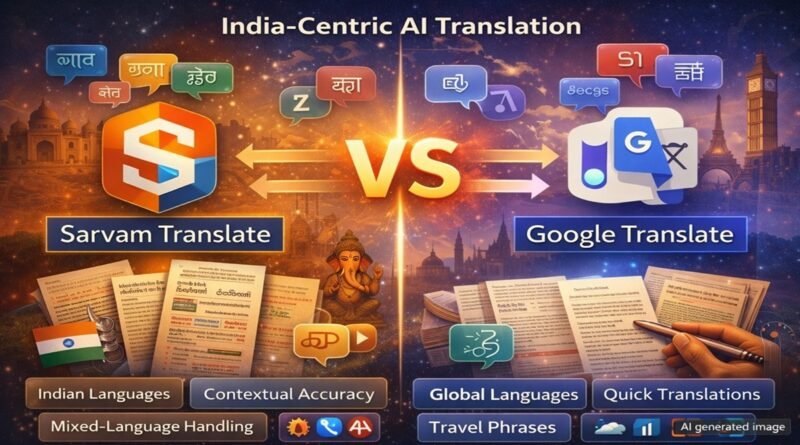
Sarvam Translate vs Google Translate — A Deep, Unique Comparison (India-Centric Perspective)
Machine translation tools today are no longer just dictionaries — they are language understanding systems.
However, a major divide has appeared in modern AI translation:
Global universal translators vs region-specialized linguistic AI
This difference is best understood through Sarvam Translate (India-focused AI translation) and Google Translate (worldwide general translator).
Both translate languages — but they think about language very differently.
Read This: SLM vs LLM: A Detailed Comparison of Small Language Models and Large Language Models
1. Philosophy Behind the Two Systems
Google Translate: Coverage First
Google Translate was designed to solve a global problem — help any person translate any language quickly.
So its design philosophy is:
“Support as many languages as possible, fast.”
It prioritizes:
- breadth
- speed
- accessibility
- short-sentence accuracy
Meaning: acceptable translation for everyone, everywhere.
Sarvam Translate: Understanding First
Sarvam Translate was designed for India’s multilingual ecosystem, where translation errors can completely change meaning in governance, education, or legal documents.
Its philosophy:
“Preserve meaning, not just words.”
It prioritizes:
- linguistic nuance
- Indic grammar structure
- mixed language usage (Hinglish/Tanglish etc.)
- long document accuracy
Meaning: fewer languages — but deeper understanding.
2. How They Actually Translate (Core Technical Difference)
Google Translate Workflow
Google Translate generally processes translation like a pipeline:
Sentence → representation → generate equivalent sentence
It excels in:
- tourism phrases
- short chats
- navigation instructions
But struggles in:
- cultural context
- government language
- poetry
- Indian administrative terminology
Because it treats language statistically.
Sarvam Translate Workflow
Sarvam Translate behaves more like a reader than a converter.
It does:
Sentence → meaning → intent → regenerate in target language
Instead of mapping words, it reconstructs the idea.
This is extremely important for Indian languages where:
Hindi:
“Aapka form nirast kiya gaya hai”
Literal translation: Your form has been destroyed ❌
Actual meaning: Your application has been rejected ✔
Sarvam preserves administrative meaning better because it understands domain usage.
3. The English Bridge Problem
Most global translators secretly translate like this:
Tamil → English → Marathi
Every bridge step introduces distortion.
This causes classic mistakes:
| Original | Google-like output | Real meaning |
|---|---|---|
| सेवा उपलब्ध है | Service available | Welfare assistance available |
| दर्शन बंद हैं | Sight closed | Temple entry closed |
| योजना लागू | Plan applied | Government scheme implemented |
Sarvam avoids this because it performs direct Indic-to-Indic translation.
So:
Tamil → Hindi
Hindi → Bengali
Marathi → Gujarati
No English middleman.
4. Mixed-Language Reality (India’s Biggest Translation Challenge)
Indians rarely speak one pure language.
Example:
“Kal meeting hai, par documents submit karna mat bhoolna”
This sentence contains:
- Hindi grammar
- English nouns
- administrative context
Google Translate Reaction
Usually over-translates or removes English words.
Sarvam Translate Reaction
Keeps natural bilingual structure because it was trained on Indian speech patterns.
That makes it usable in:
- WhatsApp chats
- Government notices
- Office communication
- Education portals
5. Long Document Behavior
This is where the gap becomes dramatic.
Google Translate
Works sentence-by-sentence.
Result:
- paragraphs lose continuity
- pronouns mismatch
- legal meaning changes
Sarvam Translate
Works document-level.
Result:
- consistent terminology
- preserved tone
- correct references
For example, in legal or policy documents, repeating a term matters:
“beneficiary” must not become “receiver” later in the same document.
Sarvam maintains terminology consistency.
6. Cultural Meaning Preservation
Indian languages contain words that cannot be translated directly.
| Word | Literal | True Meaning |
|---|---|---|
| Prasad | Offering | Blessed offering |
| Seva | Service | Devotional service |
| Darshan | Viewing | Sacred viewing |
| Sanskar | Ritual | Cultural moral value |
Google Translate often converts meaning into closest English equivalent.
Sarvam tries to retain cultural semantics rather than replacing them.
7. Accuracy by Use-Case
| Use Case | Better Tool | Why |
|---|---|---|
| Travel phrases | Fast & universal | |
| School textbook | Sarvam | Context preservation |
| Government circular | Sarvam | Administrative terminology |
| WhatsApp casual chat | Sarvam | Mixed language handling |
| Foreign language translation | More languages | |
| Legal documents | Sarvam | Meaning consistency |
| Academic research | Sarvam | Structured text |
| International websites | Global coverage |
8. Speed vs Reliability
| Feature | Google Translate | Sarvam Translate |
|---|---|---|
| Speed | Extremely fast | Slightly slower |
| Fluency | Good | Natural |
| Context awareness | Medium | High |
| Cultural understanding | Low | High |
| Indic grammar handling | Average | Strong |
| Long text stability | Weak | Strong |
9. Why This Comparison Matters
The competition is not really product vs product.
It is:
Universal AI vs Sovereign AI
Google solves:
communication across the world
Sarvam solves:
understanding inside a civilization
In countries like India where language affects law, welfare, identity, and education — mistranslation is not a minor error, it is a governance failure.
That is why localized AI models are emerging globally.
10. Final Verdict
Use Google Translate if:
- You travel internationally
- You need quick translation
- You translate non-Indian languages
Use Sarvam Translate if:
- You work with Indian languages
- You handle official documents
- You need meaning accuracy
- You deal with mixed Hindi-English text
Conclusion
Google Translate is a global communication tool.
Sarvam Translate is a semantic understanding tool for India.
They are not replacements — they serve different linguistic realities.
But in the context of India’s multilingual governance, education, and digital public infrastructure, the future likely belongs to translation systems that understand culture, not just vocabulary.
