
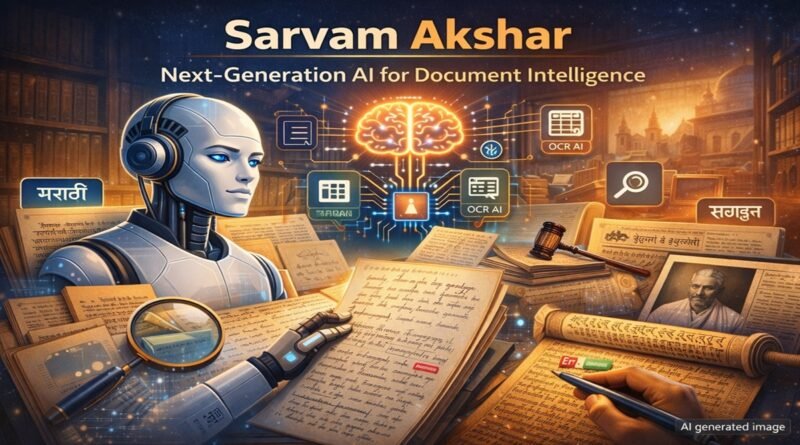
Sarvam Akshar: India’s Next-Generation Document Intelligence AI (Detailed Analysis)
On 15 February 2026, Sarvam AI introduced Sarvam Akshar, a new AI system designed to fundamentally change how documents are digitized, understood, and verified — especially for Indian languages and complex layouts.
Unlike normal OCR tools that merely convert images into text, Akshar acts as an AI reasoning layer over documents.
This article explains the technology, architecture, significance, real-world applications, and why this release matters for India’s AI ecosystem.
Read This: Recent India-Made AI Products and Tools (2022-2026)
1. What is Sarvam Akshar?
Sarvam Akshar is a document intelligence workbench built on top of Sarvam’s multimodal model Sarvam Vision.
It enables:
- Layout-aware extraction
- Grounded reasoning
- Automated proofreading
- Error correction
- Human-in-the-loop validation
Instead of just reading text, the system understands what each part of the page means.
The platform acts as an “intelligence layer” over visual models and moves beyond passive extraction to active reasoning. (Sarvam AI)
2. The Problem Akshar Solves
Digitizing documents sounds simple — scan → convert → done.
In reality, it is one of the hardest problems in AI, especially in India.
Traditional OCR Problems
Conventional OCR systems (like character recognizers) work bottom-up:
They detect:
- letters
- words
- lines
But they do NOT understand:
- layout structure
- columns
- headers
- footnotes
- tables
- context
This leads to broken outputs.
Multi-column pages are often read linearly, producing discontinuous text. (Sarvam AI)
Why Indic Languages Are Even Harder
Indian scripts include:
- matras (vowel signs)
- conjunct characters
- ligatures
- varying baselines
Older manuscripts add:
- archaic fonts
- faded ink
- irregular spacing
OCR frequently misinterprets Indic conjuncts and diacritics. (Sarvam AI)
So digitized text becomes unusable for search or analysis.
3. Limitations of Modern AI Models
Even modern vision-language models (VLMs) struggle.
They can:
- read text
- understand images
- extract fields
But they still fail in real archives.
Key Issues
- probabilistic outputs
- hallucinations
- lack of auditability
- prompt dependency
Complex documents like historical newspapers still produce low-accuracy results. (Sarvam AI)
4. Akshar’s Core Innovation: Reasoning-Based Document AI
Akshar introduces a new paradigm:
From OCR → to Cognitive Document Understanding
Instead of “reading pixels,” it understands relationships between elements.
The Four Core Capabilities
1) Visual Grounding
Pinpoints exact coordinates of text blocks in the document.
This allows:
- traceability
- verification
- auditability
The system can identify the exact location of extracted content. (Sarvam AI)
2) Semantic Layout Understanding
The AI identifies:
- title
- heading
- paragraph
- caption
- table
- footnote
Not just text — meaning.
3) Block-Level Extraction
Instead of one long paragraph output, Akshar produces structured information.
Example:
- Header
- Date
- Article body
- Image description
- Sections
4) Automated Proofreading
This is the biggest breakthrough.
The model highlights uncertain regions and asks humans only where needed.
Experts can validate hundreds of pages in the time previously required for one. (Sarvam AI)
5. Architecture: Sarvam Vision + Agent Loop
Akshar is not just a model — it is a workflow system.
Layered Architecture
Layer 1 — Vision Model
Reads document visually
Layer 2 — Language Reasoning
Understands meaning
Layer 3 — Agent Loop
Self-checks and asks for corrections
Layer 4 — Human Review
Validates only flagged parts
This drastically reduces manual effort.
6. Why This Matters for India
India has massive unstructured data:
- court records
- land records
- newspapers
- manuscripts
- government archives
- historical literature
Most of it is not searchable.
Akshar can unlock:
1) Digital Governance
Automated processing of government paperwork
2) Legal Tech
Case law digitization
3) Cultural Preservation
Old manuscripts in regional languages
4) Education
Searchable textbooks
7. Example Use Case: Historical Newspapers
Traditional workflow:
Scan → OCR → Manual correction → Months of work
With Akshar:
Scan → AI reasoning → Flag errors → Human verify
Result:
Mass digitization at national scale.
8. Comparison: OCR vs Akshar
| Feature | Traditional OCR | Modern VLM | Akshar |
|---|---|---|---|
| Reads text | Yes | Yes | Yes |
| Understands layout | No | Partial | Yes |
| Handles Indian scripts | Poor | Moderate | Strong |
| Auditability | No | Low | High |
| Proofreading | Manual | Manual | Automated |
| Reasoning | None | Limited | Built-in |
9. Strategic Importance
Akshar represents a shift:
India moving from
Chatbot AI → Infrastructure AI
It enables:
- sovereign data processing
- archival digitization
- government automation
- multilingual search engines
It is particularly aligned with India’s push for:
- AI public infrastructure
- language inclusion
- digital knowledge preservation
10. Future Possibilities
Akshar can evolve into:
Searchable Bharat Archive
All historical documents searchable
AI Legal Research Engine
Instant precedent lookup
Rural Governance Automation
Forms processed automatically
Multilingual Knowledge Graph
Indian knowledge network
Conclusion
Sarvam Akshar is not just another AI product —
it is a foundational system aimed at solving one of India’s biggest digital challenges: turning paper knowledge into structured intelligence.
By combining:
- visual understanding
- language reasoning
- agent workflows
- human verification
it creates a scalable path for digitizing India’s historical and administrative records.
In the long term, systems like Akshar may become as important as Aadhaar or UPI — because they transform information accessibility itself, not just services.
