
Salt in Shampoo: Potential Effects on Hair Texture and Moisture
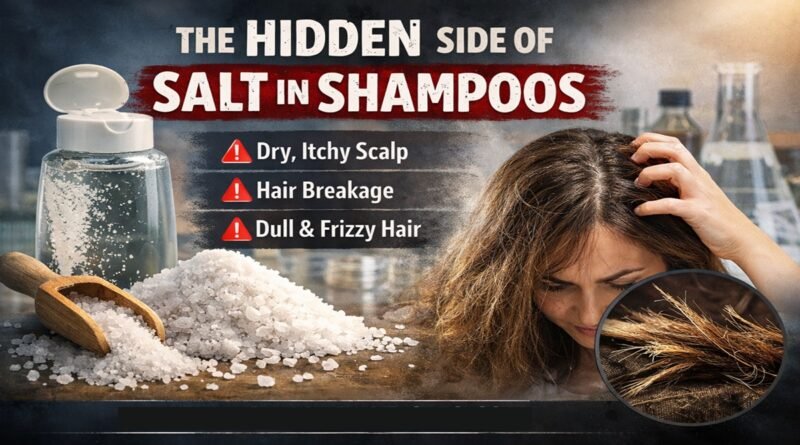
According to a report published on PubMed Central, sodium chloride is used as a thickener in shampoos containing sodium lauryl sulfate. Salt in shampoo side effects may include dry, itchy scalp, eye irritation, faster moisture loss from hair, dull texture, and increased breakage when used frequently, especially in high-salt formulations over time chronic.
Most people trust shampoo labels far more than they should.
A quick glance at the front of the bottle, a familiar claim, a comforting word like ‘gentle’ or ‘sulphate-free’, and the decision is made. Very few people stop to ask what actually sits inside the formula or how it behaves on hair over weeks and months of use.
That’s where the gap begins.salt in shampoo
Hair problems rarely appear overnight. They build slowly. Dryness that feels normal. Roughness that shows up gradually. Scalp irritation that comes and goes. Hair that needs more conditioner, more masks, and eventually more treatments just to feel manageable.
Sulphates are often blamed for this, but they are only one part of the equation. They clean. That’s their job. In many cases, they’re doing exactly what they’re meant to do.
What often goes unnoticed is another ingredient that appears quietly in most shampoos, including many that claim to be gentle.
Sodium chloride.
Plain salt.
Because it sounds familiar, it rarely raises concern. Because it’s inexpensive and widely used, it rarely gets explained. But in shampoo formulas, salt is not there for hair health. It’s there to change how the product feels, and in higher amounts, it can slowly affect moisture balance, texture, and scalp comfort without any obvious warning signs.
By the time people notice something is wrong, the shampoo has already become part of the problem.
Why salt is added to shampoo at all
Salt is not added to shampoo for hair health. Its primary purpose is thickening.
In many formulations, sodium chloride is used as a quick and inexpensive way to control viscosity. Without it, a shampoo may feel watery and less “premium” when poured. In technical terms, salt helps surfactant systems reach a thickness consumers associate with quality.
Because of this, many mass-market shampoos in India typically contain around 1–2% sodium chloride. At that level, salt does its job quietly: the shampoo looks richer, pours better, and feels more substantial in the hand.
The problem is not its presence. The problem is what happens when such formulations are used frequently, especially on hair that is already dry, treated, or textured.
How salt affects moisture balance in hair
Hair may not be living tissue, but it behaves like a fibre that depends on internal moisture to stay flexible. When moisture levels drop, hair becomes stiff, rough, and more prone to breakage during everyday handling.
Salt has a basic property that matters here. It attracts water to balance concentration. When hair is repeatedly exposed to a salt-rich environment during washing, it can gradually encourage moisture to move away from the hair fibre.
This helps explain a pattern most people accept without questioning: shampooing often leaves hair feeling dry, which creates the need for conditioners, masks, oils, and eventually professional treatments like keratin or smoothening.
This dryness is not only about “harsh cleansing.” It is about repeated disruption of moisture balance, and salt can amplify that effect when used in higher quantities or combined with frequent washing.
Over time, this shows up as hair that feels rougher sooner, loses softness faster, and seems to need constant repair.
Texture changes and everyday friction
Damage is not always dramatic. A lot of it is slow.
Salt is a mineral, and in some formulas, tiny traces can remain on the hair surface after rinsing. You won’t see grains. You won’t feel anything immediately. But daily friction makes a difference.
In Indian routines, hair is tied, braided, brushed quickly, worn under helmets, rubbed against clothing, and exposed to humidity and heat. When hair is already drier, this friction becomes harsher.
Over weeks, people notice:
- rougher ends
- reduced shine
- hair that tangles more easily
- split ends appearing faster
At this stage, serums and oils only mask the issue. The underlying texture has already changed.
Salt and salon treatments: where the impact becomes obvious
If you have spent money on keratin, cysteine, smoothening, or a Brazilian blowout, salt becomes more than a background ingredient.
These treatments depend on maintaining a smooth surface and a controlled moisture environment. Salt-heavy shampoos can shorten the visible life of these treatments by accelerating dryness and surface roughness.
This is why many people experience a familiar pattern:
- first two weeks: hair looks excellent
- third or fourth week: frizz returns early, shine drops, ends feel dry
The treatment itself is often blamed. In reality, the shampoo used at home plays a major role, especially when it combines strong cleansing with higher salt content.
Salt and natural hair colour
Salt does not bleach hair or chemically alter pigment. But it can still affect how hair colour looks.
When hair becomes drier and the cuticle surface roughens, light reflects poorly. The result is hair that looks duller and flatter, even when the natural colour has not changed.
This is one reason people feel their hair colour has “faded” with frequent washing. In many cases, it is loss of shine and moisture, not loss of pigment.
Clearing the sulphate confusion
Sulphates are not villains. They are tools. In the right concentration and formulation, they clean effectively without causing discomfort.
The mistake is assuming that removing sulphates automatically makes a shampoo gentle. Many sulphate-free shampoos rely more heavily on salt to achieve texture, which can still leave hair feeling dry and rough over time.
The smarter question is not “Is this sulphate-free?”
It is “How does my hair feel after using this consistently for a few weeks?”
Who is more likely to notice the negative effects
Salt-related issues tend to appear faster in:
- dry, rough, or frizzy hair
- wavy or curly hair that struggles to retain moisture
- people who wash frequently due to workouts or oily scalp
- chemically treated or coloured hair
- sensitive scalps prone to tightness or irritation
Not everyone needs to eliminate salt. But for these groups, higher salt formulations often make hair harder to manage, not easier.
Making better choices without fear
There is no need to panic or chase perfect labels.
A practical approach is simple:
- read the ingredient list, not just the front claim
- if sodium chloride appears high and your hair feels dry, try a lower-salt option
- observe your hair over two to three weeks, not one wash
If hair consistently feels rough immediately after rinsing, that formula is likely not suited to your hair type or routine.
Read This: Vitamin C vs Vitamin E: Which One Does Your Skin Really Need — and Why?
The takeaway
Salt is widely used in shampoos because it works as a thickener and keeps costs down. That makes it common, not harmless.
In higher amounts or frequent routines, it can contribute to dryness, rough texture, faster loss of shine, and shorter-lasting salon results. These effects are gradual, which is why they are often missed.
You don’t need to fear shampoo ingredients. You just need to understand them.
Because sometimes the problem isn’t what your shampoo promises on the front of the bottle.
It’s what it quietly does, wash after wash.
Disclaimer: This is a sponsored article. BharatArticles.com is not responsible for any claims, accuracy, or outcomes associated with the products or information mentioned.
