
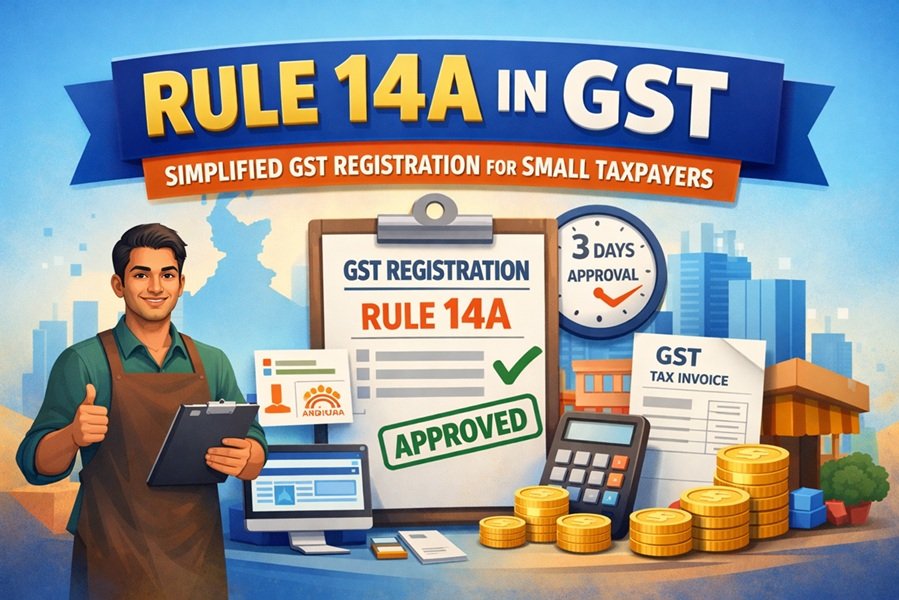
Rule 14A in GST Explained: Simplified GST Registration Scheme for Small Taxpayers
Introduction
The Goods and Services Tax (GST) framework in India has undergone continuous refinement since its launch, with the government focusing on improving compliance while reducing procedural complexity for genuine taxpayers. In a significant step towards easing business formalities, the Central Board of Indirect Taxes and Customs (CBIC) introduced Rule 14A in the CGST Rules, 2017, creating a simplified and time-bound GST registration mechanism for eligible small taxpayers.
Effective from 1 November 2025, Rule 14A aims to address one of the most common pain points faced by micro and small businesses—delays in GST registration despite complete documentation and Aadhaar authentication. This article explains Rule 14A in detail, its purpose, eligibility conditions, registration process, compliance requirements, and its broader impact on India’s GST ecosystem.
What Is Rule 14A in GST?
Rule 14A is a newly inserted rule under the Central Goods and Services Tax (CGST) Rules, 2017, introduced through the CGST (Fourth Amendment) Rules, 2025.
The rule provides an optional, simplified GST registration pathway for certain taxpayers, ensuring faster approval—within three working days—based on Aadhaar authentication and low-risk parameters.
Unlike earlier provisions where registration timelines were often extended due to physical verification or officer scrutiny, Rule 14A introduces a trust-based, risk-filtered system for small businesses.
Why Was Rule 14A Introduced?
The government identified three major challenges in GST registration:
- Long processing time despite Aadhaar authentication
- Discretionary delays due to officer verification
- Entry barriers for small and first-time taxpayers
Rule 14A addresses these issues by:
- Promoting ease of doing business
- Encouraging voluntary GST compliance
- Reducing administrative burden on tax officers
- Supporting formalisation of small enterprises
Who Can Opt for GST Registration Under Rule 14A?
Rule 14A is optional, not mandatory. A taxpayer may choose this route if all eligibility conditions are met.
Eligibility Conditions
A person applying for GST registration under Rule 14A must:
- Apply under Rule 8 (FORM GST REG-01)
- Complete Aadhaar authentication
- Have an estimated monthly output tax liability (B2B supplies only) of ₹2.5 lakh or less
- Include all applicable taxes:
- CGST
- SGST / UTGST
- IGST
- Compensation Cess (if any)
- Not have another active Rule 14A registration in the same State/UT under the same PAN
Important:
The limit is based on monthly output tax liability, not turnover.
Supplies Covered Under Rule 14A
Rule 14A primarily focuses on:
- Supplies made to registered persons (B2B)
- Excludes B2C tax liability for threshold calculation
This ensures that only low-risk, traceable transactions fall within the simplified framework.
GST Registration Process Under Rule 14A
Step-by-Step Process
- Online Application
- File FORM GST REG-01 on the GST portal
- Select the option to opt for Rule 14A registration
- Aadhaar Authentication
- Mandatory for:
- Primary Authorized Signatory
- One Promoter / Partner (if applicable)
- Mandatory for:
- System-Based Approval
- If Aadhaar authentication is successful and no risk flags arise, registration is granted automatically
- Timeline
- GST registration must be granted within 3 working days
- If no action is taken by the officer, approval is deemed
What Makes Rule 14A Different from Normal GST Registration?
| Feature | Normal Registration | Rule 14A Registration |
|---|---|---|
| Approval timeline | 7–30 days | 3 working days |
| Officer discretion | High | Minimal |
| Physical verification | Possible | Avoided |
| Risk assessment | Manual | System-based |
| Target users | All taxpayers | Small, low-risk taxpayers |
Compliance Obligations After Registration
Opting for Rule 14A does not relax GST compliance after registration. The taxpayer must:
- Issue valid GST invoices
- File GST returns (GSTR-1, GSTR-3B, etc.)
- Pay tax on time
- Maintain proper records
- Monitor monthly output tax liability
Failure to comply can still lead to cancellation, penalty, or scrutiny.
What If the ₹2.5 Lakh Limit Is Crossed?
If the monthly output tax liability exceeds ₹2.5 lakh:
- The taxpayer must exit Rule 14A
- File FORM GST REG-32 for withdrawal
- Officer issues an order in FORM GST REG-33
Minimum Filing Requirement for Exit
- Applications before 1 April 2026:
→ At least 3 months of returns filed - Applications on or after 1 April 2026:
→ At least 1 tax period return filed
Can Registration Be Cancelled Under Rule 14A?
Yes. Registration can be cancelled if:
- False information is furnished
- Aadhaar authentication is misused
- Tax liability is understated
- GST returns are not filed
Rule 14A does not provide immunity from enforcement actions.
Impact of Rule 14A on Small Businesses
Positive Outcomes
- Faster market entry
- Reduced compliance anxiety
- Better cash-flow planning
- Increased GST registrations among MSMEs
- Strengthened trust-based taxation
Broader Policy Significance
Rule 14A aligns with:
- Digital India
- Ease of Doing Business
- Formalisation of the informal economy
Conclusion
Rule 14A in GST marks a major policy shift, moving from officer-centric registration to technology-driven trust mechanisms. By offering faster registration to low-risk taxpayers without diluting compliance standards, the rule strikes a careful balance between facilitation and enforcement.
For small businesses, freelancers, and early-stage enterprises, Rule 14A can be a game-changer, provided eligibility conditions are met and compliance discipline is maintained.
