
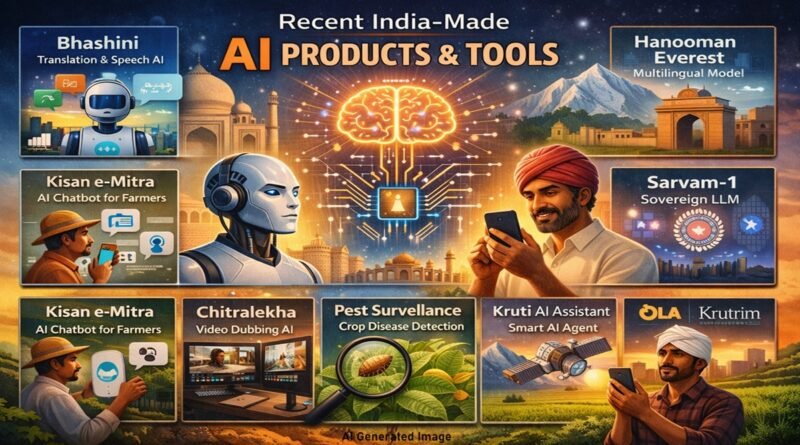
Recent India-Made AI Products and Tools (2022-2026)
India is rapidly moving from being only an AI user to becoming an AI creator nation. Over the last few years, the country has launched large language models (LLMs), multimodal AI systems, agricultural intelligence platforms, public-sector chatbots, and private-sector AI assistants — many specifically designed for Indian languages, governance, and real-world problems rather than just generic global use-cases.
This article provides a detailed and structured overview of the most important India-made AI products and tools released recently — including government initiatives, academic projects, and startup innovations.
Read This: SLM vs LLM: A Detailed Comparison of Small Language Models and Large Language Models
1. Language & Foundation AI Models (The Core of India’s AI Ecosystem)
India’s biggest challenge in AI adoption has always been linguistic diversity. With 22 scheduled languages and hundreds of dialects, global English-centric AI models cannot serve the entire population.
Therefore, India’s first wave of AI innovation focuses on multilingual intelligence infrastructure.
Bhashini — India’s National Language Translation AI Platform
Launch: 2022
Type: Speech + Text Translation & Transliteration AI
Languages Supported: 20+
Models: 350+ AI models
Downloads: 1 million+
Bhashini is a government-backed platform designed to remove language barriers in digital services. It provides:
- Speech-to-speech translation
- Text translation
- Transliteration between scripts
- Voice assistants in Indian languages
Real-World Uses
- Railway station announcements in regional languages
- Multilingual government chatbots
- Banking & e-governance portals
- Voice services for rural users
Instead of forcing citizens to learn English, Bhashini allows systems to speak the user’s language — making it a foundational digital inclusion technology.
BharatGen — India’s First Government Multimodal Foundation Model
Launch: September 30, 2024
Led by: IIT Bombay + IITs + IIITs
Type: Multimodal Foundation Model (Text + Audio + Vision)
Goal: Open-source public AI infrastructure
BharatGen is India’s equivalent of a national AI backbone — similar to how Aadhaar became the identity backbone.
Key objectives:
- Build large models trained on Indian cultural context
- Support 22+ Indian languages
- Enable startups to build applications without relying on foreign APIs
- Provide sovereign AI capability for governance
This project is extremely important because it shifts India from AI consumer → AI infrastructure provider.
Sarvam-1 — India’s Sovereign LLM Ecosystem
Developer: Sarvam AI (Bengaluru)
Model Size: 2 Billion parameters (initial)
Languages: Hindi + Mixed English
Status: Government approved & funded (2025)
Sarvam-1 is among the first Indian-built conversational large language models focused on real governance applications.
Planned integrations include:
- Aadhaar services
- Citizen grievance systems
- Public helplines
- Government documentation automation
The aim is to create a “Sovereign LLM Stack” — meaning sensitive citizen data never needs to be processed on foreign AI servers.
Hanooman Everest 1.0 — Private Multilingual AI Model
Developer: Samasya ML
Languages: 35 (Target: 90)
Hanooman Everest focuses heavily on translation and cultural context generation.
Unlike general chatbots, it is optimized for:
- Regional content creation
- Educational material translation
- Government documentation
- Local media publishing
This represents a growing trend: India’s private sector building culturally aware AI rather than generic assistants.
2. Media & Content AI Tools
Chitralekha — Indian Language Video Dubbing AI
Developer: AI4Bharat
Release: 2024
Type: Open-source video localization AI
Chitralekha automatically:
- Generates subtitles in multiple Indian languages
- Creates synchronized voiceovers
- Performs “transcreation” (context-aware translation)
This is particularly valuable for:
- Education platforms
- OTT streaming localization
- Government awareness videos
- YouTube creators
Instead of just translating words, it adapts meaning culturally — a major requirement in India’s multilingual society.
3. Agriculture AI (India’s Largest Real-World AI Deployment)
India has quietly become one of the largest agricultural AI users in the world, because farmers benefit massively from predictive and advisory intelligence.
Kisan e-Mitra — AI Voice Chatbot for Farmers
Launch: 2023
Languages: 11
Daily Queries: ~8,000
Farmers can ask questions about:
- PM-Kisan schemes
- Crop insurance
- Subsidies
- Farming practices
The most important feature: voice interaction — farmers do not need literacy or typing skills.
National Pest Surveillance System — Crop Disease AI Detection
Launch: 2024
Technology: Image recognition AI
Coverage:
- 66 crops
- 432 pest species
- 10,000+ agricultural workers
Farmers simply upload a photo of the plant → the AI identifies disease → gives treatment advice.
This reduces pesticide misuse and increases yield.
AI Monsoon Forecast Tool — Predictive Farming Weather Intelligence
Pilot: Kharif 2025
Partners: IMD + AI systems
Reach: ~3.88 crore farmers
Results from surveys:
- 31–52% farmers changed sowing decisions
- Better crop planning
- Reduced losses
This is one of the world’s largest AI-to-SMS agricultural deployments.
4. AI Assistants & Agent Platforms
India is now moving beyond chatbots toward agentic AI systems — tools that perform tasks, not just answer questions.
NxtGen “M” — Open-Source Generative AI Assistant Platform
Launch: August 2025
Developer: NxtGen Cloud (Pune)
“M” is not a single AI model — it is an orchestration platform connecting thousands of open-source AI models.
Capabilities:
- Book tickets
- Retrieve data
- Execute workflows
- Automate real-world operations
It uses Indian cloud infrastructure and integrates models like large open-source LLMs — meaning India can run advanced AI without relying entirely on foreign hyperscalers.
Kruti — Ola’s Agentic AI Assistant
Launch: June 2025
Developer: Krutrim AI (Ola)
Languages: 11+
Kruti acts like a real personal assistant:
- Cab booking
- Food ordering
- Bill payments
- Image generation
- Voice conversations
It is powered by the Krutrim V2 LLM and offers an SDK so developers can embed AI agents into apps.
This marks India’s entry into consumer AI ecosystems similar to global AI assistant platforms.
5. Specialized Domain AI Tools Emerging Across India
Apart from national-scale projects, many targeted AI solutions are appearing:
Government & Public Sector
- MahaAgri-AI farm monitoring platform
- Smart city surveillance analytics
- AI grievance redressal systems
- Multilingual e-governance portals
Industry & Startups
- Fresh produce quality scanners
- Energy optimization AI for factories
- Healthcare diagnosis assistance
- AI tutoring platforms
Consumer Technology
- Local language voice assistants on devices
- Indian-language AI chat features in apps
- Regional content recommendation engines
6. What Makes India’s AI Ecosystem Unique?
Unlike Western AI ecosystems focused on productivity tools and marketing automation, India’s AI development is shaped by population-scale problems.
Key Differences
| Global AI Focus | India AI Focus |
|---|---|
| Office productivity | Public service delivery |
| Marketing & content | Agriculture & governance |
| English-first | Multilingual first |
| Individual users | Mass population scale |
| Cloud-centric | Mobile + SMS centric |
India’s innovation is therefore problem-driven rather than hype-driven.
7. The Bigger Picture: India Moving Toward AI Sovereignty
These tools together form a layered ecosystem:
Infrastructure Layer
- BharatGen
- Sarvam-1
- Hanooman
Language Layer
- Bhashini
Application Layer
- Kruti
- M Platform
- Chitralekha
Impact Layer
- Kisan e-Mitra
- Pest Surveillance
- Monsoon AI
India is essentially building its own AI stack comparable to its digital public infrastructure (UPI + Aadhaar + DigiLocker model).
Conclusion
India’s AI progress is not just about competing with global chatbots — it is about solving national-scale challenges:
- Language diversity
- Agricultural risk
- Government accessibility
- Digital inclusion
From multilingual foundation models to farmer advisory SMS systems, the country is creating an AI ecosystem tailored to 1.4 billion people, not just urban tech users.
If this trajectory continues, India may pioneer a new category of AI —
“Population-Scale Public AI Infrastructure” — a model different from Silicon Valley’s enterprise-centric approach and potentially more impactful globally.
