
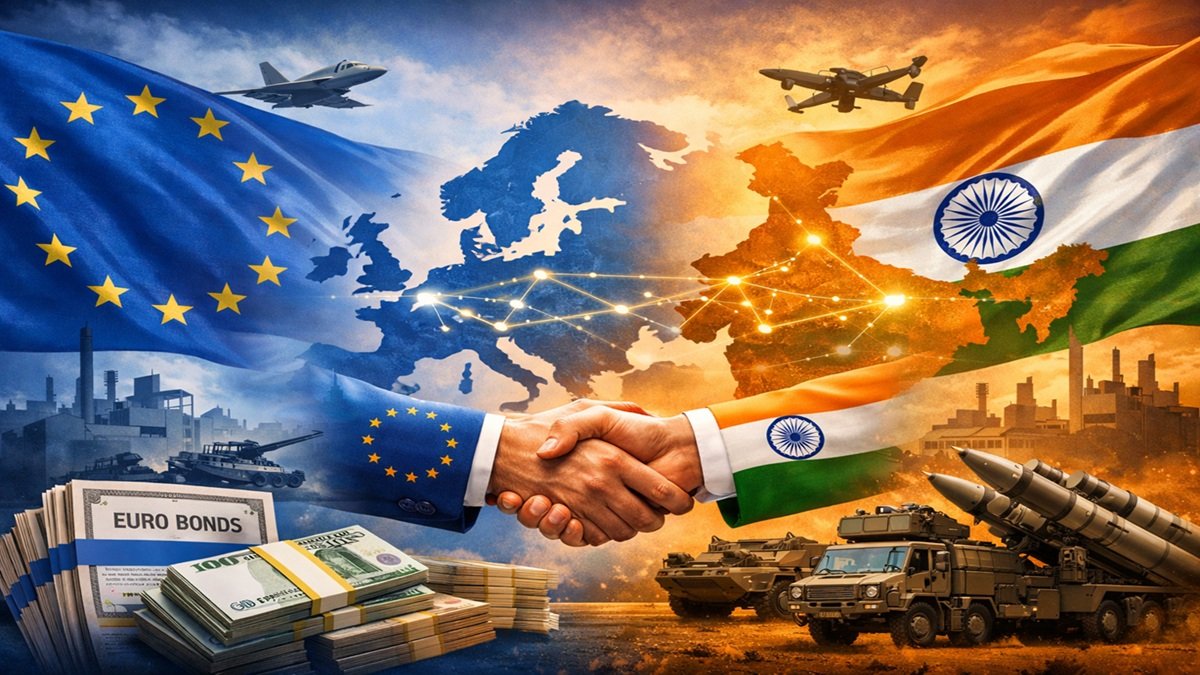
ReArm Europe and the SAFE Programme: Europe’s Defence Reset and India’s Strategic Entry
Introduction
Europe is undergoing its most significant defence transformation since the Cold War. Rising geopolitical tensions, supply-chain vulnerabilities, and uncertainty over long-term external security guarantees have pushed the European Union to rethink how it funds, produces, and procures military capabilities. At the centre of this shift lies ReArm Europe, officially rebranded as Readiness 2030, and its core financial instrument — the Security Action for Europe (SAFE) programme.
While SAFE was initially designed as an internal European mechanism, recent geopolitical developments — especially the conclusion of a landmark Free Trade Agreement (FTA) and enhanced defence partnership between India and the European Union — have opened a new strategic dimension. India is now positioned as a trusted external defence partner with structured access to Europe’s rearmament ecosystem.
This article explains:
- What the SAFE programme is and how it works
- Why ReArm Europe matters strategically
- How the India–EU FTA and defence partnership change the rules
- What “access” to the SAFE ecosystem realistically means for India
- Long-term implications for global defence geopolitics
What Is ReArm Europe and the SAFE Programme?
ReArm Europe is a comprehensive EU initiative aimed at rebuilding Europe’s defence readiness by 2030. Its financial backbone is the SAFE programme, a €150-billion EU-backed loan facility designed to accelerate defence procurement and industrial capacity across Europe.
Unlike traditional defence funding, SAFE focuses on:
- Joint procurement among EU member states
- Long-term, low-interest loans, not grants
- Industrial scale-up, not just weapons purchases
- Supply-chain security within friendly and trusted partners
The European Commission raises capital from global markets using the EU’s strong credit rating and then lends it to member states for approved defence projects.
Strategic Objectives of SAFE
The SAFE programme is built around four strategic goals:
1. Rapid Capability Development
Europe aims to close urgent gaps in areas such as air defence, ammunition stockpiles, drones, cyber defence, and strategic logistics.
2. Defence Industrial Sovereignty
Decades of fragmented procurement weakened Europe’s defence industry. SAFE incentivizes coordinated production runs and shared platforms.
3. Interoperability
Joint procurement ensures European armed forces can operate seamlessly together and with NATO allies.
4. Reduced External Dependence
Europe wants to reduce reliance on uncertain external suppliers by anchoring production within the EU or among trusted strategic partners.
How SAFE Works in Practice
- EU member states submit national or joint defence investment plans
- Projects must align with EU-defined priority capabilities
- The European Commission evaluates industrial, financial, and security criteria
- Approved projects receive SAFE loans with long repayment horizons
- Procurement contracts are then awarded to eligible defence manufacturers
Although SAFE loans go to governments, the real beneficiaries are defence manufacturers, technology firms, and supply-chain partners.
The India–EU FTA and Defence Partnership: A Strategic Breakthrough
The conclusion of the India–EU Free Trade Agreement, alongside a parallel defence and security partnership, represents a turning point in Europe’s external defence engagement.
This agreement goes beyond tariffs and market access. It establishes:
- Defence industrial cooperation frameworks
- Technology transfer and co-development clauses
- Secure supply-chain recognition
- Preferential treatment for trusted partners
For Europe, India is no longer just a market — it is a strategic production and innovation partner.
How India Gains Access to the ReArm Europe / SAFE Ecosystem
It is important to clarify: India does not receive SAFE loans directly. SAFE remains an EU instrument. However, India gains indirect but highly valuable access through multiple channels.
1. Eligibility as a Trusted Defence Partner
Under the new defence partnership framework, Indian defence firms can now:
- Participate in EU-led joint procurement projects
- Act as subcontractors or co-producers for SAFE-funded programmes
- Supply components, systems, or platforms to EU prime contractors
This status places India in a different category from ordinary third-country suppliers.
2. Integration into European Defence Supply Chains
SAFE prioritizes:
- Reliable production capacity
- Cost-effective manufacturing
- Political alignment and supply security
India’s strengths — large-scale manufacturing, skilled workforce, and competitive costs — make it an attractive partner for:
- Ammunition manufacturing
- Electronics and avionics
- Drone systems
- Naval and land-system components
Indian firms become part of SAFE-enabled European defence supply chains, benefiting from long-term contracts and stable demand.
3. Joint Development and Co-Production
The India–EU defence partnership promotes:
- Co-development of new defence technologies
- Shared intellectual property frameworks
- Dual-use innovation (civil + military tech)
Projects funded under SAFE may include joint R&D or production lines involving Indian facilities, especially where scaling speed and cost efficiency matter.
4. Strategic Diversification Away from China
One unstated but critical driver is Europe’s desire to reduce exposure to Chinese defence-related supply chains. India emerges as a democratic, geopolitically aligned alternative.
SAFE-funded projects increasingly seek:
- Non-Chinese electronics
- Secure rare-earth processing
- Trusted software and cyber components
India fits squarely into this strategic requirement.
What India Does NOT Get from SAFE
To avoid overstatement, it is important to note limitations:
- India does not receive EU defence loans
- India does not influence SAFE governance decisions
- Final procurement authority remains with EU governments
- EU strategic autonomy remains the priority
India’s role is participatory, not controlling — but still economically and strategically significant.
Strategic Benefits for India
1. Defence Industrial Expansion
Access to European defence demand strengthens India’s domestic defence manufacturing ambitions under “Make in India”.
2. Technology Upgradation
Joint projects accelerate access to advanced European defence technologies.
3. Export Market Stability
SAFE-linked procurement offers long-term, predictable contracts — rare in global defence markets.
4. Geopolitical Positioning
India positions itself as a bridge between European and Indo-Pacific security architectures.
Implications for Global Defence Geopolitics
The India–EU defence alignment under ReArm Europe has wider consequences:
- Europe diversifies away from over-dependence on the US and China
- India deepens strategic ties beyond Russia and the US
- A multipolar defence-industrial order begins to emerge
- NATO-centric and Indo-Pacific security frameworks start overlapping
SAFE thus becomes more than a funding tool — it becomes a geopolitical connector.
Challenges and Risks
Despite its promise, the arrangement faces challenges:
- Regulatory complexity across jurisdictions
- Export control harmonisation
- Political resistance within some EU states
- Intellectual property disputes
- Workforce and skills integration
Managing these will determine how effective India’s SAFE access truly becomes.
Conclusion
The SAFE programme under ReArm Europe marks Europe’s decisive shift from fragmented defence spending to coordinated industrial mobilisation. Through the India–EU FTA and defence partnership, India gains structured entry into this transformation — not as a borrower, but as a strategic production, technology, and supply-chain partner.
This evolving relationship strengthens Europe’s defence resilience while accelerating India’s emergence as a global defence manufacturing hub. In an era of unstable alliances and contested supply chains, the India–EU defence axis under the SAFE framework may become one of the most consequential security developments of the decade.
